Expressionism
Marsh bridge (Emil Nolde)
Emil Nolde (1867–1956) a réalisé Marsh bridge. Il appartient au mouvement Expressionism. Réalisée en Oil On Canvas.
- Oil On Canvas

 Aperçu en situation

 Peinture à l'huile faite main
 Envoyer
 Partager
 Fiche pédagogique


 Télécharger l'image
 Articles similaires
 Radiographie
 Diaporama
 Questions et réponses

 Statistiques
Marsh bridge, en bref
- Titre
- Marsh bridge
- Artiste
- Emil Nolde (1867–1956)
- Lieu de naissance de l'artiste
- Nolde, Danemark
- Technique
- Oil On Canvas
- Mouvement
- Expressionism
- Période
- Modern
- Sujet
- bridge, marsh, water, sky, trees, blue
Que représente Marsh bridge ?
Identification of the Artwork and Artist
The artwork titled Marsh bridge is a painting by the artist Emil Nolde. This piece depicts a marsh landscape where a wooden bridge serves as the central subject. The composition focuses on the intersection of the man-made structure and the organic forms of the surrounding wetlands.
Emil Nolde, born in Nolde, Denmark, was a figure associated with the Expressionist movement. His approach to this subject matter is characterized by a style strongly influenced by Expressionism, prioritizing subjective experience through the application of paint. The work utilizes an impasto technique, where thick layers of oil paint create a palpable surface relief on the canvas.
Composition and Visual Elements
The composition is organized around a wooden bridge that traverses the canvas diagonally from the lower right toward the upper left. This diagonal movement provides a sense of direction through the landscape. The structure of the bridge is defined by a series of short, choppy lines that form the railings. A body of water occupies much of the background, reflecting the sky and the surrounding vegetation. On the horizon line, distant buildings and trees are visible, though they appear flattened due to a lack of clear atmospheric perspective.
Horizontal elements dominate the arrangement, specifically the water line, the bridge’s railings, and the distant treeline. These lines create a sense of expansive space across the marsh. The bridge is positioned in the foreground, appearing closer to the viewer than the trees in the distance. While the bridge provides a geometric contrast to the organic and irregular shapes of the marsh, its structure remains somewhat distorted by the application of the paint.
Technique and Material Application
The work is executed in oil paint on canvas. The artist employs an impasto technique, characterized by a thick application of paint across the surface. This method results in a palpable sense of surface relief, where the physical weight of the medium is evident. The paint is not applied in thin, translucent glazes but in heavy, substantial layers that create a tactile topography on the canvas.
The brushwork is highly visible throughout the composition. Rather than being blended into smooth transitions, the colors are applied in thick, distinct strokes. These marks are short and choppy, particularly where the railings of the bridge are defined. The application of the pigment is energetic, with the texture of the brushstrokes contributing directly to the visual impact of the landscape. The uneven surface created by these strokes catches the light, emphasizing the physical presence of the material.
Color and Lighting Details
The color palette is dominated by shades of blue, green, and white. These tones establish the primary visual field of the marsh and the sky. Along the path, the application of paint introduces areas of muted yellow and ochre. In the distance, the color scheme shifts to include touches of brown and red, which provide a subtle contrast to the cooler tones of the foreground and midground.
The lighting in the scene is diffused, suggesting the conditions of an overcast day. This lack of direct sunlight results in an even distribution of light across the landscape. There are no strong highlights or deep shadows present in the composition. The light does not create sharp edges or high-contrast points, maintaining a consistent luminosity across the water, the bridge, and the horizon.
Artistic Style and Subject Matter
The subject matter consists of a marsh landscape where a wooden bridge serves as the central focus. This structure traverses the canvas diagonally from the lower right toward the upper left. The bridge's railings are defined by short, choppy lines, while the surrounding water is suggested through wavy, broken strokes. The shapes within the scene are largely organic and irregular, reflecting the natural forms of the marshland. Perspective is not rendered realistically; objects in the distance appear flattened and lack clear depth cues, which emphasizes the expressive nature of the work over a faithful representation of reality.
The style is characterized by Expressionism, prioritizing subjective experience and emotional expression. The application of paint through the impasto technique creates a palpable surface relief, where thick, distinct strokes contribute to an energetic feel. This approach, combined with a muted color palette of blues, greens, and whites, contributes to a mood of solitude and melancholy. The bridge itself functions as a symbol of transition or connection within this quiet, atmospheric setting. The composition relies on horizontal elements—the water line, the railings, and the distant treeline—to create a sense of expansive space despite the flattened perspective.
Related Works by Emil Nolde
The artist's exploration of landscape and atmosphere extends to several other compositions. He painted Marshy Landscape under the Evening Sky, a work that captures a quiet moment where the land meets a heavy sky. His interest in maritime and elemental themes is further seen in Autumn Sea, created about 1908. These works demonstrate a recurring focus on the interaction between terrain and the shifting light of the sky.
Beyond landscape subjects, the artist's output includes more figurative and symbolic imagery. He produced The Mocking of Christ in 1909. Additionally, he created Masks around 1906-1907, which lean into the expressive power of primitive forms. These pieces reflect the breadth of his subject matter, moving from the wide expanse of a marsh to specific religious and formal studies.
Images haute résolution de Marsh bridge
Domaine public : l'artiste est décédé en 1956.
Emil Nolde, Marsh bridge. Domaine public
Questions sur Marsh bridge, réponses
Quelle est la technique utilisée pour « Marsh bridge » ?
« Marsh bridge » est réalisé en Oil On Canvas.
Que représente « Marsh bridge » ?
L'œuvre « Marsh bridge » représente bridge, marsh, water, sky, trees, blue, green, brown.
L'œuvre «Marsh bridge» de Emil Nolde est-elle dans le domaine public ?
Concernant les droits d'auteur, « Marsh bridge » est dans le dans le domaine public - ses droits d'auteur sont tombés dans le domaine public.
Qui est l'auteur de "Marsh bridge" ?
« Marsh bridge » a été créé par Emil Nolde. Les informations présentes sur cette page décrivent l'œuvre originale de Emil Nolde.
À quel mouvement artistique appartient « Marsh bridge » ?
«Marsh bridge» de Emil Nolde appartient au mouvement Expressionism. Ce mouvement apporte le contexte stylistique de l'œuvre.
Quelle est la situation du droit d'auteur pour «Marsh bridge» de Emil Nolde ?
«Marsh bridge» de Emil Nolde est dans le dans le domaine public - ses droits d'auteur sont tombés dans le domaine public. La durée du droit d'auteur court à partir du décès de l'artiste, survenu en 1956.
Comment « Marsh bridge » s'inscrit-il dans les thèmes et le style de Emil Nolde ?
«Marsh bridge» partage avec les autres œuvres de Emil Nolde son style Expressionism ainsi que ses thèmes récurrents : post-impressionism, die brücke, expressionism, subjective experience, nature and color.
« Marsh bridge » est-il représentatif de l'œuvre habituelle de Emil Nolde ?
Parmi les thèmes récurrents de Emil Nolde — post-impressionism, die brücke, expressionism, subjective experience, nature and color — « Marsh bridge » met l'accent sur bridge, marsh, water, sky, trees, blue, green, brown.
À propos de l'artiste, Emil Nolde
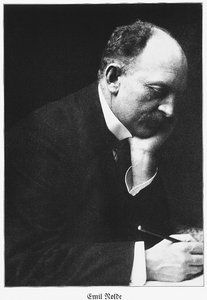
1867–1956, Danemark
Emil Nolde
La Vie et l'Identité d'Emil Nolde Né sous le nom de Hans Emil Hansen le 7 août 1867, l'homme qui allait devenir célèbre sous le nom d'Emil Nolde a grandi près du village de Nolde, dans le duché de Schleswig. Ses premières années furent façonnées par la vie rurale et agraire de sa famille. Il s'est finalement éloigné de cette voie, choisissant plutôt de travailler comme sculpteur sur bois et décorateur de meubles. Ce travail manuel et tactile a précédé sa transition vers la peinture et la gravure.
Autres œuvres de Emil Nolde
 Coucher de soleil
 Mer au ciel rouge
 Couple sur la plage1903
 Masques1911
Essais sur Marsh bridge
 L'Éclosion des Mondes Intérieurs : Explorer l'Intensité Émotionnelle de l'ExpressionnismeExplorez l'intensité émotionnelle de l'Expressionnisme allemand avec OriginalUniqueArt. Découvrez les œuvres poignantes de Kirchner, Die Br…
 Émotion brute et traits audacieux : le Top 10 du Néo-ExpressionnismePlongez dans l'énergie brute du néo-expressionnisme. Découvrez les chefs-d'œuvre de Basquiat et Kiefer sur OriginalUniqueArt.com. Explorez …
 Émile Nolde : Voyage au cœur de la nature expressionniste et du soi primalExplorez l'univers puissant d'Émile Nolde, figure majeure de l'expressionnisme allemand. Découvrez son voyage artistique, de ses racines no…