Aperçu en situation
 Envoyer
 Partager
 Détails de l'œuvre

 Télécharger
 Articles similaires
 Radiographie
 Diaporama
Proun


 Lire la suite
Reproduction à l'huile faite à la main
Huile sur toile peinte à la main, avec cadre et dimensions personnalisés, réalisée sur commande par nos artistes. ( Commander l'impression Télécharger l'image haute résolution)




P118B $10

P118H $10

P118W $10

P438Z $10

P508JH $12

P508YH $12

P805H $10

P805Z $10

P919BZ $10

P919G $10

P919XJ $10

P959ZH $10

P968JZ $12

W106C $8

W218G $10

W218JH $8

W218Y $10

W307PJ $10

W316G $10

W316PJ $8

W316Y $10

W398PJ $8

W4111J $10

W500HY $15

W500JH $15

W692G $12

W849H $8

W940BG $15

W953PJ $8




Choisissez parmi nos formats prédéfinis qui respectent les proportions originales de l’œuvre.

Vous pouvez saisir vos propres dimensions pour l'adapter à un cadre ou à un espace spécifique. Si la taille sélectionnée ne correspond pas aux proportions de l'image d'origine, nous recadrerons l'œuvre ou prolongerons la peinture avec des éléments peints à la main supplémentaires. Une maquette numérique vous sera envoyée pour approbation avant le début de la production.
Veuillez noter que l'aperçu à l'écran ne reflète pas le recadrage ou l'extension réels. Seule la maquette montrera fidèlement la composition finale.
Bien que des tailles personnalisées soient disponibles, nous vous recommandons de sélectionner une dimension dans la liste prédéfinie afin de préserver les proportions d'origine.
Après la commande, l’équipe OriginalUniqueArt.com contactera le client par e-mail pour recueillir ses instructions et lui fournira une maquette d’aperçu
Livraison dans le monde entier () en 3 à 4 semaines au lieu des 5 semaines habituelles. (18 août). Aucun compromis sur la qualité.

Livraison express gratuite dans le monde entier

Toile de lin de qualité supérieure

Assurance transport complète

Garantie de remboursement des droits de douane

Garantie de fidélité des couleurs

Politique de retour de 60 jours (uniquement en cas de défaut)

Garantie de remboursement à 100%

Offre de tarifs dégressifs
 L'option verre n'est disponible que pour les dimensions inférieures à 110 cm.

Proun
Technique de reproduction
Format de la reproduction
-


Prix total
$ 300
Description de l'œuvre
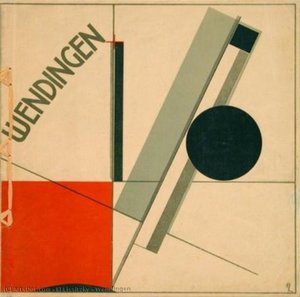
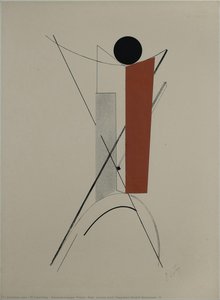
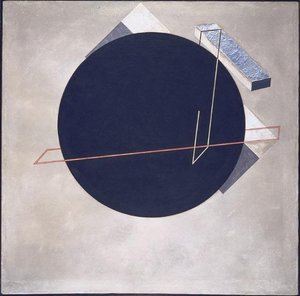
El Lissitzky’s Proun: A Revolutionary Geometry of Space
The photograph presented here offers a glimpse into “Proun 19D,” a seminal work by El Lissitzky, created in 1923 and embodying the radical principles of Constructivism. More than simply a painting, Proun (derived from the Czech word for ‘pronunciation’) represented Lissitzky’s ambitious attempt to redefine art's relationship with space – to move it beyond mere representation and into the realm of pure form and experience. This piece, executed in stark black and white, showcases his signature geometric abstraction: a carefully orchestrated arrangement of circles, crosses (the “X”), and lines that seem to defy conventional perspective. The composition isn’t about depicting an object; instead, it aims to reveal the underlying structure of space itself, suggesting a dynamic interplay between positive and negative forms.
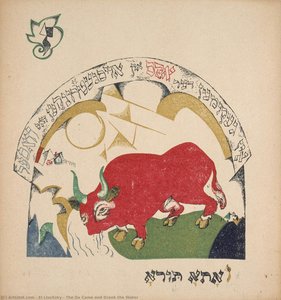
Lissitzky's journey to this groundbreaking style was deeply rooted in his early life and artistic training. Born Lazar Markovich Lissitzky in 1890 in Pochinki, Russia, he initially pursued architecture and engineering, disciplines that were frustratingly closed off to him due to restrictions placed on Jewish students. This experience fueled a desire to create art that transcended social barriers and actively shaped the world around it. His early illustrations for Yiddish children’s books – works like ‘Chad Gadya’ – demonstrated an innate understanding of narrative and visual storytelling, foreshadowing his later explorations into abstract forms. His time in Berlin and Darmstadt exposed him to European avant-garde movements, particularly Cubism and Futurism, which profoundly influenced his thinking about space and form. However, it was upon returning to Russia that Lissitzky truly developed his unique vision, culminating in the creation of Proun.
The Principles of Constructivism and the Birth of Proun
Proun emerged from the broader context of Constructivism, a Russian artistic movement advocating for art’s role in building a new socialist society. Constructivists believed that art should be functional, accessible, and directly contribute to practical design – influencing architecture, furniture, typography, and even propaganda. Lissitzky embraced this philosophy wholeheartedly, rejecting traditional notions of illusionistic painting and instead focusing on the inherent properties of geometric forms. He theorized that a “Proun” was not merely a flat image but a three-dimensional projection of space, a ‘stage’ upon which the world could be reconfigured. The X shape, for instance, represented the intersection of two planes, while circles symbolized the sun and the cosmos – fundamental elements in his vision of a new spatial order.
Crucially, Lissitzky developed a system of “Proun stages,” believing that each work evolved through a series of transformations. “Proun 19D” is considered an early example, demonstrating the gradual shift from representational imagery to pure abstraction. He meticulously documented these changes in his diaries and drawings, creating a visual record of his artistic process – a testament to his belief in art as a dynamic, evolving entity.
Symbolism and Emotional Impact
While seemingly austere, “Proun 19D” is rich with symbolic meaning. The geometric forms aren’t arbitrary; they represent fundamental forces and relationships within the universe. The circle, often associated with wholeness and unity, suggests a harmonious balance between opposing elements. The X, representing intersection and connection, symbolizes the dynamic interaction of space and form. Lissitzky's work wasn't simply about aesthetics; it was an attempt to create a visual language that could communicate complex ideas about space, time, and social transformation.
The stark black and white palette further amplifies the piece’s impact, stripping away distractions and focusing attention on the essential forms. It evokes a sense of clarity, precision, and intellectual rigor – reflecting Lissitzky's commitment to rationalism and his belief in art as a tool for social progress. “Proun 19D” remains a powerful example of how abstract art can be both intellectually stimulating and emotionally resonant, inviting viewers to contemplate the fundamental nature of reality itself.
OriginalUniqueArt Reproductions: Bringing Proun to Life
OriginalUniqueArt is proud to offer meticulously crafted hand-painted reproductions of El Lissitzky’s “Proun 19D.” Our artists utilize traditional techniques and archival-quality materials to faithfully recreate the artwork's intricate details and subtle nuances. Whether you are an art collector, interior designer, or simply a lover of modern art, our reproductions provide a stunning way to experience the power and beauty of this iconic work. Explore our selection of sizes and framing options to find the perfect addition to your home or office – a tangible connection to one of the 20th century’s most visionary artists.
Biographie de l'artiste
jeune enfance et éducation
El Lissitzky, artiste, designer, photographe, typographe, polémiste et architecte russe réputé, est né le 23 novembre 1890 à Pochinok, en Russie. Sa jeune enfance a été marquée par un intérêt inné pour le dessin, ce qui l'a conduit à recevoir des instructions auprès de Yehuda Pen, artiste juif local, à l’âge de 13 ans.carrière et influences
La carrière de Lissitzky a été caractérisée par sa collaboration avec Kazimir Malevitch dans le développement du suprématisme, influençant considérablement le Bauhaus et les mouvements constructivistes. Son œuvre, s’étendant sur divers médias, a joué un rôle essentiel dans la formation de la conception graphique du 20e siècle.- contributions clés :
- a développé le groupe artistique suprématiste Unovis avec Kazimir Malevitch
- a créé la série Proun, une variante de la série suprématiste
- a servi d'ambassadeur culturel russe à Weimar en Allemagne, influençant les figures clés du Bauhaus et des mouvements De Stijl
- innovations :*
- typographie
- conception d’expositions
- photomontage
- conception de livres
œuvres notables et héritage
Certaines des œuvres notables de Lissitzky comprennent :- Le Constructeur (1924), un photomontage auto-portrait présentant des thèmes récurrents tels que la main de Dieu, reliant son héritage juif aux mouvements artistiques contemporains.
- Une affiche de propagande soviétique (1941), l’une de ses dernières œuvres, appelant le peuple à construire davantage de chars pour combattre le nazisme.
musées et collections
L'œuvre de Lissitzky se trouve dans divers musées, notamment :- Musée d’art de Taganrog, Russie /fr/art/show/art-d3bb5m-fr/
- Musée d’art de Novokouznetesk, Russie /fr/art/show/art-d3akex-fr/
fondation et catalogue raisonné
En 2014, la fondation Lissitzky a été établie en collaboration avec le Van Abbemuseum et des érudits de premier plan du monde entier pour préserver l'héritage de l'artiste et préparer un catalogue raisonné de son œuvre.- Pour plus d’informations sur El Lissitzky, veuillez consulter : https://OriginalUniqueArt.com/@/el-lissitzky
- Explorez les œuvres exposées au musée d’art de Taganrog : /fr/art/show/to-explore-the-artworks-exhibited-in-taganrog-art-museum/
références :
- https://en.wikipedia.org/wiki/el_lissitzky
- https://OriginalUniqueArt.com/@/el-lissitzky

El Lissitzky
1890 - 1941 , Russie
L'essentiel de l'artiste
- Artistes Influents: ['Kazimir Malevich']
- Date De Naissance: 23 novembre 1890
- Influences Artistiques:
- Bauhaus
- De Stijl
- Lieu De Naissance: Pochinki, Russie
- Mouvement Artistique:
- Suprematisme
- Constructivisme
- Nationalité: Russe
- Nom Complet: El Lissitzky
- Oeuvres Notables:
- Le Constructeur (1924)
- Série Proun
- Affiche de propagande soviétique
Articles connexes

El Greco : Les 25 Chefs-d'Œuvre Incontournables pour une Décoration d'Exception
Plongez dans l'univers spirituel d'El Greco ! Découvrez les 25 œuvres incontournables du maître espagnol, de *L'Enterrement du Comte d'Orgaz* à ses portraits saisissants. Inspirez votre décoration intérieure avec des reproductions d'art exceptionnelles sur OriginalUniqueArt.com.

Abstraction Géométrique : Les 10 Chefs-d'œuvre qui ont Marqué l'Histoire de l'Art
Plongez au cœur de l'abstraction géométrique avec OriginalUniqueArt.com ! Découvrez les 10 œuvres majeures de Mondrian, Malevitch et Kandinsky qui ont révolutionné l'art moderne. Inspirez votre décoration intérieure avec des reproductions de tableaux exceptionnelles. Explorez la collection en ligne !

Beyond Form & Color: Geometric Abstraction's Evolution in 20th/21st Century Art
Explore the evolution of geometric abstraction from Cubism to contemporary art. Discover key artists like Malevich & Mondrian, investment insights, and expert collecting advice at OriginalUniqueArt.
Kazimir Malevich : Les 25 Œuvres Maîtresses du Suprématisme pour une Décoration d'Exception
Plongez dans l'univers révolutionnaire de Kazimir Malevich ! Découvrez les 25 œuvres clés du Suprématisme, de 'Carré Noir' à 'Blanc sur Blanc'. Inspirez votre décoration intérieure avec des reproductions d'art exceptionnelles. Explorez la collection complète sur OriginalUniqueArt.com.
Geometric Design in Art: A Historical Survey & Contemporary Appeal for Collectors
Explore the enduring legacy of geometric abstraction! Discover key artists, historical movements & investment insights for discerning art collectors. Expert guidance from OriginalUniqueArt.