Aperçu en situation
 Partager
 Partager
 Détails
 Guide imprimable

 Télécharger
 Articles similaires
 Radiographie
 Voir le diaporama
 Statistiques
Four (arithmetic) actions


 Afficher la suite
Reproduction à l'huile faite à la main
Huile sur toile peinte à la main, avec cadre et dimensions personnalisés, réalisée sur commande par nos artistes. ( Passer au format impression Passer au format image numérique)




P118B €10

P118H €10

P118W €10

P438Z €10

P508JH €12

P508YH €12

P805H €10

P805Z €10

P919BZ €10

P919G €10

P919XJ €10

P959ZH €10

P968JZ €12

W106C €8

W218G €10

W218JH €8

W218Y €10

W307PJ €10

W316G €10

W316PJ €8

W316Y €10

W398PJ €8

W4111J €10

W500HY €15

W500JH €15

W692G €12

W849H €8

W940BG €15

W953PJ €8




Choisissez parmi nos formats prédéfinis qui respectent les proportions originales de l’œuvre.

Saisissez la largeur et la hauteur souhaitées, pour s'adapter à votre cadre ou à votre mur. Cette œuvre est peinte à la main ; ainsi, pour un format de forme différente, l'artiste peut peindre un peu plus autour du tableau ou réduire légèrement les bords — c'est vous qui choisissez. Nous vous envoyons une maquette numérique pour approbation avant que la peinture ne commence. L'image présentée sur cette page ne reflète pas le résultat réel — seule la maquette le fait.
Après la commande, l’équipe OriginalUniqueArt.com contactera le client par e-mail pour recueillir ses instructions et lui fournira une maquette d’aperçu
Livraison dans le monde entier () en 3 à 4 semaines au lieu des 5 semaines habituelles. (22 octobre). Aucun compromis sur la qualité.

Livraison express gratuite dans le monde entier

Toile de lin de haute qualité

Assurance transport complète

Garantie de remboursement des droits de douane

Garantie de fidélité des couleurs

Garantie de retour de 100 jours (uniquement en cas de défaut)

Garantie de remboursement à 100%

Tarifs dégressifs sur quantité
 L'option verre n'est disponible que pour les dimensions inférieures à 110 cm.

Four (arithmetic) actions
Technique de reproduction
Format de la reproduction
-


Prix total final
€ 263
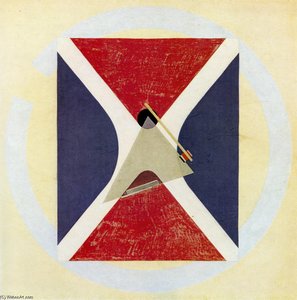
El Lissitzky’s “Four (Arithmetic) Actions”: A Constructivist Meditation on Form and Number
El Lissitzky's "Four (Arithmetic) Actions," painted in 1928, is more than just a depiction of four stacked figures; it’s a potent distillation of the core tenets of Russian Constructivism. This striking black-and-white image, born from Lissitzky’s revolutionary vision, embodies his belief that art could be a tool for social and intellectual transformation – a concept deeply rooted in the burgeoning modernist movement of the time. The painting's stark simplicity belies its complex engagement with mathematical principles, presenting them not as abstract concepts but as tangible forms demanding rigorous investigation.
Constructivist Principles and Geometric Abstraction
Created during a period of intense artistic experimentation following the Russian Revolution, “Four (Arithmetic) Actions)” exemplifies Constructivism’s rejection of traditional representational art. Lissitzky, along with other key figures like Vladimir Tatlin, sought to build a new visual language based on geometric abstraction and industrial forms. The painting's composition – the deliberate layering of the red figures – is a direct manifestation of this approach. Each figure isn't merely a representation of an action; it’s a carefully constructed element contributing to a larger, dynamic whole. The use of bold, primary colors—a conscious choice reflecting the era’s embrace of industrial materials and machine aesthetics—further emphasizes this geometric sensibility.
Symbolism Within the Structure
The numerical markings associated with each figure are crucial to understanding the artwork's deeper meaning. These aren’t arbitrary additions; they represent fundamental mathematical operations – addition, subtraction, multiplication, and division. Lissitzky was interested in exploring how visual forms could embody abstract concepts, transforming mathematics from a theoretical discipline into an accessible and engaging aesthetic experience. The larger figure, visually dominant, can be interpreted as representing the culmination of these actions—the result or outcome of the mathematical process. This layering creates a sense of progression and hierarchy, mirroring the sequential nature of calculation itself.
Historical Context and Artistic Legacy
"Four (Arithmetic) Actions)" was created in 1928, a pivotal year for Lissitzky’s career. It reflects his growing interest in exploring the relationship between art, architecture, and technology – themes that would become central to his later work. The painting's influence extends far beyond its immediate historical context. Lissitzky’s pioneering use of geometric abstraction paved the way for subsequent developments in modern art, including Suprematism and De Stijl. Today, “Four (Arithmetic) Actions)” remains a powerful example of Constructivism’s ambition – a testament to the idea that art can be both intellectually stimulating and profoundly beautiful.
Questions et réponses
Quel espace est suggéré pour «Four (arithmetic) actions» de El Lissitzky ?
Une reproduction de « Four (arithmetic) actions » s'intègre parfaitement dans une Living Room.
Comment le mouvement et l'époque se rencontrent-ils dans «Four (arithmetic) actions» de El Lissitzky ?
«Four (arithmetic) actions» de El Lissitzky s'inscrit dans le mouvement Constructivism, au sein de l'époque Époque moderne de son créateur.
À quelle période de la carrière de El Lissitzky se situe « Four (arithmetic) actions » ?
« Four (arithmetic) actions » représente la période Early Period de El Lissitzky.
Biographie de l'artiste
jeune enfance et éducation
El Lissitzky, artiste, designer, photographe, typographe, polémiste et architecte russe réputé, est né le 23 novembre 1890 à Pochinok, en Russie. Sa jeune enfance a été marquée par un intérêt inné pour le dessin, ce qui l'a conduit à recevoir des instructions auprès de Yehuda Pen, artiste juif local, à l’âge de 13 ans.carrière et influences
La carrière de Lissitzky a été caractérisée par sa collaboration avec Kazimir Malevitch dans le développement du suprématisme, influençant considérablement le Bauhaus et les mouvements constructivistes. Son œuvre, s’étendant sur divers médias, a joué un rôle essentiel dans la formation de la conception graphique du 20e siècle.- contributions clés :
- a développé le groupe artistique suprématiste Unovis avec Kazimir Malevitch
- a créé la série Proun, une variante de la série suprématiste
- a servi d'ambassadeur culturel russe à Weimar en Allemagne, influençant les figures clés du Bauhaus et des mouvements De Stijl
- innovations :*
- typographie
- conception d’expositions
- photomontage
- conception de livres
œuvres notables et héritage
Certaines des œuvres notables de Lissitzky comprennent :- Le Constructeur (1924), un photomontage auto-portrait présentant des thèmes récurrents tels que la main de Dieu, reliant son héritage juif aux mouvements artistiques contemporains.
- Une affiche de propagande soviétique (1941), l’une de ses dernières œuvres, appelant le peuple à construire davantage de chars pour combattre le nazisme.
musées et collections
L'œuvre de Lissitzky se trouve dans divers musées, notamment :- Musée d’art de Taganrog, Russie /fr/art/show/art-d3bb5m-fr/
- Musée d’art de Novokouznetesk, Russie /fr/art/show/art-d3akex-fr/
fondation et catalogue raisonné
En 2014, la fondation Lissitzky a été établie en collaboration avec le Van Abbemuseum et des érudits de premier plan du monde entier pour préserver l'héritage de l'artiste et préparer un catalogue raisonné de son œuvre.- Pour plus d’informations sur El Lissitzky, veuillez consulter : https://OriginalUniqueArt.com/@/el-lissitzky
- Explorez les œuvres exposées au musée d’art de Taganrog : /fr/art/show/to-explore-the-artworks-exhibited-in-taganrog-art-museum/
références :
- https://en.wikipedia.org/wiki/el_lissitzky
- https://OriginalUniqueArt.com/@/el-lissitzky

El Lissitzky
1890 - 1941 , Russie
En bref
- Artistes Influents: ['Kazimir Malevich']
- Date De Naissance: 23 novembre 1890
- Influences Artistiques:
- Bauhaus
- De Stijl
- Lieu De Naissance: Pochinki, Russie
- Mouvement Artistique:
- Suprematisme
- Constructivisme
- Nationalité: Russe
- Nom Complet: El Lissitzky
- Oeuvres Notables:
- Le Constructeur (1924)
- Série Proun
- Affiche de propagande soviétique
Articles connexes

Constructivisme : Révolution Esthétique et Idéologique dans l'Art du XXe Siècle
Explorez le constructivisme : son histoire révolutionnaire, ses figures clés (Malevitch, Tatlin), et son impact durable sur l'art, l'architecture & le design. Un guide expert pour collectionneurs avertis.

El Greco : Les 25 Chefs-d'Œuvre Incontournables pour une Décoration d'Exception
Plongez dans l'univers spirituel d'El Greco ! Découvrez les 25 œuvres incontournables du maître espagnol, de *L'Enterrement du Comte d'Orgaz* à ses portraits saisissants. Inspirez votre décoration intérieure avec des reproductions d'art exceptionnelles sur OriginalUniqueArt.com.

Les 10 Chefs-d'œuvre Noirs : Peintures Célèbres et Décoration d'Intérieur
Plongez dans l'univers fascinant des 10 plus beaux tableaux noirs de l'histoire de l'art. Découvrez les secrets de Goya, Manet, Rothko et autres maîtres. Inspirez votre décoration intérieure avec !
Kazimir Malevich : Les 25 Œuvres Maîtresses du Suprématisme pour une Décoration d'Exception
Plongez dans l'univers révolutionnaire de Kazimir Malevich ! Découvrez les 25 œuvres clés du Suprématisme, de 'Carré Noir' à 'Blanc sur Blanc'. Inspirez votre décoration intérieure avec des reproductions d'art exceptionnelles. Explorez la collection complète sur OriginalUniqueArt.com.

L'Âge d'Or Réinventé : Esthétique et Héritage Durable de l'Art Déco
Explorez l'histoire fascinante de l'Art Déco : influences, artistes emblématiques, matériaux luxueux et héritage durable. Découvrez comment ce style révolutionnaire continue d'inspirer le design contemporain.