Post-Impressionism
After Work (Edward William Stott)
Edward William Stott (1859–1918) a réalisé After Work. Il appartient au mouvement Post-Impressionism. Réalisée en Oil On Canvas.
- Oil On Canvas

 Aperçu en situation

 Peinture à l'huile faite main
 Envoyer
 Partager
 Fiche pédagogique


 Télécharger l'image
 Articles similaires
 Radiographie
 Diaporama
 Questions et réponses

 Statistiques
After Work, en bref
- Titre
- After Work
- Artiste
- Edward William Stott (1859–1918)
- Lieu de naissance de l'artiste
- Rochdale, Angleterre
- Technique
- Oil On Canvas
- Mouvement
- Post-Impressionism
- Période
- 19th Century
- Sujet
- landscape, solitude, travel, rural, dusk, horseback
Que représente After Work ?
Identification of After Work by Edward William Stott
In this work, titled After Work, we encounter a quiet moment of transition captured by the English painter Edward William Stott. Born in 1859, Stott developed a sensibility deeply rooted in the nuances of the natural world, a focus that remains central to this piece. The painting presents a solitary figure on horseback navigating a desolate landscape, a scene that reflects the artist's lifelong interest in the rhythms of rural life and the changing qualities of light.
Edward William Stott, who lived until 1918, possessed a specific ability to render the atmosphere of the English countryside. In After Work, this is expressed through a somber, melancholic mood, established by an overcast sky and a palette of earthy browns and muted yellows. The composition relies on strong horizontal lines—the rider's back, the terrain, and the distant horizon—to create a sense of vastness and isolation within the frame.
The subject matter centers on a lone traveler in a rugged environment, suggesting themes of solitude and resilience. There is a palpable sense of the weight of the day's labor, as the figure moves through a landscape where the background recedes into a hazy darkness. It is a study of a quiet, singular moment caught between the physical reality of the terrain and the emotional stillness of the evening.
The Composition and Visual Elements
The composition is defined by a series of heavy horizontal lines. The horse’s back, the uneven ground, and the distant horizon all pull the eye across the canvas, emphasizing a sense of vastness and isolation. This structural choice anchors the solitary figure on horseback as they traverse a desolate landscape. The subject is a lone traveler moving through a rugged environment, a figure that seems small against the weight of the terrain.
The color palette is restrained, relying primarily on earthy browns and muted yellows. These tones contribute to a somber mood, mirroring the quietude of the scene. Lighting is diffused and flat, lacking any strong highlights that might disrupt the stillness. Instead, the light settles softly over the landscape, allowing the forms to emerge through subtle shifts in tone rather than sharp contrast. In the distance, the background recedes into a hazy darkness, creating a sense of depth that feels both immense and impenetrable.
Technique and Artistic Style
The work is executed in oil on canvas, a choice that allows for the heavy, moisture-laden texture characteristic of the artist's approach to the landscape. There is a palpable sense of weight in the application of the paint. Thick brushstrokes define the terrain and the figure, suggesting a painterly technique that prioritizes the physical presence of the medium. This tactile quality gives the organic shapes of the horse and rider a tangible, grounded reality.
The style leans toward realism, yet it is handled with an expressive brushstroke technique that avoids clinical precision. Lines are loose and expressive, defining the forms of the traveler and the rugged environment without relying on sharp or rigid edges. This softness allows the subject to merge subtly with the atmosphere of the desolate landscape. The shapes remain largely organic, rendered with a visible texture that emphasizes the raw, unpolished nature of the scene.
Images haute résolution de After Work
Domaine public : l'artiste est décédé en 1918.
Edward William Stott, After Work. Domaine public
Questions sur After Work, réponses
Quelle est la technique utilisée pour «After Work» de Edward William Stott ?
« After Work » est réalisé en Oil On Canvas.
Que représente «After Work» de Edward William Stott ?
Les thèmes présents dans «After Work» de Edward William Stott incluent landscape, solitude, travel, rural, dusk, horseback, melancholy, vastness. Ensemble, ils résument le sujet de l'œuvre.
L'œuvre «After Work» de Edward William Stott est-elle dans le domaine public ?
«After Work» de Edward William Stott est dans le dans le domaine public - ses droits d'auteur sont tombés dans le domaine public. Ce statut régit les modalités de reproduction de l'image de l'œuvre.
À quel artiste est attribuée l'œuvre "After Work" ?
L'artiste à l'origine de « After Work » est Edward William Stott. L'œuvre est répertoriée sous le nom de Edward William Stott.
À quel mouvement artistique appartient « After Work » ?
« After Work » est une œuvre issue du Post-Impressionism. Ce mouvement définit la tradition artistique à laquelle l'œuvre appartient.
À quelle étape de la carrière de Edward William Stott « After Work » s'inscrit-elle ?
Au cours de la carrière de Edward William Stott, « After Work » s'inscrit dans la période Late Victorian. Cette phase permet de le comparer aux autres œuvres de l'artiste.
Pourquoi le statut du droit d'auteur de « After Work » est-il tel qu'il est ?
«After Work» de Edward William Stott est dans le dans le domaine public - ses droits d'auteur sont tombés dans le domaine public. La durée du droit d'auteur court à partir du décès de l'artiste, survenu en 1918.
Quelle place occupe « After Work » dans l'œuvre de Edward William Stott ?
Au sein de la production de Edward William Stott, « After Work » s'inscrit dans le style Post-Impressionism, tout en explorant les thèmes de sussex colony's artistic hub, domestic scenes, fading light focus, bastien-lepage, impressionism, linnell, palmer – english tradition.
« After Work » est-il représentatif de l'œuvre habituelle de Edward William Stott ?
Parmi les thèmes récurrents de Edward William Stott — sussex colony's artistic hub, domestic scenes, fading light focus, bastien-lepage, impressionism, linnell, palmer – english tradition — « After Work » met l'accent sur landscape, solitude, travel, rural, dusk, horseback, melancholy, vastness.
À propos de l'artiste, Edward William Stott

1859–1918, Angleterre
Edward William Stott
L'Âme Atmosphérique du Paysage Anglais Edward William Stott demeure une figure captivante dans la tapisserie de l'art britannique, un peintre dont l'œuvre respire la beauté tranquille et mélancolique de la fin de l'ère victorienne. Né en 1855 au cœur de la rudesse industrielle de Rochdale, dans le Lancashire, les sensibilités artistiques de Stott étaient bien loin de la suie et du fer de son lieu de naissance. Au contraire, il a cherché une connexion profonde avec le monde naturel, trouvant finalement sa demeure spirituelle et créative dans les paysages vallonnés et paisibles de la campagne du Sussex. Son parcours fut celui d'un raffinement constant, s'éloignant des environnements académiques structurés de Manchester et de Paris pour rejoindre les champs spontanés et baignés de lumière de la campagne anglaise.
À propos de Edward William Stott Œuvres notables de Edward William Stott
Autres œuvres de Edward William Stott
 Chat noir et blanc
 The Labourer's Cottage
 Hagar And Ishmael Beside A Well In The Desert
 Ploughing
Essais sur After Work
 Les 10 Chefs-d'œuvre du XIXe Siècle : Artistes et Décor IntemporelsPlongez au cœur du XIXe siècle avec les 10 œuvres incontournables de Manet, Monet et Renoir. Découvrez l'histoire, les techniques et l'émot…
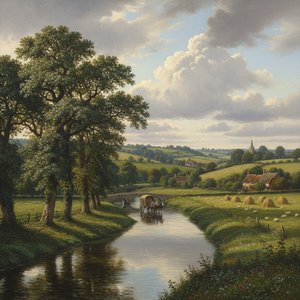 John Constable : Nature, Lumière et Vision Romantique de la Campagne AnglaiseExplorez l'univers de John Constable, maître du romantisme anglais et précurseur de l'impressionnisme. Découvrez son œuvre, sa technique un…
 Œuvres américaines des années 1850Plongez dans l'âge d'or de l'Hudson River School avec Church et Durand. Explorez la collection sur OriginalUniqueArt.com.