Aperçu en situation
 Partager
 Partager
 Détails
 Guide imprimable

 Télécharger
 Articles similaires
 Radiographie
 Voir le diaporama
 Statistiques
Eleven AM


 Afficher la suite
L’œuvre d'art présentée sur cette page est protégée par le droit d'auteur, ce qui signifie que nous ne pouvons légalement créer ou vendre de reproduction identique. Cette protection est appliquée en vertu d'accords internationaux tels que la Convention de Berne et par les lois nationales, notamment celles énoncées par le Loi américaine sur le droit d'auteur - Titre 17.
Cette méthode est pleinement conforme aux réglementations sur le droit d'auteur car elle ne repose pas sur la copie ou la duplication de l'œuvre protégée. Il s'agit plutôt d'une réinterprétation créative — une nouvelle peinture qui s'inspire de l'original sans pour autant lui être identique.
Giclées et impressions d'art
Impressions giclées ou sur toile de qualité musée, avec une production rapide et des finitions au choix. ( Acheter la peinture faite à la main Passer au format image numérique)




P118B €10

P118H €10

P118W €10

P438Z €10

P508JH €12

P508YH €12

P805H €10

P805Z €10

P919BZ €10

P919G €10

P919XJ €10

P959ZH €10

P968JZ €12

W106C €8

W218G €10

W218JH €8

W218Y €10

W307PJ €10

W316G €10

W316PJ €8

W316Y €10

W398PJ €8

W4111J €10

W500HY €15

W500JH €15

W692G €12

W849H €8

W940BG €15

W953PJ €8




Choisissez parmi nos formats prédéfinis qui respectent les proportions originales de l’œuvre.

Saisissez la largeur et la hauteur souhaitées pour qu'elles s'adaptent à votre cadre ou à votre mur. Une impression ne peut être que découpée, elle ne peut jamais être agrandie au-delà de l'image originale ; ainsi, un format de forme différente entraînera la perte d'une partie de l'image. Nous vous envoyons une maquette numérique pour approbation avant toute impression. L'image présentée sur cette page ne montre pas le recadrage réel — seule la maquette le permet.
Livraison dans le monde entier () en 2 semaines au lieu des 4/5 semaines habituelles. (20 octobre)

Livraison express gratuite dans le monde entier

Toile de lin de haute qualité

Assurance transport complète

Garantie de remboursement des droits de douane

Garantie de fidélité des couleurs

Garantie de retour de 100 jours (uniquement en cas de défaut)

Garantie de remboursement à 100%

Tarifs dégressifs sur quantité
 L'option verre n'est disponible que pour les dimensions inférieures à 110 cm.

Eleven AM
Giclées et impressions d'art
Format de la reproduction
-


Prix total final
€ 70
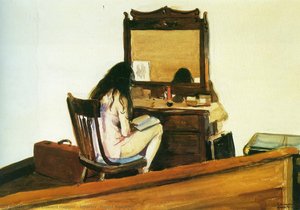
A Quiet Moment of Urban Solitude: Exploring Edward Hopper’s “Eleven AM”
Edward Hopper, a master of American realism, possessed an uncanny ability to distill the essence of modern life – its quiet desperation, its pervasive loneliness, and its fleeting moments of beauty – onto canvas. “Eleven A.M.”, painted in 1926, is a particularly poignant example of this skill. The painting depicts a solitary woman seated by a window, bathed in a soft yet revealing light that seems to simultaneously illuminate and isolate her. It’s not a scene of dramatic action, but rather one of profound stillness, inviting the viewer into an intimate contemplation of interiority and the human condition.
The composition is deceptively simple: a woman in a blue armchair, positioned near a window that offers a glimpse of the world outside. However, it’s within this simplicity that Hopper's genius resides. The room itself is modestly furnished – a dresser, a framed picture, and a lamp all contribute to a sense of everyday life, yet they also underscore the woman’s isolation. She isn’t actively engaged with her surroundings; instead, she appears lost in thought, her gaze directed outwards but seemingly unfocused. The careful arrangement of objects within the room doesn’t feel cluttered or busy, but rather deliberately sparse, emphasizing the emptiness that surrounds the figure. Hopper masterfully uses light and shadow to sculpt the form of the woman and define the space around her, creating a dramatic contrast that draws the eye and heightens the emotional impact.
The Language of Light and Shadow: Hopper’s Technical Brilliance
Hopper's technique in “Eleven A.M.” is characterized by a meticulous attention to detail and a masterful command of oil paint. His brushstrokes are relatively smooth, creating a realistic depiction of form and texture. The light streaming through the window isn’t merely illumination; it’s a character in itself, shaping the mood and revealing subtle nuances of emotion. Notice how the light catches on the woman's skin, highlighting her vulnerability, while simultaneously casting deep shadows that suggest a sense of melancholy or introspection. The color palette is restrained – blues, browns, and muted reds dominate the scene – further contributing to the painting’s somber atmosphere. This isn’t a vibrant, celebratory depiction of life; it’s a quiet, introspective study of human emotion.
Echoes of Modern Life: Context and Symbolism
To understand “Eleven A.M.” fully, it's essential to consider the historical context in which it was created. The 1920s were a period of rapid social change in America – urbanization, industrialization, and shifting societal norms all contributed to a sense of alienation and disillusionment. Hopper’s work often reflects these anxieties, capturing the loneliness and isolation that many people experienced in the modern world. The window in “Eleven A.M.” is particularly symbolic; it represents a connection to the outside world, yet the woman's position within the room suggests a barrier between her and that world. She is both present and absent, connected and disconnected. The painting invites us to consider the complexities of human experience – our longing for connection, our fear of isolation, and our search for meaning in a rapidly changing world.
Hopper's artistic influences are also apparent in “Eleven A.M.”. While he developed his own unique style, he was deeply influenced by French Impressionists like Édouard Manet and Edgar Degas, as well as American artists such as Robert Henri. Like these predecessors, Hopper sought to capture the realities of modern life with honesty and sensitivity. However, he went beyond mere representation; he imbued his paintings with a psychological depth that resonated with viewers on an emotional level. “Eleven A.M.” is not simply a depiction of a woman in a room; it’s a powerful exploration of the human condition – a timeless meditation on solitude, introspection, and the search for meaning.
A Portrait of Inner Reflection
The painting’s subdued palette—primarily blues and browns—mirrors the emotional tone of Hopper's work. The careful layering of paint creates depth and texture, emphasizing the materiality of the scene while simultaneously conveying a sense of stillness. Hopper skillfully uses light to sculpt the woman’s form and define the space around her, highlighting her vulnerability and suggesting an unspoken narrative.
Consider the woman’s gaze—directed outwards but seemingly unfocused—as emblematic of the human condition's inherent contradictions. The emptiness surrounding her reinforces the theme of isolation, prompting viewers to contemplate themes of longing and detachment. Hopper’s masterful technique elevates this simple composition into a profound statement about modern life.
The painting’s enduring appeal lies in its ability to evoke empathy and contemplation—a testament to Hopper's genius as an artist who captured the essence of human experience with remarkable sensitivity.
Questions et réponses
Que représente "Eleven AM" et quelle atmosphère s'en dégage ?
«Eleven AM» de Edward Hopper représente urban landscape, interior space, solitude, light & shadow, female figure, realism, american art, domestic scene, dans une atmosphère Calme. Le sujet et l'ambiance définissent ensemble l'œuvre.
Quelle émotion «Eleven AM» de Edward Hopper dégage-t-il ?
«Eleven AM» de Edward Hopper dégage un sentiment Mélancolique au sein d'une atmosphère globalement Calme.
Comment "Eleven AM" équilibre-t-il l'ombre et la lumière ?
Les valeurs enregistrées pour «Eleven AM» de Edward Hopper sont : une luminosité de ombres profondes, une luminance de Sombre.
Biographie de l'artiste
**jeunesse et influences**
Edward Hopper, peintre et graveur américain réaliste de premier plan, est né le 22 juillet 1882 à Upper Nyack, New York. Sa famille, d'ascendance principalement néerlandaise, lui a offert une éducation confortable qui lui a permis de poursuivre ses inclinations artistiques dès son plus jeune âge. - **inspirations :** L’œuvre de Hopper a été influencée par les écrits de Ralph Waldo Emerson et des maîtres impressionnistes français Édouard Manet et Edgar Degas. - **formation précoce :** Il a commencé à étudier l'art grâce à un cours par correspondance en 1899, puis est passé à l’École d'Art et de Conception de New York.**style artistique et thèmes**
Edward Hopper's rendus sobres et soigneusement calculés reflétaient sa vision personnelle de la vie américaine moderne. Son travail peut être caractérisé par : - **scènes urbaines et rurales :** Les deux ensembles étaient dépeints avec un mélange unique de réalisme et d’émotion profonde. - **lumière :** Maîtrise de la lumière, souvent utilisée pour évoquer des sentiments d'isolement ou de contemplation. - **figures :** Souvent sans visage ou en arrière-plan, mettant l'accent sur l'environnement plutôt que sur les figures.**œuvres notables et leur signification**
- House by the Railroad (Musée d'Art Moderne, New York, États-Unis), un exemple de la capacité de Hopper à évoquer un sentiment de mélancolie grâce à une composition simple mais puissante. - Reclining Nude (50 x 35 cm, Nouveau Réalisme, aquarelle), mettant en valeur sa versatilité pour capturer la forme humaine.**Héritage et influence**
- **Influence sur les artistes futurs :** Le style unique de Hopper a influencé de nombreux artistes, dont Pierre Sanford Ross, connu pour ses scènes urbaines et rurales. - **Popularité durable :** Ses œuvres continuent de captiver le public par leurs thèmes intemporels de solitude et de la condition humaine.**Explorez davantage sur OriginalUniqueArt**
- [https://OriginalUniqueArt.com/@/edward-hopper](Œuvres d'Edward Hopper) - /fr/art/show/art-8xyffg-fr/Achetez de l'art inspiré par les maîtres]- Plongez dans le monde de l'art grâce à la vaste collection de OriginalUniqueArt.
- Découvrez comment l'héritage d' Edward Hopper continue d'inspirer les artistes et les amateurs d'art.
**Références**
- [https://OriginalUniqueArt.com/@/edward-hopper](Wikipedia : Edward Hopper) - [https://en.wikipedia.org/wiki/edward_hopper](Biographie d'Edward Hopper sur Wikipédia)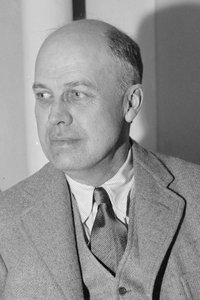
Edward Hopper
1931 - 1967 , États-Unis d'Amérique
En bref
- Artistes Influents:
- Ralph Waldo Emerson
- Édouard Manet
- Edgar Degas
- Date De Décès: 1967
- Date De Naissance: 22 juillet 1882
- Influence Sur Les Artistes: ['Pierre Sanford Ross']
- Lieu De Naissance: Upper Nyack, États-Unis
- Nationalité: Américaine
- Nom Complet: Edward Hopper
- Oeuvres Notables:
- House by the Railroad
- Nighthawks
- Gas
- Chop Suey
- Summertime
- Style Artistique: Réalisme américain
Articles connexes

Edward Hopper : Les 25 Œuvres Maîtresses d'un Artiste Américain Intemporel | OriginalUniqueArt
Plongez dans l'univers poignant d'Edward Hopper avec les 25 œuvres incontournables du maître américain. Découvrez la lumière, l'isolation et le réalisme unique de ses tableaux iconiques. Reproductions de qualité muséale sur OriginalUniqueArt.com. Explorez la collection en ligne.

Réalisme Américain : 10 Chefs-d'œuvre Incontournables pour une Déco Inspirée
Plongez au cœur du Réalisme Américain avec 10 chefs-d'œuvre d'Edward Hopper, Andrew Wyeth et plus. Découvrez l'histoire et les techniques de ces artistes emblématiques. Reproductions de tableaux de qualité musée sur OriginalUniqueArt.com !

The Unvarnished Truth: A Cultural Journey Through the Soul of American Realism
Explore the profound beauty of American Realism. From the Ashcan School's urban grit to intimate portraits, discover how artists captured the authentic soul of a nation through unvarnished truth and masterful observation.
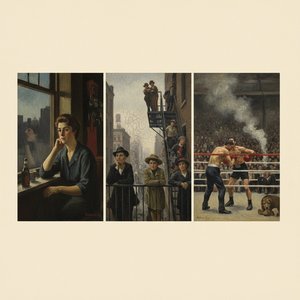
Le Réalisme Américain du XXe siècle : Un commentaire social et artistique poignant
Explorez le Réalisme Américain du XXe siècle : de l'Ashcan School à Hopper. Analyse approfondie des artistes, techniques et l'impact social de ce mouvement artistique puissant. Découvrez son héritage sur OriginalUniqueArt.
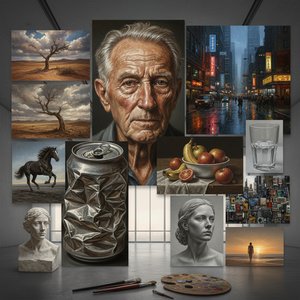
Réalisme Contemporain : Les 10 Chefs-d'œuvre Qui Ont Marqué l'Histoire de l'Art
Plongez au cœur du Réalisme Contemporain avec les 10 œuvres incontournables qui ont marqué l'histoire de l'art. Découvrez Lucian Freud, Gerhard Richter et bien d'autres ! Reproductions de qualité muséale sur .