 Aperçu en situation
 Envoyer
 Partager
 Détails de l'œuvre

 Télécharger
 Articles similaires
 Radiographie
 Diaporama
 Stats
StatsPeaceable Kingdom


 Lire la suite
Reproduction à l'huile faite à la main
Huile sur toile peinte à la main, avec cadre et dimensions personnalisés, réalisée sur commande par nos artistes. ( Switch to Print Switch to Digital Image)




P118B $10

P118H $10

P118W $10

P438Z $10

P508JH $12

P508YH $12

P805H $10

P805Z $10

P919BZ $10

P919G $10

P919XJ $10

P959ZH $10

P968JZ $12

W106C $8

W218G $10

W218JH $8

W218Y $10

W307PJ $10

W316G $10

W316PJ $8

W316Y $10

W398PJ $8

W4111J $10

W500HY $15

W500JH $15

W692G $12

W849H $8

W940BG $15

W953PJ $8




Choisissez parmi nos formats prédéfinis qui respectent les proportions originales de l’œuvre.

Vous pouvez saisir vos propres dimensions pour l'adapter à un cadre ou à un espace spécifique. Si la taille sélectionnée ne correspond pas aux proportions de l'image d'origine, nous recadrerons l'œuvre ou prolongerons la peinture avec des éléments peints à la main supplémentaires. Une maquette numérique vous sera envoyée pour approbation avant le début de la production.
Veuillez noter que l'aperçu à l'écran ne reflète pas le recadrage ou l'extension réels. Seule la maquette montrera fidèlement la composition finale.
Bien que des tailles personnalisées soient disponibles, nous vous recommandons de sélectionner une dimension dans la liste prédéfinie afin de préserver les proportions d'origine.
Après la commande, l’équipe OriginalUniqueArt.com contactera le client par e-mail pour recueillir ses instructions et lui fournira une maquette d’aperçu
Livraison dans le monde entier () en 3 à 4 semaines au lieu des 5 semaines habituelles. (8 septembre). Aucun compromis sur la qualité.

Livraison express gratuite dans le monde entier

Toile de lin de qualité supérieure

Assurance transport complète

Garantie de remboursement des droits de douane

Garantie de fidélité des couleurs

Politique de retour de 100 jours (uniquement en cas de défaut)

Garantie de remboursement à 100%

Offre de tarifs dégressifs
 L'option verre n'est disponible que pour les dimensions inférieures à 110 cm.

Peaceable Kingdom
Technique de reproduction
Format de la reproduction
-


Prix total
$ 300
A Pastoral Vision of Dominion: Edward Hicks’ “Peaceable Kingdom”
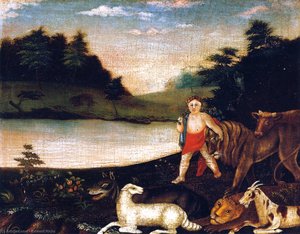
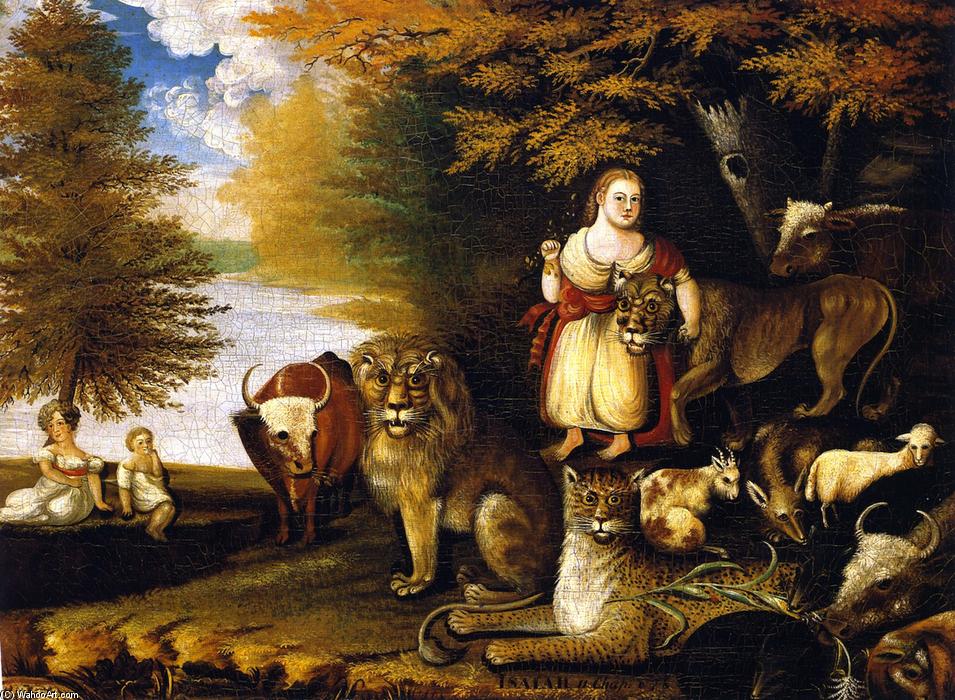
Edward Hicks' "Peaceable Kingdom," painted in 1830, is more than just a beautiful depiction of a rural landscape; it’s a profound meditation on faith, power, and the delicate balance between humanity and nature. This monumental oil painting, now a cornerstone of American art history, offers a glimpse into the heart of Quaker belief and Hicks' uniquely expressive artistic vision. The scene unfolds with an almost overwhelming sense of serenity – a vast meadow teeming with life, dominated by a central female figure holding aloft a symbolic crown or scepter. Lions, bulls, leopards, sheep, and cows gather around her, seemingly rendered docile and content under her watchful gaze. It’s a tableau that immediately evokes the grandeur of Renaissance allegories while retaining a distinctly American sensibility.
The Quaker Narrative: Faith as Foundation
Understanding Hicks' artistic practice requires acknowledging his deep connection to the Religious Society of Friends, or Quakers. Born into an Anglican family but raised by the devout Matron Elizabeth Twining, Hicks’ life was fundamentally shaped by their core tenets – simplicity, peace, and a belief in the “inner light” – that resided within each individual. "Peaceable Kingdom" isn't simply a landscape; it’s a visual representation of this spiritual philosophy. The central figure is often interpreted as representing Christ or Providence, embodying divine authority and offering a message of reconciliation and harmony. The animals, traditionally symbols of earthly power and potential conflict, are rendered peaceful and obedient, suggesting that true dominion comes not through force but through grace and understanding.
Technique and Composition: A Masterclass in Detail
Hicks’ masterful technique is immediately apparent upon close inspection. The painting is executed in the rich, layered style of oil paint, utilizing a meticulous approach to detail that was characteristic of his work. He employs a carefully constructed composition, drawing the eye towards the central figure through strategic use of light and shadow. The receding planes of land and trees create a sense of depth, while the vibrant colors – dominated by warm golds, browns, and reds – contribute to the painting’s overall warmth and inviting quality. Noticeably, Hicks utilizes impasto in certain areas, particularly within the foliage and animal fur, adding textural richness and emphasizing the tactile nature of the scene. The flattened perspective, reminiscent of earlier Renaissance styles, is skillfully balanced by a dynamic arrangement of figures and elements, preventing the composition from feeling static.
Symbolism Unveiled: A Tapestry of Meaning
Beyond its immediate visual appeal, “Peaceable Kingdom” is laden with symbolic meaning. The animals themselves carry significant weight – the lion representing strength, the bull symbolizing fertility and earthly power, the leopard embodying cunning and vigilance, while sheep represent innocence and vulnerability. The woman’s crown or scepter isn't merely a symbol of authority; it represents the divine right to rule, not through coercion but through benevolent guidance. The presence of two women seated beneath the tree on the left side adds another layer of interpretation, potentially representing the role of female wisdom and nurturing within this harmonious landscape. Even the body of water reflecting the sky reinforces the theme of interconnectedness – mirroring the heavens in the earth below.
“Peaceable Kingdom” remains a powerful testament to Edward Hicks’ artistic vision and his unwavering faith. It's a painting that invites contemplation, prompting viewers to consider their own relationship with nature, power, and the enduring promise of peace. Reproductions offer an accessible way to experience this remarkable work of art, bringing its serene beauty and profound symbolism into any space.
Biographie de l'artiste
Première Vie et Contexte
- Né: 4 avril 1780, à Attleboro (aujourd'hui Langhorne), comté de Bucks, Pennsylvanie
- Décédé: 23 août 1849
- Ses parents étaient anglicans, mais il a été élevé par Matron Elizabeth Twining, une quaker. Cela l'a introduit aux croyances des quakers à un jeune âge.
- Apprenti chez William et Henry Tomlinson, fabricants de calèches, dès l'âge de treize ans, où il a appris les techniques de peinture de carrosserie.
- A quitté la firme en 1800 pour travailler indépendamment comme peintre de maisons et de carrosseries.
Ministère Quaker et Développement Artistique
- Accepté dans la Société des Amis en 1803 et a commencé à assister régulièrement aux réunions des quakers.
- A épousé Sarah Worstall, également quaker, et est devenu prédicateur itinérant dans tout Philadelphie.
- Pour subvenir aux besoins de sa famille, il a élargi sa peinture pour inclure des objets ménagers, du matériel agricole et des enseignes de tavernes.
- A brièvement abandonné la peinture ornementale en 1815 en raison de difficultés financières, mais l'a reprise en 1816.
Style Artistique et Œuvres Clés
- Artiste Autodidacte: Hicks était largement autodidacte, développant un style d'art populaire unique.
- Influence Quaker: Son travail reflétait les croyances des quakers en la "lumière intérieure", mettant l'accent sur l'expérience spirituelle personnelle. Cela se manifeste dans ses compositions simples et son accent mis sur la nature.
- La Série du Royaume Pacifique: Sa série la plus célèbre, comprenant 62 versions, dépeint une vision de l'harmonie entre les humains et les animaux, représentant la paix et la coexistence.
- Tableaux Notables:
- Royaume Pacifique (31) – Exposé à la Yale University Art Gallery
- Chutes du Niagara – Exposé au Abby Aldrich Rockefeller Folk Art Center
- George Washington avec son armée traversant le Delaware – Également exposé au Abby Aldrich Rockefeller Folk Art Center
- Royaume Pacifique (34) - Dépeint l'arche de Noé dans une peinture à l'huile sereine.
- Tombe de William Penn à Jordans en Angleterre - Une représentation de la campagne anglaise mettant en valeur le patrimoine quaker.
Héritage et Importance Historique
- Icône de l'Art Populaire: Edward Hicks est reconnu comme une figure importante de l'art populaire américain, connu pour son style distinctif et ses thèmes récurrents.
- Représentation des Valeurs Quaker: Ses peintures fournissent des informations précieuses sur les croyances et les valeurs de la Société des Amis au XIXe siècle.
- Vision Artistique Unique: Hicks a mélangé la foi religieuse à l'expression artistique, créant un ensemble d'œuvres qui sont à la fois visuellement attrayantes et spirituellement significatives.
- Appréciation Continue: Ses œuvres sont exposées dans les principaux musées et continuent d'être étudiées et appréciées pour leur importance historique et artistique.

Edward Hicks
1780 - 1849 , États-Unis d'Amérique
L'essentiel de l'artiste
- Artistic Movement Or Style: Art populaire
- Date De Décès: 23 août 1849
- Date De Naissance: 4 avril 1780
- Full Name: Edward Hicks
- Nationalité: Américain
- Notable Artworks:
- Peaceable Kingdom (31)
- Falls of Niagara
- George Washington Crossing Delaware
- Peaceable Kingdom of the Branch
- Grave of William Penn
- Place De Naissance (Ville Et Pays): Attleboro, États-Unis
Articles connexes

Edward Hicks’ ‘Peaceable Kingdom’: American Folk Art & the Shaping of a National Identity
Explore the profound symbolism & historical context of Edward Hicks’ ‘Peaceable Kingdom.’ Discover how this iconic American folk art masterpiece reflects Quaker values and shaped a nation's identity. Learn more at OriginalUniqueArt.
The Soul of Tradition: Exploring the Vibrant Heritage and Naive Mastery of Global Folk Art
Discover the profound beauty of folk art through a cultural lens. Explore how naive masterpieces and vibrant global traditions preserve heritage, offering timeless inspiration for collectors and art enthusiasts seeking authenticity and soul in every brushstroke.
Les 10 Chefs-d'œuvre du XIXe Siècle : Artistes et Décor Intemporels
Plongez au cœur du XIXe siècle avec les 10 œuvres incontournables de Manet, Monet et Renoir. Découvrez l'histoire, les techniques et l'émotion derrière ces chefs-d'œuvre impressionnistes et réalistes. Trouvez votre reproduction idéale sur OriginalUniqueArt.com !
Edward Hopper : Les 25 Œuvres Maîtresses d'un Artiste Américain Intemporel | OriginalUniqueArt
Plongez dans l'univers poignant d'Edward Hopper avec les 25 œuvres incontournables du maître américain. Découvrez la lumière, l'isolation et le réalisme unique de ses tableaux iconiques. Reproductions de qualité muséale sur OriginalUniqueArt.com. Explorez la collection en ligne.
Échos de Tradition : L'Héritage Durable des Mouvements Folkloriques dans l'Art
Explorez l'héritage durable des mouvements folkloriques dans l'art ! Découvrez les traditions populaires à travers le monde, les techniques artisanales et les musées qui préservent ce patrimoine unique. Un voyage culturel enrichissant.