Passer au format impression
 Lire la suite







































 Pour les œuvres ou reproductions dont un côté mesure plus de 105 cm (environ 41 pouces), le cadre sera expédié sous forme de kit démonté. Cette méthode garantit une livraison sécurisée et prévient tout dommage pendant le transport.


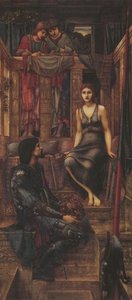
A Vision of Myth and Beauty: Edward Burne-Jones’s “Study for The Sirens”
Edward Coley Burne-Jones, a pivotal figure bridging the romantic currents of the Pre-Raphaelite Brotherhood with the burgeoning aesthetic sensibilities of late Victorian England, possessed an extraordinary ability to conjure worlds both fantastical and deeply human. His art wasn't merely decorative; it was a deliberate exploration of myth, symbolism, and the very essence of beauty. Among his most captivating works is this exquisite “Study for The Sirens,” a preparatory drawing that offers a tantalizing glimpse into the genesis of a monumental painting—a testament to Burne-Jones’s meticulous process and profound artistic vision. This particular study, recently rediscovered and now held within the Ringling Museum of Art in Sarasota, Florida, reveals not just a sketch but a carefully considered meditation on desire, temptation, and the alluring power of the unknown.
The drawing itself is executed with remarkable delicacy in black and red chalk, upon a sheet of high-quality paper. Burne-Jones’s hand moves with confident fluidity, capturing the subtle nuances of form and gesture with breathtaking precision. The composition—a partial view of two figures, a young man and a woman, seated on a grassy bank beside a stream—is deceptively simple yet brimming with latent drama. Notice the loose, expressive lines that define the contours of their bodies, suggesting both vulnerability and an underlying current of sensuality. The artist’s attention to detail is immediately apparent in the rendering of the foliage, the flowing water, and the delicate folds of fabric – elements that contribute significantly to the overall atmosphere of the piece.
Echoes of Mythology and Pre-Raphaelite Sensibilities
“The Sirens,” as Burne-Jones envisioned it, was deeply rooted in Greek mythology. The sirens were mythical creatures—often depicted as beautiful women whose enchanting songs lured sailors to their doom. However, Burne-Jones’s interpretation transcends the traditional cautionary tale. This study hints at a more complex narrative – one of irresistible attraction and the perilous allure of beauty. The figures are not presented as victims but as active participants in a scene of quiet contemplation, suggesting an awareness of the potential consequences of their encounter. The composition draws heavily on Pre-Raphaelite conventions: the emphasis on naturalism, the idealized portrayal of the human form, and the incorporation of classical motifs – all hallmarks of Burne-Jones’s distinctive style.
The influence of Dante Gabriel Rossetti is also palpable in this study. Like Rossetti, Burne-Jones was fascinated by medieval romance and folklore, and he frequently drew inspiration from Arthurian legends and other mythological tales. The use of rich colors, the dramatic lighting, and the evocative atmosphere all contribute to a sense of heightened emotion and psychological intensity – qualities that are characteristic of both artists’ work. The drawing's intimate scale further enhances its emotional impact, inviting the viewer to step into the scene and contemplate the unspoken desires and anxieties of the figures depicted.
A Window into the Artist’s Process
What makes this particular “Study for The Sirens” so compelling is that it offers a rare glimpse into Burne-Jones's creative process. It’s not a finished masterpiece but rather a preliminary sketch—a series of studies and drawings that he created as he developed his ideas for larger works. The drawing reveals the artist’s initial thoughts, experiments with composition, and adjustments to the figures’ poses and expressions. The fact that this particular study was previously misidentified as being by the circle of Augustus John adds an intriguing layer of historical complexity to its story.
Further research into Burne-Jones's work reveals a fascinating connection to the Institute for Advanced Study in Princeton, where scholars from across Europe sought refuge and intellectual stimulation during the tumultuous years following World War I. Burne-Jones’s own life was marked by both artistic triumph and personal tragedy – his marriage to Georgiana MacDonald ended in heartbreak after her death, and he struggled with bouts of depression throughout his career. Despite these challenges, he remained a prolific artist, producing some of the most enduring images of the Victorian era. The rediscovery of this “Study for The Sirens” serves as a poignant reminder of Burne-Jones’s extraordinary talent and his lasting contribution to the world of art.
A Timeless Appeal
“Study for The Sirens” is more than just a drawing; it's an invitation to lose oneself in a world of myth, beauty, and psychological depth. Its evocative atmosphere, masterful technique, and profound symbolism continue to resonate with viewers today. Whether you are an art collector seeking a rare and significant addition to your collection, or simply an admirer of Victorian art, this exquisite study offers a unique opportunity to connect with one of the most celebrated artists of the 19th century. Reproductions of this piece capture the essence of Burne-Jones’s vision, allowing you to bring its timeless beauty into your home or office.
Questions et réponses
Quelle nuance dominante traverse «Study for» de Edward Coley Burne-Jones ?
«Study for» tend vers une nuance De l'ambre au safran.
«Study for» de Edward Coley Burne-Jones est-il une peinture, un dessin ou une estampe ?
«Study for» de Edward Coley Burne-Jones est classé comme Décoration murale. Cette catégorie définit la nature de l'œuvre originale.
Qui est l'auteur de "Study for" ?
« Study for » a été créé par Edward Coley Burne-Jones. Les informations présentes sur cette page décrivent l'œuvre originale de Edward Coley Burne-Jones.
 Aperçu en situation
 Envoyer
 Partager
 Détails de l'œuvre
 Guide
Guide

 Télécharger l'image
 Articles similaires
 Radiographie
 Diaporama
 Questions et réponses
 Statistiques