

 Aperçu en situation
 Partager
 Partager
 Détails
 Guide imprimable

 Télécharger
 Articles similaires
 Radiographie
 Voir le diaporama
 Statistiques
Chief David Shoppenegons


 Afficher la suite
Giclées et impressions d'art
Impressions giclées ou sur toile de qualité musée, avec une production rapide et des finitions au choix. ( Acheter la peinture faite à la main Passer au format image numérique)




P118B $10

P118H $10

P118W $10

P438Z $10

P508JH $12

P508YH $12

P805H $10

P805Z $10

P919BZ $10

P919G $10

P919XJ $10

P959ZH $10

P968JZ $12

W106C $8

W218G $10

W218JH $8

W218Y $10

W307PJ $10

W316G $10

W316PJ $8

W316Y $10

W398PJ $8

W4111J $10

W500HY $15

W500JH $15

W692G $12

W849H $8

W940BG $15

W953PJ $8




Choisissez parmi nos formats prédéfinis qui respectent les proportions originales de l’œuvre.

Vous pouvez saisir vos propres dimensions pour vous adapter à un cadre ou à un espace spécifique. Si la taille sélectionnée ne correspond pas aux proportions de l'image originale, nous recadrerons l'œuvre ou étendrons l'image avec une bordure en miroir ou une couleur unie. Une maquette numérique vous sera envoyée pour approbation avant le début de la production.
Veuillez noter que l'aperçu à l'écran ne reflète pas le recadrage ou l'extension réelle. Seule la maquette montrera avec précision la composition finale.
Bien que des tailles personnalisées soient disponibles, nous vous recommandons de choisir une dimension dans la liste prédéfinie afin de préserver les proportions originales.
Livraison dans le monde entier () en 2 semaines au lieu des 4/5 semaines habituelles. (26 septembre)

Livraison express gratuite dans le monde entier

Toile de lin de haute qualité

Assurance transport complète

Garantie de remboursement des droits de douane

Garantie de fidélité des couleurs

Garantie de retour de 100 jours (uniquement en cas de défaut)

Garantie de remboursement à 100%

Tarifs dégressifs sur quantité
 L'option verre n'est disponible que pour les dimensions inférieures à 110 cm.

Chief David Shoppenegons
Giclées et impressions d'art
Format de la reproduction
-


Prix total final
$ 80
The Soul of the Southwest: Eanger Irving Couse’s “Chief David Shoppenegons”
Eanger Irving Couse's "Chief David Shoppenegons," painted in 1911, is more than just a portrait; it’s a profound meditation on cultural encounter and the enduring spirit of the American West. This arresting canvas, currently residing within the Detroit Institute of Arts, captures not merely a likeness but an essence—the quiet dignity and inherent wisdom of Chief David Shoppenegons, a prominent figure in the Chippewa tribe of Michigan. Couse’s decision to focus on this Native American subject was revolutionary for his time, reflecting a genuine desire to move beyond stereotypical depictions and instead offer a respectful portrayal rooted in observation and empathy.
Couse's artistic journey is inextricably linked to his fascination with the Chippewa people of Michigan. Born in Saginaw, he spent much of his childhood observing their traditions and customs, fostering a deep respect that profoundly shaped his artistic vision. This early exposure informed his approach to painting Native Americans – he didn’t simply sketch them; he sought to understand their lives, their beliefs, and their connection to the land. His time in Taos, New Mexico, further solidified this commitment, allowing him to immerse himself within a thriving artist community dedicated to capturing the beauty and complexity of Southwestern life.
A Masterclass in Impressionistic Detail
Technically, “Chief David Shoppenegons” exemplifies Couse’s signature style – a harmonious blend of academic training with the vibrant colors and loose brushwork characteristic of Impressionism. The painting is rendered in oil on canvas, utilizing a palette dominated by earthy tones—rich browns, ochres, and deep greens—that evoke the rugged landscape of the American Southwest. Couse masterfully employs broken color techniques, layering thin washes of paint to create a luminous effect, particularly noticeable in the folds of Shoppenegons’ coat and the dappled light filtering through the trees behind him. The brushstrokes are visible yet controlled, contributing to a sense of immediacy and movement.
The composition itself is carefully considered. Shoppenegons stands with a commanding presence, his posture conveying both strength and serenity. His gaze, directed slightly off-canvas, suggests contemplation and an awareness of the world around him. The dark background serves to isolate the figure, drawing attention to his face and emphasizing his connection to the land. Couse’s meticulous attention to detail—the texture of the fabric, the lines etched on Shoppenegons' face—adds a layer of realism that elevates the portrait beyond mere representation.
Symbolism and Cultural Resonance
Beyond its technical brilliance, “Chief David Shoppenegons” is rich in symbolic meaning. The staff or cane he holds represents his authority as a leader and his connection to the traditions of his people. The simple brown coat speaks to practicality and resilience – qualities deeply valued within Native American culture. More subtly, the setting—a sparsely wooded area—suggests a deep respect for nature, reflecting the interconnectedness between humans and the environment that is central to many indigenous belief systems.
It’s important to note that Couse's work was not without its complexities. While his intention was undoubtedly respectful, some critics have questioned whether fully capturing the nuances of Native American culture through a Western lens was truly possible. However, “Chief David Shoppenegons” remains a significant achievement—a testament to Couse’s artistic skill and his pioneering efforts to bridge cultural divides through art.
Bringing "Chief David Shoppenegons" into Your Space
Reproductions of “Chief David Shoppenegons” offer a beautiful way to bring the spirit of the Southwest into your home or office. Whether you choose a hand-painted reproduction or a high-quality print, this iconic image will serve as a constant reminder of the beauty and resilience of Native American culture. Its evocative colors and powerful composition make it an ideal addition to any room—a conversation starter and a source of inspiration. Consider framing it in a natural wood frame to further enhance its connection to the landscape.
For those seeking more information about Eanger Irving Couse and his work, we encourage you to explore the resources listed below:
Biographie de l'artiste
Première Vie et Formation
- Né: 3 septembre 1866, Saginaw, Michigan
- Décédé: 26 avril 1936
- Origine: Saginaw, États-Unis d'Amérique
- Un intérêt précoce pour les cultures amérindiennes s’est développé pendant son enfance à proximité des tribus Chippewa.
- A brièvement fréquenté l'Art Institute de Chicago puis la National Academy of Design à New York City.
- A étudié à l'École des Beaux-Arts et à l'Académie Julian sous William-Adolphe Bouguereau à Paris pendant dix ans. Il a principalement peint des paysages de la côte normande.
Carrière Artistique et Développement
- Après son retour aux États-Unis, il a passé du temps à New York City et a peint chaque été dans divers endroits.
- A commencé à passer les étés à Taos, au Nouveau-Mexique, vers 1898.
- A étudié et peint la vie et la culture des Indiens de Taos.
- Est devenu membre fondateur et premier président de la Taos Society of Artists en 1915.
- A développé un style distinctif représentant la vie amérindienne, soulignant souvent des scènes paisibles et idylliques.
- Son travail a été influencé par sa formation académique à Paris et par ses observations de la culture amérindienne.
Œuvres Majeures et Reconnaissance
- Elk-foot of the Taos Tribe: Considéré comme son chef-d'œuvre, acheté pour la collection nationale d’art des États-Unis.
- The Captive: Œuvre de jeunesse représentant un sujet amérindien, exposée au Salon de Paris en 1892.
- De nombreuses peintures commandées par le Santa Fe Railway entre 1914 et 1936, utilisées comme matériel publicitaire.
- A reçu des prix décernés par diverses institutions, dont la National Academy of Design (Altman Prize), le Salmagundi Club (Isidor Prize) et la Pennsylvania Academy of Fine Arts (Lippincott Prize).
- Ses œuvres sont conservées dans de nombreux musées à travers les États-Unis et à l'international.
Signification Historique et Héritage
- A contribué de manière significative au développement de l’art américain de l’Ouest, en particulier les représentations des Amérindiens.
- A aidé à établir Taos comme un centre artistique important.
- Sa représentation de la vie amérindienne a offert une perspective différente de celles plus stéréotypées courantes à l'époque.
- La maison et l’atelier d’Eanger Irving Couse—Joseph Henry Sharp Studios sont inscrits au registre national des lieux historiques, préservant ainsi son héritage pour les générations futures.
- Son travail continue d’être exposé et étudié, fournissant un aperçu de l'histoire de l'art américain et de la représentation culturelle.
Vie Personnelle
- A épousé Virginia Walker en 1889.
- A eu un fils, Kibbey Couse.
- Virginia a joué un rôle important dans le soutien à sa carrière artistique et a fourni des critiques constructives.
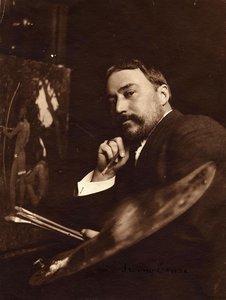
Eanger Irving Couse
1866 - 1936 , États-Unis d'Amérique
En bref
- Artistes Influents:
- William-Adolphe Bouguereau
- Tony Robert Fleury
- Date De Décès: 26 avril 1936
- Date De Naissance: 3 septembre 1866
- Lieu De Naissance: Saginaw, États-Unis
- Mouvement Artistique: Impressionnisme
- Nationalité: Américain
- Nom Complet: Eanger Irving Couse
- Œuvres Notables:
- Elk-foot of the Taos tribe
- Taos pueblo - moonlight
- The captive
Articles similaires

Grant Wood & American Regionalism: Identity, Myth & the Rural Landscape
Explore the world of Grant Wood & American Regionalism with OriginalUniqueArt. Discover the symbolism behind 'American Gothic', recurring themes, and the movement's lasting impact on art history. High-quality reproductions available.
Eanger Irving Couse: Bridging Tradition & Modernity in American Southwest Art
Explore the life & art of Eanger Irving Couse, a pivotal figure in Southwestern Impressionism and founder of the Taos Society of Artists. Discover his captivating paintings & legacy.
James Otto Lewis: Navigating American Modernism Through Regional Identity & Stylistic Innovation
Explore the captivating portraits of James Otto Lewis, a pivotal figure bridging 19th-century realism & American Modernism. Discover his groundbreaking work documenting Native American culture and regional identity.
Joseph Henry Sharp: Capturing the Spirit of the Plains – Life, Art & Legacy
Explore the life & art of Joseph Henry Sharp, a founding member of the Taos Society of Artists renowned for his realistic depictions of Native American culture and Western landscapes. Discover his legacy with OriginalUniqueArt.

Réalisme Américain : 10 Chefs-d'œuvre Incontournables pour une Déco Inspirée
Plongez au cœur du Réalisme Américain avec 10 chefs-d'œuvre d'Edward Hopper, Andrew Wyeth et plus. Découvrez l'histoire et les techniques de ces artistes emblématiques. Reproductions de tableaux de qualité musée sur OriginalUniqueArt.com !

