Commander l'impression Acheter l'image haute résolution
 Partager
 Partager
 Détails de l'œuvre
 Ajouter aux favoris

 Télécharger
 Articles similaires
 Radiographie
 Diaporama
Ju Jitsu
 Oil On Board
- Cubism
 1913
1913- Late Medieval
 62.0 x 62.0 cm
 Tate Liverpool
 Afficher la suite
Reproduction à l'huile faite à la main
Huile sur toile peinte à la main, avec cadre et dimensions personnalisés, réalisée sur commande par nos artistes.




P118B $10

P118H $10

P118W $10

P438Z $10

P508JH $12

P508YH $12

P805H $10

P805Z $10

P919BZ $10

P919G $10

P919XJ $10

P959ZH $10

P968JZ $12

W106C $8

W218G $10

W218JH $8

W218Y $10

W307PJ $10

W316G $10

W316PJ $8

W316Y $10

W398PJ $8

W4111J $10

W500HY $15

W500JH $15

W692G $12

W849H $8

W940BG $15

W953PJ $8




Choisissez parmi nos formats prédéfinis qui respectent les proportions originales de l’œuvre.

Vous pouvez saisir vos propres dimensions pour l'adapter à un cadre ou à un espace spécifique. Si la taille sélectionnée ne correspond pas aux proportions de l'image d'origine, nous recadrerons l'œuvre ou prolongerons la peinture avec des éléments peints à la main supplémentaires. Une maquette numérique vous sera envoyée pour approbation avant le début de la production.
Veuillez noter que l'aperçu à l'écran ne reflète pas le recadrage ou l'extension réels. Seule la maquette montrera fidèlement la composition finale.
Bien que des tailles personnalisées soient disponibles, nous vous recommandons de sélectionner une dimension dans la liste prédéfinie afin de préserver les proportions d'origine.
Après la commande, l’équipe OriginalUniqueArt.com contactera le client par e-mail pour obtenir ses instructions et lui fournira une maquette d’aperçu.
Livraison dans le monde entier () en 3 à 4 semaines au lieu des 5 semaines habituelles. (21 juillet). Aucune concession sur la qualité.

Livraison express gratuite dans le monde entier

Toile de lin de haute qualité

Assurance transport complète

Garantie de remboursement des frais de douane

Garantie de fidélité des couleurs

Politique de retour de 60 jours (uniquement en cas de défaut)

Garantie de remboursement à 100%

Réduction sur les achats groupés
 L'option verre n'est disponible que pour les dimensions inférieures à 110 cm.

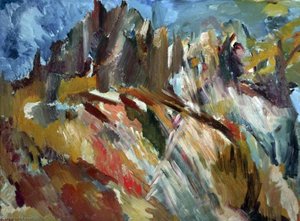
Ju Jitsu
Technique de reproduction
Format de reproduction
-


Prix total final
-
Description de l'œuvre
David Bomberg’s ‘Ju Jitsu’: A Fragmented Dance of Energy
David Bomberg's 1913 painting, “Ju Jitsu,” is not merely a depiction of a martial art; it’s a dynamic exploration of form, movement, and the very essence of human interaction. Captured on a relatively small board – measuring just 62 x 62 cm – the work explodes with an arresting energy that belies its modest scale. Bomberg, a key figure within the ‘Whitechapel Boys,’ a group of East End artists pushing against established artistic conventions, presents us with a collage-like composition featuring four figures engaged in what appears to be a grappling match. However, this isn’t a straightforward representation; instead, Bomberg employs a fractured, almost Cubist approach, layering torso and arm fragments against each other, creating an illusion of simultaneous action and spatial ambiguity.
The muted color palette – dominated by ochres, browns, and greys – contributes significantly to the painting’s subdued yet powerful atmosphere. This deliberate restraint allows the geometric forms and the implied movement to take center stage. The checkered backdrop, a subtle but effective element, adds depth and reinforces the sense of fragmented space, mirroring the disjointed nature of the figures themselves. Bomberg's use of line is particularly striking; bold, angular strokes define the contours of the bodies, conveying both strength and vulnerability. The painting’s roots lie in the burgeoning avant-garde movements of the early 20th century – Cubism, Futurism, and Constructivism – all of which sought to break down traditional representation and explore new ways of perceiving and depicting reality.
Influences and Artistic Context
Bomberg’s artistic journey was shaped by a diverse range of influences. His early training at the City and Guilds Technical Art School provided a foundational understanding of technique, while his time under Walter Sickert at Westminster School of Art instilled in him an appreciation for form and urban life – elements that would later inform his own distinctive style. Crucially, Bomberg’s exposure to Paul Cézanne through the 1910 Roger Fry exhibition “Manet and the Post-Impressionists” proved transformative, introducing him to Cézanne's emphasis on geometric simplification and the exploration of underlying structure. This influence is evident in Bomberg’s own use of fragmented forms and his focus on capturing essential shapes rather than detailed representations.
Furthermore, Bomberg was deeply engaged with the radical artistic currents circulating at the Slade School of Art during this period. Alongside contemporaries like Mark Gertler and Stanley Spencer, he experimented with abstract geometric compositions, drawing inspiration from the Futurists’ celebration of dynamism and movement. The painting “Ju Jitsu” stands as a testament to this experimental spirit, embodying Bomberg's willingness to challenge conventional artistic norms and explore new visual languages.
Decoding the Symbolism
While ostensibly depicting a scene of physical combat, "Ju Jitsu" transcends a simple representation of martial arts. The fragmented figures can be interpreted as symbols of human interaction – the struggle for dominance, the interplay of power and vulnerability, and the inherent tension between individuals. The act of grappling itself represents a negotiation, a yielding and resisting, mirroring the broader themes of conflict and resolution that permeate human experience. Considering Bomberg’s background as a Jewish immigrant in London's East End, one might also read the painting as an exploration of identity and resilience within a rapidly changing urban landscape.
The painting’s abstraction further enhances its symbolic resonance. By stripping away extraneous details and focusing on essential forms, Bomberg invites viewers to engage with the underlying dynamics of the scene – to contemplate the forces at play and to project their own interpretations onto the composition. The lack of a clear narrative or resolution encourages active participation from the viewer, transforming the painting into a dynamic meditation on human interaction.
A Legacy of Innovation
“Ju Jitsu” is more than just a striking visual work; it’s a pivotal example of David Bomberg's artistic evolution. It represents a crucial stage in his development as an abstract painter, bridging the gap between his early training and his later explorations of landscape and portraiture. The painting’s bold geometric forms, dynamic composition, and muted color palette established Bomberg as a leading figure within the British avant-garde, paving the way for future generations of artists to push the boundaries of artistic expression. Reproductions of this captivating work offer a unique opportunity to experience the energy and innovation of one of Britain's most important 20th-century painters.
Biographie de l'artiste
Jeunesse et Formation Artistique
- Né : Birmingham, Royaume-Uni (5 décembre 1890)
- Décédé : Londres, Royaume-Uni (19 août 1957)
- L'un des 'Whitechapel Boys' – un groupe d'artistes de l'East End qui ont émergé au début du XXe siècle.
Né dans une famille immigrante polonaise-juive, Abraham et Rebecca Bomberg, à Birmingham. La famille a déménagé à Whitechapel, Londres, en 1895.
A étudié initialement à la City and Guilds Technical Art School avant de se former comme lithographe à Birmingham.
A étudié sous Walter Sickert à Westminster School of Art (1908-1910), où il a été influencé par l'accent mis par Sickert sur la forme et la vie urbaine.
Exposition significative à Paul Cézanne grâce à l'exposition de 1910 de Roger Fry "Manet et les post-impressionnistes".
A fréquenté la Slade School of Art (1911), remportant le prix Tonks pour son dessin du camarade étudiant Isaac Rosenberg.
Les Années d'Avant-Garde : Cubisme, Futurisme et Controverse
- À la Slade, Bomberg faisait partie d'une génération remarquable comprenant Mark Gertler, Stanley Spencer, C.R.W. Nevinson et Dora Carrington.
- Influencé par les expositions londoniennes de 1912 des Futurs italiens et la deuxième exposition post-impressionniste de Fry (Picasso, Matisse, Fauves, Wyndham Lewis).
- A développé un style distinctif combinant le Cubisme et le Futurisme – caractérisé par des compositions géométriques, des palettes de couleurs limitées, des figures angulaires et des structures en forme de grille.
- Son approche radicale a conduit à son expulsion de la Slade School of Art en 1913, jugé trop audacieux pour les méthodes conventionnelles de l'institution.
- A été brièvement associé à l'Omega Workshops du Bloomsbury Group et a exposé avec le Camden Town Group.
- A montré une affinité avec le mouvement Vorticiste de Wyndham Lewis mais est resté indépendant, refusant toute implication complète.
De la Guerre au Paysage : Un Changement de Style
Les expériences en tant que soldat pendant la Première mondiale ont profondément influencé sa vision artistique, conduisant à un éloignement de l'abstraction.
Dans les années 1920, Bomberg a adopté un style plus figuratif, se concentrant sur des portraits et des paysages tirés directement de la nature.
A développé une technique expressionniste de plus en plus marquée, caractérisée par un impasto texturé et une intensité émotionnelle.
De nombreux voyages à travers le Moyen-Orient (en particulier la Palestine) et l'Europe ont considérablement influencé son œuvre ultérieure. Ses représentations de Jérusalem sont particulièrement notables.
Les Dernières Années et Héritage
- De 1945 à 1953, a enseigné à Borough Polytechnic (aujourd'hui London South Bank University), influençant une génération d'artistes dont Frank Auerbach, Leon Kossoff, Philip Holmes, Cliff Holden, Edna Mann, Dorothy Mead, Gustav Metzger, Dennis Creffield, Cecil Bailey et Miles Richmond.
- A épousé la peintre de paysages Lilian Holt.
- Malgré des périodes d'obscurité relative pendant sa vie, l'œuvre de Bomberg a acquis une reconnaissance croissante ces dernières décennies en tant que contribution significative à l'art britannique moderne.
- La David Bomberg House se trouve à London South Bank University en son honneur.
- Son héritage réside dans sa synthèse unique des mouvements d'avant-garde européens et son développement ultérieur d'un style de paysage puissant et expressif qui capturait l'essence du lieu et de l'expérience humaine.

David Bomberg
1890 - 1957 , Royaume-Uni
En bref
- Artistes Influencés:
- Frank Auerbach
- Leon Kossoff
- Artistes Influents:
- Paul Cézanne
- Walter Sickert
- Date De Décès: 19 août 1957
- Date De Naissance: 5 décembre 1890
- Lieu De Naissance: Birmingham, Royaume-Uni
- Mouvement Artistique:
- Cubisme
- Futurisme
- Expressionnisme
- Nationalité: Britannique
- Nom Complet: David Garshen Bomberg
- Oeuvres Notables:
- Self Portrait (1937)
- Jerusalem
- Kitty...
Articles connexes
David Bomberg: Reassessing the Pioneering Spirit of Early British Abstraction
Explore the groundbreaking work of David Bomberg, a pivotal figure in British abstraction. Discover his artistic evolution, influences, and lasting legacy through insightful analysis & expert commentary.
Déconstruire la réalité : L'impact révolutionnaire du cubisme sur l'art du XXe siècle
Explorez l'impact révolutionnaire du cubisme sur l'art moderne. Découvrez Picasso, Braque et les secrets de ce mouvement artistique majeur. Conseils d'experts pour collectionner des œuvres cubistes authentiques.

Deconstructing Reality: Cubism's Evolution, Impact & Enduring Legacy
Explore the revolutionary world of Cubism with expert insights from OriginalUniqueArt. Discover Picasso & Braque's groundbreaking techniques, its philosophical roots, and lasting impact on modern art. Expert appraisal & custom reproductions available.
Déconstruction de la réalité : L'évolution et l'impact du cubisme synthétique
Explorez l'évolution du cubisme synthétique avec OriginalUniqueArt : Picasso, Braque et les papiers collés décryptés. Guide pour collectionneurs avertis et passionnés d'art moderne.
Déconstruction de la réalité : L'impact révolutionnaire du cubisme sur l'art du XXe siècle
Explorez l'impact révolutionnaire du cubisme sur l'art moderne. Découvrez Picasso, Braque et les maîtres de ce mouvement clé. Guide pour collectionneurs éclairés.