

 Aperçu en situation
 Envoyer
 Partager
 Détails de l'œuvre

 Télécharger
 Articles similaires
 Radiographie
 Diaporama
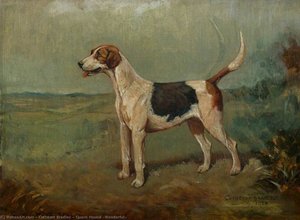
'Fallible' and 'Ranter'
 1926
1926 31.0 x 49.0 cm
 Lire la suite
Reproduction à l'huile faite à la main
Huile sur toile peinte à la main, avec cadre et dimensions personnalisés, réalisée sur commande par nos artistes. ( Commander l'impression Acheter l'image haute résolution)




































Choisissez parmi nos formats prédéfinis qui respectent les proportions originales de l’œuvre.

Vous pouvez saisir vos propres dimensions pour l'adapter à un cadre ou à un espace spécifique. Si la taille sélectionnée ne correspond pas aux proportions de l'image d'origine, nous recadrerons l'œuvre ou prolongerons la peinture avec des éléments peints à la main supplémentaires. Une maquette numérique vous sera envoyée pour approbation avant le début de la production.
Veuillez noter que l'aperçu à l'écran ne reflète pas le recadrage ou l'extension réels. Seule la maquette montrera fidèlement la composition finale.
Bien que des tailles personnalisées soient disponibles, nous vous recommandons de sélectionner une dimension dans la liste prédéfinie afin de préserver les proportions d'origine.
Après la commande, l’équipe OriginalUniqueArt.com contactera le client par e-mail pour recueillir ses instructions et lui fournira une maquette d’aperçu
Livraison dans le monde entier () en 3 à 4 semaines au lieu des 5 semaines habituelles. (29 août). Aucun compromis sur la qualité.

Livraison express gratuite dans le monde entier

Toile de lin de qualité supérieure

Assurance transport complète

Garantie de remboursement des droits de douane

Garantie de fidélité des couleurs

Politique de retour de 60 jours (uniquement en cas de défaut)

Garantie de remboursement à 100%

Offre de tarifs dégressifs
 L'option verre n'est disponible que pour les dimensions inférieures à 110 cm.

'Fallible' and 'Ranter'
Technique de reproduction
Format de la reproduction
-


Prix total
$ 325
Biographie de l'artiste
The Painter of Sporting Elegance
Cuthbert Bradley was far more than a mere chronicler of the English countryside; he was a visual poet of the Edwardian era, capturing the pulse and prestige of a vanishing way of life. Born in 1861 in the heart of Lincolnshire, Bradley’s early life was steeped in the traditions of rural England. As the eldest son of the Reverend Edward Bradley—a man who wrote under the evocative pseudonym Cuthbert Bede—the artist was raised in an environment where literature and tradition intertwined. His formal education at King’s College London provided him with a foundation in architecture, a discipline that would later manifest in his art through a profound sense of structural precision and spatial mastery. This architectural eye allowed him to render the powerful musculature of a charging horse or the delicate tension of a rider’s posture with an almost scientific accuracy, yet he never lost the ability to infuse these scenes with a luminous, atmospheric grace.
The trajectory of Bradley's career was uniquely shaped by his dual identity as both a fine artist and a sporting journalist. His work for prestigious publications such as The Field and his illustrations for Vanity Fair allowed him to observe the nuances of aristocratic leisure from the front lines of the sporting world. This journalistic immersion provided him with an unparalleled intimacy with his subjects, ranging from the rhythmic chaos of a foxhunt to the disciplined intensity of polo matches. Through his pen and brush, he documented the social fabric of his time, translating the fleeting excitement of the chase into permanent, evocative canvases. His mastery of movement ensured that his paintings were never static portraits but rather living moments caught in the interplay of light and shadow.
Technique and the Spirit of the Chase
Bradley’s artistic language was deeply influenced by luminism, a style that prioritized the subtle gradations of light to create depth and mood. His canvases are celebrated for their ability to capture the atmospheric effects of the English landscape—the morning mist clinging to a meadow or the golden glow of a late afternoon sun hitting a racing thoroughbred. This focus on tonal nuance allowed him to achieve a sense of realism that went beyond mere imitation; he captured the very essence of the air and the earth. His brushwork, while precise enough to satisfy his architectural training, possessed a fluid vitality that mirrored the subjects he loved. Whether depicting the formidable presence of the Quorn Hounds or the spirited energy of a polo match, Bradley utilized a palette that felt both vibrant and grounded in the natural world.
The depth of his technical skill is perhaps most evident in his portrayal of animals. He possessed an extraordinary ability to convey the individual character of hounds and horses, treating each creature not as a generic element of a landscape but as a protagonist with its own spirit. This dedication to anatomical truth, combined with his talent for dramatic composition, elevated his sporting illustrations into the realm of high art. His works often feature complex arrangements of figures that guide the viewer's eye through the scene, creating a sense of narrative tension and breathless anticipation.
A Lasting Legacy in British Art
The historical significance of Cuthbert Bradley lies in his role as a definitive visual historian of British sporting culture. His paintings serve as windows into the Edwardian and late Victorian periods, preserving the grandeur and the specific social rituals of the landed gentry. Notable works such as “King’s Messenger”, held at Penrhyn Castle, and various pieces within the Leicestershire County Council collections stand as enduring testaments to his skill and his subject matter. Beyond the canvas, his literary contributions—including books on foxhunting and kennel management—further solidified his status as a leading authority on the rural pursuits of his age.
Though the era of the great hunting meets he so lovingly depicted has transformed, Bradley’s work remains a vital touchstone for those seeking to understand the aesthetic and social landscape of early 20th-century England. His ability to blend the meticulous detail of an architect with the observational soul of a journalist created a body of work that is both intellectually rigorous and emotionally resonant. Today, his paintings continue to evoke a sense of nostalgia and admiration, standing as elegant tributes to the grace, power, and tradition of the English sporting spirit.
cuthbert bradley
1861 - 1943
L'essentiel de l'artiste
- Artistic Movement Or Style: Sporting Illustration
- Date Of Birth: 1861
- Date Of Death: 1943
- Full Name: Cuthbert Bradley
- Nationality: English
- Notable Artworks: ["King's Messenger"]
- Place Of Birth: Lincolnshire

