Menu

() ·

A painting made for you, by hand

Melancholy

Reproduction à l'huile faite à la main

Huile sur toile peinte à la main, avec cadre et dimensions personnalisés, réalisée sur commande par nos artistes. ( Passer au format impression Passer au format numérique)

Description de la pièce

Experience 'Melancholy' by Constance Charpentier – a poignant neoclassical painting capturing quiet introspection and emotional depth. Explore its history, style & artistic significance.

Biographie de l'artiste

Découvrez Constance Charpentier (1767-1849) : peintre française de scènes de genre et portraits captivants, en particulier les enfants et les femmes. Elle a étudié auprès de David et une figure de proue des portraitistes de son époque.

from ·

Chapter 1

How large should it be?

Slide to change the size; the picture on the left shows the frame at its real width. The proportions of the original are kept.

Format standard
sur mesure
CM
INCH

Choisissez parmi nos formats prédéfinis qui respectent les proportions originales de l’œuvre.

largeur
hauteur

Saisissez la largeur et la hauteur souhaitées, pour s'adapter à votre cadre ou à votre mur. Cette œuvre est peinte à la main ; ainsi, pour un format de forme différente, l'artiste peut peindre un peu plus autour du tableau ou réduire légèrement les bords — c'est vous qui choisissez. Nous vous envoyons une maquette numérique pour approbation avant que la peinture ne commence. L'image présentée sur cette page ne reflète pas le résultat réel — seule la maquette le fait.

Chapter 2

How should it arrive?

Choose the edges of the stretched canvas

Choose your frame

Corner sample of the WhiteWrap canvas edge finish, stretched on bois massif bars
White €1
Corner sample of the BlurSideWrap canvas edge finish, stretched on bois massif bars
Blurside €1
Corner sample of the ExtendedWrap canvas edge finish, stretched on bois massif bars
Extended €1
Corner sample of the P118B picture frame: polystyrène moulé, 5 cm wide and 3 cm thick
P118B €10
Corner sample of the P118H picture frame: polystyrène moulé, 5 cm wide and 3 cm thick
P118H €10
Corner sample of the P118W picture frame: polystyrène moulé, 5 cm wide and 3 cm thick
P118W €10
Corner sample of the P438Z picture frame: polystyrène moulé, 5.5 cm wide and 3.5 cm thick
P438Z €10
Corner sample of the P508JH picture frame: polystyrène moulé, 7 cm wide and 3.5 cm thick
P508JH €12
Corner sample of the P508YH picture frame: polystyrène moulé, 7 cm wide and 3.5 cm thick
P508YH €12
Corner sample of the P805H picture frame: polystyrène moulé, 5 cm wide and 3.5 cm thick
P805H €10
Corner sample of the P805Z picture frame: polystyrène moulé, 5 cm wide and 3.5 cm thick
P805Z €10
Corner sample of the P919BZ picture frame: polystyrène moulé, 7 cm wide and 3.5 cm thick
P919BZ €10
Corner sample of the P919G picture frame: polystyrène moulé, 7 cm wide and 3.5 cm thick
P919G €10
Corner sample of the P919XJ picture frame: polystyrène moulé, 7 cm wide and 3.5 cm thick
P919XJ €10
Corner sample of the P959ZH picture frame: polystyrène moulé, 5 cm wide and 3 cm thick
P959ZH €10
Corner sample of the P968JZ picture frame: polystyrène moulé, 6 cm wide and 4 cm thick
P968JZ €12
Corner sample of the W106C picture frame: bois massif, 5 cm wide and 3 cm thick
W106C €8
Corner sample of the W218G picture frame: bois massif, 5 cm wide and 3 cm thick
W218G €10
Corner sample of the W218JH picture frame: bois massif, 5 cm wide and 3 cm thick
W218JH €8
Corner sample of the W218Y picture frame: bois massif, 5 cm wide and 3 cm thick
W218Y €10
Corner sample of the W307PJ picture frame: bois massif, 6 cm wide and 3 cm thick
W307PJ €10
Corner sample of the W316G picture frame: bois massif, 6 cm wide and 3 cm thick
W316G €10
Corner sample of the W316PJ picture frame: bois massif, 6 cm wide and 3 cm thick
W316PJ €8
Corner sample of the W316Y picture frame: bois massif, 6 cm wide and 3 cm thick
W316Y €10
Corner sample of the W398PJ picture frame: bois massif, 5 cm wide and 3 cm thick
W398PJ €8
Corner sample of the W4111J picture frame: bois massif, 6.5 cm wide and 3.5 cm thick
W4111J €10
Corner sample of the W500HY picture frame: bois massif, 7 cm wide and 5 cm thick
W500HY €15
Corner sample of the W500JH picture frame: bois massif, 7 cm wide and 5 cm thick
W500JH €15
Corner sample of the W692G picture frame: bois massif, 8 cm wide and 4 cm thick
W692G €12
Corner sample of the W849H picture frame: bois massif, 5 cm wide and 3 cm thick
W849H €8
Corner sample of the W940BG picture frame: bois massif, 7.5 cm wide and 4.5 cm thick
W940BG €15
Corner sample of the W953PJ picture frame: bois massif, 6 cm wide and 3.5 cm thick
W953PJ €8
Corner sample of the H24-GOLD picture frame: bois sculpté et apprêté au gesso, 10 cm wide and 6 cm thick
H24-GOLD €30
Corner sample of the H24-SILVER picture frame: bois sculpté et apprêté au gesso, 10 cm wide and 6 cm thick
H24-SILVER €30
Corner sample of the H36-GOLD picture frame: bois sculpté et apprêté au gesso, 15 cm wide and 6.5 cm thick
H36-GOLD €45
Corner sample of the H36-SILVER picture frame: bois sculpté et apprêté au gesso, 15 cm wide and 6.5 cm thick
H36-SILVER €45
Aperçu du cadre
Sous cadre

Moulding: . Overall size with the frame: .

Chapter 3

Who paints it, and should anything change?

Examples of what can be changed: Replace face with customer photo; Add pet (e.g., replace cat with dog); Include hidden message in background; Change background landscape or elements.
After order, OriginalUniqueArt.com team will email client for instructions and provide a mockup preview

Livraison dans le monde entier () en 3 à 4 semaines au lieu des 5 semaines habituelles. (31 octobre). Aucun compromis sur la qualité.

Chapter 4

The finishing touches

A nameplate, as in a museum?

Détails de la plaque en bronze gravée

This elegant plaque features the artist's name and the title of the artwork, finely engraved for a timeless presentation.

It is made from bronze with a refined, elegant finish. The text is precisely laser-engraved for a sharp and permanent result. Measuring 9x2 cm, the plaque is compact yet easy to read. It's built to be durable and scratch-resistant, offering a professional, museum-quality look. Mounting is simple thanks to the included adhesive backing.

Détails de la plaque en acrylique transparent

The plaque includes essential engraved details such as the artist's name, the title of the artwork, the date it was created, the type of media used-like oil on canvas or watercolor-a brief description of the piece, and a QR code that links to the complete artwork information.

It is crafted from clear acrylic, offering a sleek, modern appearance. The text is UV-engraved in black to ensure strong visual contrast. With a size of 10x15 cm, it ensures optimal readability. It comes equipped with two metal hooks for secure wall mounting. The plaque is designed to be weather-resistant, making it suitable for various environments, and it includes interactive features that work seamlessly with smartphone scanning.

Détails de la plaque en acrylique noir

This elegant plaque includes engraved information such as the artist's name, the title of the artwork, the date it was created, the type of media used (like oil on canvas or watercolor), a short description of the artwork, and a QR code for quick access to more information.

The plaque itself is made from refined black acrylic with a premium finish. The text is laser-engraved in white for high contrast and readability. Its size is 10x15 cm, designed to be easy to read. It comes with two metal hooks for professional mounting. The design is sleek and fits any interior style. It is also weather-resistant and durable, with built-in digital integration for mobile compatibility.

A protective varnish?

When do you need it?

Chapter 5

Your painting, as you ordered it

Melancholy

Technique de reproduction

Format de la reproduction

-

Artiste de prestige

Plus de détails, de finesse et un temps de production accru

-

Cadre de reproduction

-

-

Pour les œuvres ou reproductions dont un côté mesure plus de 105 cm (environ 41 pouces), le cadre sera expédié sous forme de kit démonté. Cette méthode garantit une livraison sécurisée et prévient tout dommage pendant le transport.

Assemblage professionnel requis - ce produit n'est pas destiné au bricolage (DIY).
Le kit doit être assemblé et la toile tendue par un encadreur professionnel expérimenté, en utilisant de la colle à bois (non fournie), une pince à tendre la toile et des serre-joints pour maintenir les traverses d'équerre pendant le séchage de la colle. Un assemblage incorrect ou une tension inégale de la toile peut endommager l'œuvre de manière irréversible et n'est pas couvert par notre garantie.

  • Toutes les baguettes en bois massif sont incluses, découpées avec précision à la taille requise.

  • À assembler avec les vis fournies, ainsi qu'avec de la colle à bois pour les assemblages d'angles (non fournie), à prévoir par votre encadreur.

  • L'utilisation d'outils professionnels est requise et non incluse : une pince à tendre la toile (tendeur) et des serre-joints pour maintenir les baguettes bien d'équerre pendant le séchage de la colle.

Important :
L'assemblage des angles nécessite de la colle à bois, les barres doivent être maintenues avec des serre-joints jusqu'au séchage complet de la colle, et le tendage de la toile sur le châssis assemblé nécessite une pince à tendre la toile. Aucun de ces éléments n'est inclus dans le kit. Veuillez consulter un encadreur professionnel expérimenté avant de commander ce format.

Cartel

-

-

Vernis de protection

Vernis brillant (intensifie les couleurs, protège de la lumière et de l'humidité)

-

Personnaliser mon œuvre

Exemples de personnalisation : remplacer le visage par une photo du client ; ajouter un animal de compagnie (par exemple, remplacer un chat par un chien) ; inclure un message caché en arrière-plan ; modifier le paysage ou les éléments d'arrière-plan.

-

Livraison urgente

Livraison dans le monde entier () en 3 à 4 semaines au lieu des 5 semaines habituelles. (31 octobre). Aucune concession sur la qualité.

-

Livraison express

Livraison dans le monde entier () sous 5 semaines. (7 novembre).

Inclus

Prix total

€ 266

Prix total € 266

L'option verre n'est disponible que pour les dimensions inférieures à 110 cm.

Included with every order

  • Livraison express gratuite dans le monde entier
  • Toile de lin de qualité supérieure
  • Assurance transport complète
  • Garantie de remboursement des droits de douane
  • Garantie de fidélité des couleurs
  • Politique de retour de 100 jours (uniquement en cas de défaut)
  • Garantie de remboursement à 100%
  • Offre de tarifs dégressifs

Melancholy by Constance Charpentier: A Portrait of Quietude

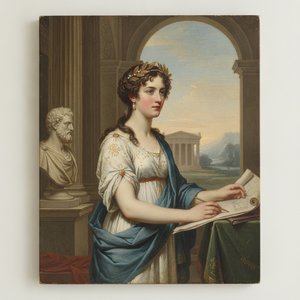
Constance Charpentier’s “Melancholy,” painted in 1801, is more than just a depiction of a seated woman; it's an exquisitely rendered meditation on solitude and the lingering grief of a generation. This oil-on-canvas masterpiece, currently residing within the hallowed halls of the Musée de Picardie in Amiens, France, offers a poignant glimpse into the artistic sensibilities of early 19th-century Europe – a period grappling with the aftermath of revolution and war.

The painting immediately draws the viewer’s eye to its central figure: a young woman lost in contemplative thought. Her posture is subtly slumped, her gaze fixed downwards, suggesting an inward journey of sorrow. The setting—a darkened landscape punctuated by indistinct trees—amplifies this sense of isolation and reinforces the theme of melancholy. Notice how Charpentier masterfully employs chiaroscuro, utilizing dramatic contrasts between light and shadow to sculpt the figure’s form and create a palpable atmosphere of quiet sadness. The muted palette – primarily creams, whites, and grays – further contributes to the painting's somber mood, while subtle variations within these tones hint at depth and texture.

Neoclassical Elegance: Style and Technique

“Melancholy” is a quintessential example of Neoclassicism, an artistic movement that sought inspiration from the art and ideals of ancient Greece and Rome. Charpentier’s work embodies this style through its emphasis on order, clarity, and balanced composition. The meticulous brushwork—evident in the delicate rendering of the fabric draped across the woman's body and the subtle modeling of her features—demonstrates a remarkable level of technical skill. The use of clean lines and defined edges is characteristic of Neoclassicism, lending the painting an air of formality and restraint.

Technically, Charpentier’s approach leans towards a restrained emotional palette, prioritizing form and structure over overt sentimentality. However, she skillfully captures the nuances of human emotion through her masterful use of light and shadow, creating a powerful sense of introspection within the subject's gaze. The painting’s shallow perspective further focuses attention on the figure, immersing the viewer in her internal world.

A Window into an Era: Historical Context

To fully appreciate “Melancholy,” it’s crucial to understand the historical context in which it was created. Following the tumultuous years of the French Revolution and Napoleonic Wars, France was a nation grappling with profound social and emotional upheaval. The loss of countless young men had left an indelible mark on society, particularly on women who often bore the brunt of responsibility and grief. Charpentier’s painting reflects this collective sorrow, offering a visual representation of the quiet despair that permeated French society at the time.

The Musée de Picardie, where “Melancholy” is housed, provides further context by showcasing other works from the same period, including pieces by Pierre Puvis de Chavannes and Frans Hals. These artists, like Charpentier, were deeply influenced by Neoclassicism and sought to capture the beauty and dignity of human experience through their art.

Symbolism and Emotional Resonance

Beyond its technical brilliance, “Melancholy” is rich in symbolism. The woman’s contemplative pose and downward gaze evoke a sense of introspection and sorrow, while the darkened landscape suggests a world shrouded in grief. The classical drapery—a hallmark of Neoclassicism—references ancient virtues and ideals, subtly hinting at a longing for a lost past or a more harmonious future. The painting's overall effect is profoundly moving, inviting viewers to contemplate the complexities of human emotion and the enduring power of melancholy.

Reproductions of “Melancholy” offer an accessible way to experience the beauty and emotional depth of this remarkable artwork. Whether displayed in a private residence or a public space, it serves as a timeless reminder of the capacity for art to capture and convey the most profound human experiences.

Questions et réponses

Quel est le format de « Melancholy » ?

L'œuvre « Melancholy » est au format Landscape. Cette information est utile pour prévoir l'emplacement de sa reproduction.

Quel format choisir pour l'impression de "Melancholy" afin qu'il s'adapte à ma pièce ?

Pour une Living Room, la taille d'impression recommandée pour «Melancholy» de Constance Charpentier est Medium.

Qui est l'auteur de « Melancholy » et en quelle année a-t-elle été créée ?

«Melancholy» a été créé par Constance Charpentier en 1801.

More about this painting

Aperçu en situation Visualiser en RA Passer au format impression Passer au format numérique Envoyer
Détails de l'œuvre Guide Ajouter aux favoris Télécharger l'image Articles similaires Radiographie Diaporama Q&A Statistiques

In numbers

  • 1801the year it was painted
  • 29frames to choose from
  • standard sizes, in its own proportions
  • 5weeks to paint and deliver it
Constance Charpentier

Constance Charpentier

1767 - 1849, France

Quick facts about Constance Charpentier

  • Artistic Movement Or Style: Néo-Classique, Genre
  • Artists Who Influenced This Artist:
    • Jacques-Louis David
    • François Gérard
    • Pierre Bouillon
    • Louis Lafitte
    • Johann Wille
  • Date Of Birth: 1767-04-04
  • Full Name: Constance Marie Charpentier
  • Nationality: Française
  • Notable Artworks:
    • Melancolie
    • Jeune femme dessinant
  • Place Of Birth: Paris, France

Biographie de l'artiste

Constance Charpentier : Une Vie en Portrait

Jeunesse et Formation

Constance Marie Charpentier est née à Paris, en France, le 4 avril 1767 et est décédée en 1849. Sa jeunesse reste quelque peu enveloppée de mystère, notamment concernant sa formation artistique formelle. Les registres sont flous, mais il est largement admis qu'elle a étudié auprès de plusieurs artistes importants de l'époque.

  • Elle est souvent associée à Jacques-Louis David, figure de proue du Néoclassicisme, bien que cela reste débattu.
  • D’autres professeurs potentiels incluent François Gérard, Pierre Bouillon, Louis Lafitte, et les membres de la famille Wille – Johann Georg Wille ou son fils, Pierre-Alexandre Wille.

Développement Artistique et Style

Charpentier se spécialisa dans les scènes de genre et les portraits, avec un accent particulier sur la représentation des femmes et des enfants. Son style reflète l'influence du Néoclassicisme, caractérisé par la clarté, la précision et une palette émotionnelle retenue. Cependant, elle a également infusé son travail d’une sensibilité au caractère et d’une représentation intime de la vie domestique.

  • Ses peintures capturent souvent des moments de contemplation silencieuse ou d'activité quotidienne.
  • Elle a fait preuve de talent pour rendre les textures et les détails, en particulier dans les tissus et les expressions faciales.

Carrière et Reconnaissance

Charpentier a commencé à exposer son travail aux Salons – prestigieuses expositions d'art – de 1795 à 1819. Au cours de cette période, elle a présenté environ trente tableaux au public.

  • En 1814, elle a reçu une médaille d’or au Salon de Paris, marquant une réalisation importante dans sa carrière.
  • Elle a également été récompensée par une médaille d'argent au Salon de Douai en 1821.

Défis et Attributions Erronées

L’héritage artistique de Charpentier a été compliqué par des cas d'attribution erronée. Certaines de ses œuvres ont initialement été créditées à son professeur, Jacques-Louis David.

  • Par exemple, le tableau Jeune femme dessinant (1801) a d’abord été attribué à David, puis à Charpentier, mais est aujourd'hui considéré comme l'œuvre de Marie-Denise Villers.
  • Cela souligne les défis auxquels étaient confrontées les artistes femmes pour obtenir une reconnaissance pendant cette période et la tendance à faire passer leurs contributions pour négligées ou éclipsées.

Héritage et Importance Historique

Malgré ces défis, Constance Charpentier est aujourd'hui reconnue comme l’une des plus grandes peintres de portraits de son époque. Sur la base des œuvres survivantes positivement identifiées comme étant les siennes, elle a démontré un talent remarquable pour capturer les ressemblances et les personnalités de ses sujets.

  • Ses peintures offrent des informations précieuses sur la vie des femmes et des enfants à la fin du XVIIIe et au début du XIXe siècle en France.
  • Elle représente une figure importante dans l'histoire de l'art français, démontrant le talent et la créativité des artistes féminines à une époque où leurs opportunités étaient limitées.

Informations clés

  • Title: Melancholy
  • Location: Musée de Picardie, Amiens
  • Medium: Oil on canvas
  • Subject or theme: Melancholy, contemplation
  • Artistic style: Neoclassicism

Quiz d'art

Chaque question ne comporte qu'une seule bonne réponse.

Question 1:
What is the primary emotion conveyed by Constance Charpentier’s ‘Melancholy’?
Question 2:
In what century was the painting ‘Melancholy’ created?
Question 3:
The painting utilizes a shallow perspective. What effect does this primarily create?
Question 4:
Where is ‘Melancholy’ currently housed?
Question 5:
Which artistic movement is ‘Melancholy’ most closely associated with?