Passer au format impression
 Lire la suite







































 Pour les œuvres ou reproductions dont un côté mesure plus de 105 cm (environ 41 pouces), le cadre sera expédié sous forme de kit démonté. Cette méthode garantit une livraison sécurisée et prévient tout dommage pendant le transport.


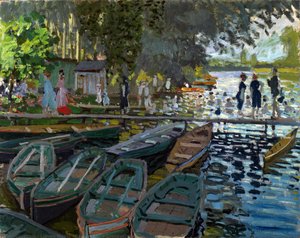
Luncheon on the Grass (Le Déjeuner sur l'herbe), 1866-67
Claude Monet’s “Luncheon on the Grass,” painted in 1866-67, stands as a cornerstone of Impressionism and arguably its most daring departure from academic tradition. More than just a depiction of a picnic scene—though it undeniably captures that idyllic moment—the painting embodies Monet's revolutionary approach to capturing light and emotion, influencing generations of artists who followed his lead.
- Subject Matter: The canvas portrays twelve figures lounging on a grassy meadow beneath the shade of a large deciduous tree. Among them are Jean Renoir, Gustave Courbet, Frédéric Bazille, Monet himself, and Camille Pissarro—artists united in their pursuit of capturing fleeting impressions of nature.
- Style & Technique: Monet employed loose brushstrokes and vibrant color palettes characteristic of Impressionism. He prioritized conveying the sensation of light rather than precise representation, utilizing broken color to simulate the shimmering effects of sunlight filtering through foliage. The painting’s surface is textured with visible brushwork, reflecting Monet's commitment to immediacy and spontaneity.
- Historical Context: “Luncheon on the Grass” emerged during a period of artistic ferment in Paris, challenging established conventions and signaling a shift towards subjective perception. It was exhibited at the Salon des Refusés in 1863—a controversial event that cemented Impressionism’s position as an alternative aesthetic.
- Symbolism: The painting's composition is laden with symbolic significance. The reclining figures represent leisure and contemplation, while the scattered fruit and wine symbolize abundance and conviviality. Monet deliberately placed the figures in a dappled light pattern to convey the ephemeral beauty of nature—a motif that would become central to his artistic vision.
The painting’s enduring appeal lies in its ability to evoke feelings of serenity, joy, and wonder. It invites viewers to immerse themselves in the sensory experience of a summer afternoon, capturing the essence of Impressionism's core philosophy: to render not what one sees but how one feels.
This fragment is housed at Musée d’Orsay, where visitors can admire Monet’s masterful technique and appreciate the painting’s contribution to art history. For those interested in exploring more of Monet’s oeuvre, “Claude Monet” is available for viewing at OriginalUniqueArt. Additionally, Musée Marmottan offers a remarkable collection showcasing Monet's artistic evolution.
Étienne Moreau-Nélaton etienne
Étienne Moreau-Nélaton (1859–1927) was a French Impressionist painter, art collector & historian known for domestic scenes and landscapes. His significant collection shaped French national museums, including the Louvre & Musée d’Orsay.
More about “Luncheon on the Grass”
“Luncheon on the Grass” is considered Monet's most ambitious work in terms of composition and technique. It represents a pivotal moment in Impressionist history—a bold assertion of artistic freedom against academic constraints.
The painting’s central panel, alongside its counterpart at Musée d’Orsay, exemplifies Monet’s innovative approach to capturing light and color. He meticulously studied the changing conditions of daylight, striving to convey the subtle nuances of atmospheric perspective.
Monet's dedication to plein air painting—working outdoors directly from nature—is evident in every brushstroke. His use of complementary colors—such as orange and violet—creates a dynamic visual harmony that enhances the painting’s expressive power.
The Influence of Manet
“Luncheon on the Grass” owes its inspiration to Édouard Manet's “Le Déjeuner sur l'herbe,” which provoked considerable controversy at the Salon of 1863. Monet deliberately distanced himself from Manet’s style, prioritizing a more subjective and immediate portrayal of nature.
However, Monet acknowledged Manet’s influence as a catalyst for artistic innovation—a recognition that underscores the interconnectedness of Impressionist artists' visions.
Exploring Monet’s Legacy
“Luncheon on the Grass” continues to captivate audiences today—serving as a testament to Monet’s genius and enduring relevance. Its luminous colors, textured surface, and evocative composition inspire admiration for its artistic merit.
OriginalUniqueArt provides high-quality reproductions of “Luncheon on the Grass,” allowing enthusiasts to experience Monet's masterpiece firsthand. Musée Marmottan showcases an impressive collection of Impressionist artworks—including Monet’s masterpieces—offering visitors a comprehensive glimpse into this transformative period in art history.
Questions et réponses
Quel âge avait Claude Monet lors de la création de « Déjeuner sur l'herbe » ?
Lorsque « Déjeuner sur l'herbe » a été créé en 1865, Claude Monet — né(e) en 1840 — était âgé(e) de 25 ans.
Quelle technique a été utilisée pour « Déjeuner sur l'herbe » et quand cette œuvre a-t-elle été créée ?
«Déjeuner sur l'herbe» de Claude Monet est une œuvre réalisée en Acrylique sur toile, datant de 1865.
Quel est le niveau de contraste de «Déjeuner sur l'herbe» de Claude Monet ?
Le contraste clair-obscur de « Déjeuner sur l'herbe » est évalué à Contrasté. Le contraste décrit l'intensité de la différence entre les zones claires et les zones sombres.
 Aperçu en situation
 Envoyer
 Partager
 Détails de l'œuvre
 Guide
Guide

 Télécharger l'image
 Articles similaires
 Radiographie
 Diaporama
 Q&A
Q&A Statistiques