Aperçu en situation
 Partager
 Partager
 Détails

 Télécharger
 Articles similaires
 Radiographie
 Voir le diaporama
 Statistiques
George Washington (Last Bust Portrait type)
 Oil On Canvas
- WallArt
- Neoclassicism
 1795
1795- Early Modern
 30.0 x 22.0 cm
 Afficher la suite
Giclées et impressions d'art
Impressions giclées ou sur toile de qualité musée, avec une production rapide et des finitions au choix. ( Acheter la peinture faite à la main Passer au format image numérique)




P118B $10

P118H $10

P118W $10

P438Z $10

P508JH $12

P508YH $12

P805H $10

P805Z $10

P919BZ $10

P919G $10

P919XJ $10

P959ZH $10

P968JZ $12

W106C $8

W218G $10

W218JH $8

W218Y $10

W307PJ $10

W316G $10

W316PJ $8

W316Y $10

W398PJ $8

W4111J $10

W500HY $15

W500JH $15

W692G $12

W849H $8

W940BG $15

W953PJ $8




Choisissez parmi nos formats prédéfinis qui respectent les proportions originales de l’œuvre.

Vous pouvez saisir vos propres dimensions pour vous adapter à un cadre ou à un espace spécifique. Si la taille sélectionnée ne correspond pas aux proportions de l'image originale, nous recadrerons l'œuvre ou étendrons l'image avec une bordure en miroir ou une couleur unie. Une maquette numérique vous sera envoyée pour approbation avant le début de la production.
Veuillez noter que l'aperçu à l'écran ne reflète pas le recadrage ou l'extension réelle. Seule la maquette montrera avec précision la composition finale.
Bien que des tailles personnalisées soient disponibles, nous vous recommandons de choisir une dimension dans la liste prédéfinie afin de préserver les proportions originales.
Livraison dans le monde entier () en 2 semaines au lieu des 4/5 semaines habituelles. (16 septembre)

Livraison express gratuite dans le monde entier

Toile de lin de haute qualité

Assurance transport complète

Garantie de remboursement des droits de douane

Garantie de fidélité des couleurs

Garantie de retour de 100 jours (uniquement en cas de défaut)

Garantie de remboursement à 100%

Tarifs dégressifs sur quantité
 L'option verre n'est disponible que pour les dimensions inférieures à 110 cm.

George Washington (Last Bust Portrait type)
Giclées et impressions d'art
Format de la reproduction
-


Prix total final
$ 80
The Soul of a Nascent Republic
In the quiet, commanding presence of Charles Willson Peale’s 1795 portrait, George Washington, one finds far more than a mere likeness of a man; one encounters the very soul of a nascent republic. This particular rendition, belonging to the "Last Bust Portrait" type, captures the first President of the United States with a profound sense of Neoclassical grace. The composition is masterfully centered, focusing our gaze upon Washington’s head and shoulders, creating an intimate yet monumental encounter. Through soft, diffused lighting, Peale breathes life into the subtle contours of the face, allowing shadows to dance gently across the features, lending a weight of wisdom and gravity to the subject. It is a piece that does not merely depict a historical figure but invites the viewer into a moment of silent, dignified reflection.
Beyond its aesthetic brilliance, the painting serves as a vital historical document, capturing the essence of an era defined by revolution and the birth of American identity. As a master of his craft, Peale utilized his deep connection to the figures of the American Revolution to create works that are both personal and political. In this portrait, the subject is rendered with a resolute expression in his eyes, suggesting a leader who has weathered the storms of war and is now anchored by the heavy responsibility of peace. For the discerning collector, owning such a piece is akin to holding a fragment of history, a window into the foundational spirit of a nation.
Technical Mastery and Neoclassical Elegance
The technical mastery displayed in this oil on canvas is nothing short of breathtaking, making it an exquisite choice for those who appreciate the meticulous traditions of classical painting. Peale utilizes a sophisticated layering of colors to achieve a lifelike texture, where the smoothness of skin contrasts beautifully with the structured folds of period clothing. The palette is intentionally restrained, dominated by deep, somber tones of brown and black that evoke a sense of timelessness and authority. These dark hues are punctuated by delicate highlights of grey and white, which catch the light to define the fine details of Washington’s hair and the dignified structure of his features.
The style leans heavily towards Neoclassicism, characterized by realistic representation and an emphasis on order and balance. The lines are predominantly smooth and controlled, defining the contours of the face and clothing with surgical precision. This sense of stability is further reinforced by a deep, muted brown background, which provides a neutral anchor for the figure. Such a composition allows the portrait to command attention in any sophisticated setting without overwhelming the surrounding decor, making it an ideal centerpiece for a study, library, or formal living space.
A Timeless Addition to the Sophisticated Interior
For the interior designer or art enthusiast, this portrait offers a unique opportunity to introduce a sense of heritage and gravitas into a room. The neutral, muted tones of the work allow it to integrate seamlessly into various design aesthetics, from traditional colonial styles to modern minimalist environments. Because the painting relies on subtle tonal shifts rather than jarring colors, it provides a calming, intellectual energy to a space.
When considering a high-quality reproduction of this masterpiece, one is not just selecting a decoration, but an atmospheric element that can transform a room's character. It serves as:
- A Focal Point: The centered, monumental composition naturally draws the eye, creating a sense of importance within a gallery wall or standalone placement.
- An Anchor of Sophistication: The dark, classical palette provides a grounding effect that complements rich woods, leather, and metallic accents.
- A Conversation Piece: The historical significance of Peale’s depiction of Washington offers endless depth for storytelling and intellectual engagement with guests.
Ultimately, this portrait is an invitation to contemplate the virtues of leadership, resilience, and dignity. It remains a breathtaking testament to the power of portraiture to transcend time, offering a lasting legacy of beauty and strength to any collection.
Biographie de l'artiste
Charles Willson Peale : Une Vie d'Art, de Science et de Patriotisme
- Né : 15 avril 1741, Chester, comté de Queen Anne, Maryland
- Décédé : 22 février 1827, Philadelphie, Pennsylvanie
Première Vie et Formation Artistique
- La première vie de Peale a été marquée par des difficultés financières après la mort de son père. Il a fait un apprentissage en tant que sellier avant de découvrir sa passion pour l'art.
- Il a reçu une formation initiale auprès de John Hesselius et a brièvement étudié avec John Singleton Copley, démontrant ainsi une aptitude précoce au portrait.
- Une période cruciale dans son développement a été son séjour à Londres sous la direction de Benjamin West (1767-1770). Cette exposition aux tendances artistiques européennes a considérablement influencé son style.
Carrière Artistique et Œuvres Majeures
- Portrait : Peale est surtout connu pour ses portraits de personnalités importantes de la Révolution américaine, y compris de nombreuses représentations de George Washington (près de soixante au total). Ces portraits sont des documents historiques précieux ainsi que des réalisations artistiques.
- Style : Son style a évolué au fil du temps, initialement influencé par l'approche néoclassique de West, mais incorporant plus tard des éléments de réalisme et un désir de capturer fidèlement le portrait.
- Œuvres Notables :
- George Washington (1772) : A marqué le début de sa longue association avec Washington.
- Le Groupe sur l'Escalier (c. 1795) : Un exemple frappant du trompe-l'œil, représentant ses fils Raphaël et Titian comme faisant partie du décor architectural.
Recherches Scientifiques et le Musée Américain de Peale
- Peale était un naturaliste et scientifique passionné, organisant des expéditions pour étudier l'histoire naturelle.
- Il a fondé le Musée Américain de Peale à Philadelphie (1784), l'un des premiers musées aux États-Unis. Il abritait des spécimens botaniques, biologiques et archéologiques.
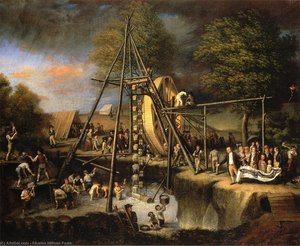
- Le musée a joué un rôle important dans la popularisation de la science et de l'éducation en Amérique. Il était particulièrement connu pour ses expositions d'os de mastodonte, acquis lors d'une expédition en 1801.
- Il s'est auto-enseigné à la taxidermie pour préserver les spécimens pour le musée, démontrant ainsi ses diverses compétences.
Héritage et Importance Historique
- L’œuvre de Peale comble le fossé entre l’art et la science, reflétant les idéaux des Lumières de son époque.
- Ses portraits fournissent des archives visuelles inestimables des figures clés de l'histoire américaine.
- La fondation du Musée Américain de Peale a été un effort pionnier qui a contribué à établir le musée comme une institution importante pour l'éducation et l'exploration scientifique.
- Il a influencé les générations futures d’artistes et de scientifiques, contribuant ainsi de manière significative au développement de la culture américaine.
- Son héritage familial s'est poursuivi par ses fils, dont James Peale et Rubens Peale, qui sont également devenus des artistes accomplis et ont contribué à la collection du musée.

Charles Willson Peale
1741 - 1827 , Royaume-Uni
En bref
- Artistes Influents:
- John Hesselius
- John Singleton Copley
- Benjamin West
- Date De Décès: 22 février 1827
- Date De Naissance: 15 avril 1741
- Lieu De Naissance: Chester, Royaume-Uni
- Mouvement Artistique: Néo-classicisme
- Nationalité: Américain
- Nom Complet: Charles Willson Peale
- Oeuvres Notables:
- Staircase Group
- George Washington (1772)
Articles similaires

Georges Seurat : Les 25 Œuvres Maîtresses du Pointillisme | OriginalUniqueArt
Plongez dans l'univers lumineux de Georges Seurat ! Découvrez les 25 œuvres majeures du pointillisme, de 'Un dimanche après-midi à l'Île de la Grande Jatte' aux 'Poseuses'. Reproductions d'art exceptionnelles et inspiration déco sur OriginalUniqueArt.com.

Georges Braque : Les 25 Œuvres Maîtresses du Cubisme et de la Modernité | OriginalUniqueArt
Plongez dans l'univers de Georges Braque avec les 25 œuvres incontournables du cubisme. Découvrez l'histoire, les techniques et l'impact de ce maître de l'art moderne. Reproductions d'art exceptionnelles sur OriginalUniqueArt.com.

Neoclassical Portraiture: The Timeless Elegance of Order, Grace, and Academic Mastery
Explore the refined world of Neoclassical portraiture. Discover the mastery of line, light, and order through an expert exploration of academic art history, from Jacques-Louis David to Jean-Antoine Houdon. Immerse yourself in the timeless elegance of classical realism.
Titian Ramsay Peale II: A Legacy of Botanical Precision & Artistic Innovation
Explore the life & art of Titian Ramsay Peale II, a master of botanical precision and wildlife painting. Discover his legacy bridging art & natural history at OriginalUniqueArt.

Charles Willson Peale: Portraiture, Enlightenment Ideals & Shaping American Identity
Explore the life & art of Charles Willson Peale – Revolutionary portraitist, scientist, and founder of America’s first museum. Discover his iconic paintings of Washington & the Enlightenment ideals that shaped a nation.