Aperçu en situation
 Envoyer
 Partager
 Détails de l'œuvre
 Guide
Guide

 Télécharger l'image
 Articles similaires
 Radiographie
 Diaporama
 Questions et réponses
 Statistiques
Dieppe


 Lire la suite
Giclées et impressions d'art
Impressions giclées ou sur toile de qualité musée, avec une production rapide et des finitions au choix. ( Commander la reproduction peinte à la main Passer au format numérique)




P118B €10

P118H €10

P118W €10

P438Z €10

P508JH €12

P508YH €12

P805H €10

P805Z €10

P919BZ €10

P919G €10

P919XJ €10

P959ZH €10

P968JZ €12

W106C €8

W218G €10

W218JH €8

W218Y €10

W307PJ €10

W316G €10

W316PJ €8

W316Y €10

W398PJ €8

W4111J €10

W500HY €15

W500JH €15

W692G €12

W849H €8

W940BG €15

W953PJ €8




Choisissez parmi nos formats prédéfinis qui respectent les proportions originales de l’œuvre.

Saisissez la largeur et la hauteur souhaitées pour qu'elles s'adaptent à votre cadre ou à votre mur. Une impression peut être recadrée, mais jamais agrandie au-delà de l'image originale ; ainsi, un format de forme différente entraînera la perte d'une partie de l'image. Nous vous envoyons une maquette numérique pour approbation avant toute impression. L'image présentée sur cette page ne montre pas le recadrage réel — seule la maquette le permet.
Livraison dans le monde entier () en 2 semaines au lieu des 4/5 semaines habituelles. (6 novembre)

Livraison express gratuite dans le monde entier

Toile de lin de qualité supérieure

Assurance transport complète

Garantie de remboursement des droits de douane

Garantie de fidélité des couleurs

Politique de retour de 100 jours (uniquement en cas de défaut)

Garantie de remboursement à 100%

Offre de tarifs dégressifs
 L'option verre n'est disponible que pour les dimensions inférieures à 110 cm.

Dieppe
Giclées et impressions d'art
Format de la reproduction
-


Prix total
€ 72
The Scene Unfolds: A Seaside Moment Captured
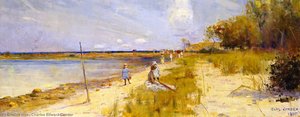
Charles Edward Conder’s “Dieppe,” painted in 1895, isn't merely a depiction of a coastal scene; it’s an immersion into a fleeting moment of tranquility and observation. The canvas breathes with the muted palette of a late afternoon – a symphony of blues deepening towards the horizon, punctuated by the warm ochres and yellows of the sand and distant buildings. The composition immediately draws the eye along a gentle diagonal path created by the sandy track leading toward the figures strolling along the beach. This isn’t a dramatic seascape; rather, it's an invitation to pause, to contemplate the quiet rhythm of daily life unfolding against the vastness of the sea.
The subject matter itself is deceptively simple: a group of people enjoying a seaside walk. Yet Conder elevates this commonplace activity through his masterful use of Impressionistic techniques. He’s less concerned with precise representation and more interested in capturing the *feeling* of the scene – the diffused light, the sense of warmth, the subtle interplay of color and texture. The figures are rendered with loose brushstrokes, their forms dissolving into the atmosphere, suggesting a momentary impression rather than a detailed portrait.
Impressionistic Techniques: A Dance of Light and Color
Conder’s approach is deeply rooted in Impressionism, a movement that sought to capture the subjective experience of light and color. Notice how he employs broken brushstrokes – short, distinct marks applied side-by-side rather than blended smoothly. This creates a shimmering effect, mimicking the way sunlight dances on water and reflects off surfaces. The layering of paint is equally significant; visible texture adds depth and richness to the canvas, inviting the viewer to examine the surface closely.
The color choices are deliberately restrained, contributing to the overall mood of serenity. He avoids bright, saturated hues, opting instead for a harmonious blend of blues, yellows, and browns. This creates a sense of atmospheric perspective – distant elements appear paler and less distinct, reinforcing the feeling of depth and distance. The use of complementary colors—the blue sky contrasted with the warm sand—further enhances the visual interest and vibrancy of the scene.
Historical Context: The Heidelberg School and Australian Modernism
To understand “Dieppe,” it’s crucial to consider Conder's place within the broader context of Australian art. He was a key figure in the Heidelberg School, a group of artists who developed a distinctly Australian style influenced by Impressionism and Post-Impressionism. Based in Melbourne, the Heidelberg School sought to capture the unique landscapes and light conditions of Victoria’s rural areas.
Conder's move to Sydney in 1884 marked a pivotal moment in his career. He quickly established himself as a talented landscape painter, experimenting with new techniques and styles. “Dieppe” reflects this period of artistic exploration, showcasing Conder’s growing mastery of Impressionistic principles while retaining a distinctly Australian sensibility. The painting's subject matter – a seaside scene – resonated deeply with the Heidelberg School’s focus on capturing the beauty of the natural world.
Symbolism and Emotional Resonance: A Moment of Quiet Reflection
Beyond its technical merits, “Dieppe” possesses a subtle yet powerful symbolic resonance. The figures strolling along the beach represent leisure, connection, and the simple pleasures of life. The vast expanse of the sea symbolizes both opportunity and uncertainty – a reminder of the world beyond our immediate surroundings. The painting evokes a sense of quiet contemplation, inviting the viewer to slow down and appreciate the beauty of the present moment.
Ultimately, “Dieppe” is more than just a landscape; it’s a meditation on light, color, and human experience. It's a testament to Conder's artistic vision and his ability to capture the essence of a fleeting scene with remarkable sensitivity and skill. A reproduction of this work offers a beautiful addition to any collection, bringing a touch of Impressionistic serenity into your home.
Questions et réponses
Qui est l'auteur de « Dieppe » et en quelle année a-t-elle été créée ?
«Dieppe» a été créé par Charles Edward Conder en 1895.
«Dieppe» de Charles Edward Conder est-il une composition en portrait, en paysage ou carrée ?
L'œuvre « Dieppe » est au format Landscape. Cette information est utile pour prévoir l'emplacement de sa reproduction.
Que représente «Dieppe» de Charles Edward Conder ?
Les thèmes présents dans «Dieppe» de Charles Edward Conder incluent seaside, beach, landscape, impressionism, leisure, tranquility, figures, atmosphere. Ensemble, ils résument le sujet de l'œuvre.
Biographie de l'artiste
Première vie et parcours artistique
Charles Edward Conder, peintre, lithographe et designer d'origine britannique, a laissé une marque indélébile sur le monde de l'art. Né à Tottenham, Middlesex, le 24 octobre 1868, son enfance fut marquée par la mort de sa mère en Inde alors qu’il n’avait que quatre ans.Carrière artistique en Australie
En 1884, à l'âge de 16 ans, Conder déménagea à Sydney, en Australie, où il travailla pour son oncle en tant que géomètre. Il découvrit rapidement que sa véritable passion résidait dans le dessin des paysages plutôt que dans la topographie. Dès 1886, il devint artiste pour le Illustrated Sydney News, aux côtés d'artistes notables tels qu’Albert Henry Fullwood et Frank Mahony.L'École de Heidelberg et œuvres remarquables
La pièce maîtresse de Conder, Departure of the Orient – Circular Quay (1888), a mis en évidence sa maîtrise nouvellement acquise de la forme et du travail à l'huile. Cette scène portuaire, représentant le port animé de Sydney Cove, fut rapidement achetée par la Art Gallery of New South Wales, faisant de ce tableau sa première œuvre à entrer dans une collection publique.- A Holiday at Mentone (1888), une peinture pleine d'entrain représentant des hommes et des femmes se relaxant sur la plage, est un autre exemple notable de son travail.
- L’association de Conder avec G. P. Nerli, un peintre italien itinérant, a considérablement influencé son développement artistique.
- Ses contributions à l’exposition « 9 by 5 Impression » à Melbourne, aux côtés de Tom Roberts et Arthur Streeton, ont consolidé sa position au sein du mouvement de l'École de Heidelberg.
Héritage et vie ultérieure
Les dernières années de Conder furent marquées par de mauvais problèmes de santé, notamment la paralysie et un épisode de délirium tremens. Malgré cela, il continua à peindre, laissant derrière lui un héritage en tant que figure clé de l'École de Heidelberg. Son art fut mieux accueilli en Angleterre qu’à Paris, son portrait étant peint par Henri de Toulouse-Lautrec en 1892. Consultez les œuvres de Conder à la Art Gallery of New South Wales ou explorez davantage l'École de Heidelberg sur la page Charles Edward Conder de OriginalUniqueArt.- Découvrez plus d’informations sur la vie et les œuvres de Conder sur la page Wikipédia consacrée à Charles Conder.
- Explorez la collection de peintures de Conder sur le site web de OriginalUniqueArt, notamment A Holiday at Mentone (1888) et Departure of the Orient – Circular Quay (1888).
Conclusion
L’impact de Charles Edward Conder sur l'impressionnisme australien est indéniable. Son héritage, marqué par ses peintures captivantes et son association avec l'École de Heidelberg, continue d’inspirer les passionnés d'art du monde entier.
Charles Edward Conder
1868 - 1909 , Royaume-Uni
L'essentiel de l'artiste
- Artistic Movement Or Style: Impressionnisme australien
- Artists Who Influenced This Artist: ['G. P. Nerli']
- Date Of Birth: 24 octobre 1868
- Date Of Death: 1909
- Full Name: Charles Edward Conder
- Nationality: Britannique
- Notable Artworks:
- Departure of the Orient
- A Holiday at Mentone
- Place Of Birth (City And Country): Tottenham, Royaume-Uni
Articles connexes
Capturing the Soul: The Most Emotionally Moving Impressionist and Post-Impressionist Masterpieces
Discover the profound emotional depth of Impressionist and Post-Impressionist masterpieces. Explore how legends like Monet, Van Gogh, and Gauguin captured light and soul through evocative landscapes and vibrant brushwork for a timeless connection to art history.

Beyond the Horizon: A Curated Guide to Integrating Post-Impressionist Landscapes into Modern Interiors
Transform your home with the emotive power of Post-Impressionist landscapes. Discover expert tips on selecting hand-painted oil reproductions to create a soulful, vibrant interior that reflects your unique style and connection to nature.

Les 10 Chefs-d'œuvre Impressionnistes qui ont Révolutionné le Paysage
Plongez au cœur de l'Impressionnisme avec les 10 chefs-d'œuvre qui ont révolutionné le paysage. Découvrez Monet, Renoir et plus encore sur OriginalUniqueArt.com – reproductions d'art de qualité muséale pour sublimer votre intérieur.
Golden Fields & Sun-Drenched Meadows: Capturing the Soul of Impressionist Landscapes
Immerse yourself in the luminous world of Impressionist landscapes. Discover how masters like Monet and Gauguin captured ephemeral light through plein air painting, and learn to bring the soul of sun-drenched meadows into your home with exquisite, hand-painted oil reproductions.

Les 10 Chefs-d'œuvre Impressionnistes qui ont Révolutionné le Paysage
Plongez dans l'univers vibrant de l'impressionnisme ! Découvrez les 10 chefs-d'œuvre de Monet, Renoir et autres maîtres qui ont révolutionné le paysage. Inspirez votre décoration intérieure avec OriginalUniqueArt.com : reproductions tableaux de qualité muséale.