
 Aperçu en situation
 Envoyer
 Partager
 Détails de l'œuvre

 Télécharger
 Articles similaires
 Radiographie
 Diaporama
Paisaje extemporal


 Lire la suite
Giclées et impressions d'art
Impressions giclées ou sur toile de qualité musée, avec une production rapide et des finitions au choix. ( Commander la reproduction peinte à la main Télécharger l'image haute résolution)




































Choisissez parmi nos formats prédéfinis qui respectent les proportions originales de l’œuvre.

Vous pouvez saisir vos propres dimensions pour vous adapter à un cadre ou à un espace spécifique. Si la taille sélectionnée ne correspond pas aux proportions de l'image originale, nous recadrerons l'œuvre ou étendrons l'image avec une bordure en miroir ou une couleur unie. Une maquette numérique vous sera envoyée pour approbation avant le début de la production.
Veuillez noter que l'aperçu à l'écran ne reflète pas le recadrage ou l'extension réelle. Seule la maquette montrera avec précision la composition finale.
Bien que des tailles personnalisées soient disponibles, nous vous recommandons de choisir une dimension dans la liste prédéfinie afin de préserver les proportions originales.
Livraison dans le monde entier () en 2 semaines au lieu des 4/5 semaines habituelles. (13 août)

Livraison express gratuite dans le monde entier

Toile de lin de qualité supérieure

Assurance transport complète

Garantie de remboursement des droits de douane

Garantie de fidélité des couleurs

Politique de retour de 60 jours (uniquement en cas de défaut)

Garantie de remboursement à 100%

Offre de tarifs dégressifs
 L'option verre n'est disponible que pour les dimensions inférieures à 110 cm.

Paisaje extemporal
Giclées et impressions d'art
Format de la reproduction
-


Prix total
$ 80
Description de la pièce
A Symphony of Light and Geometry
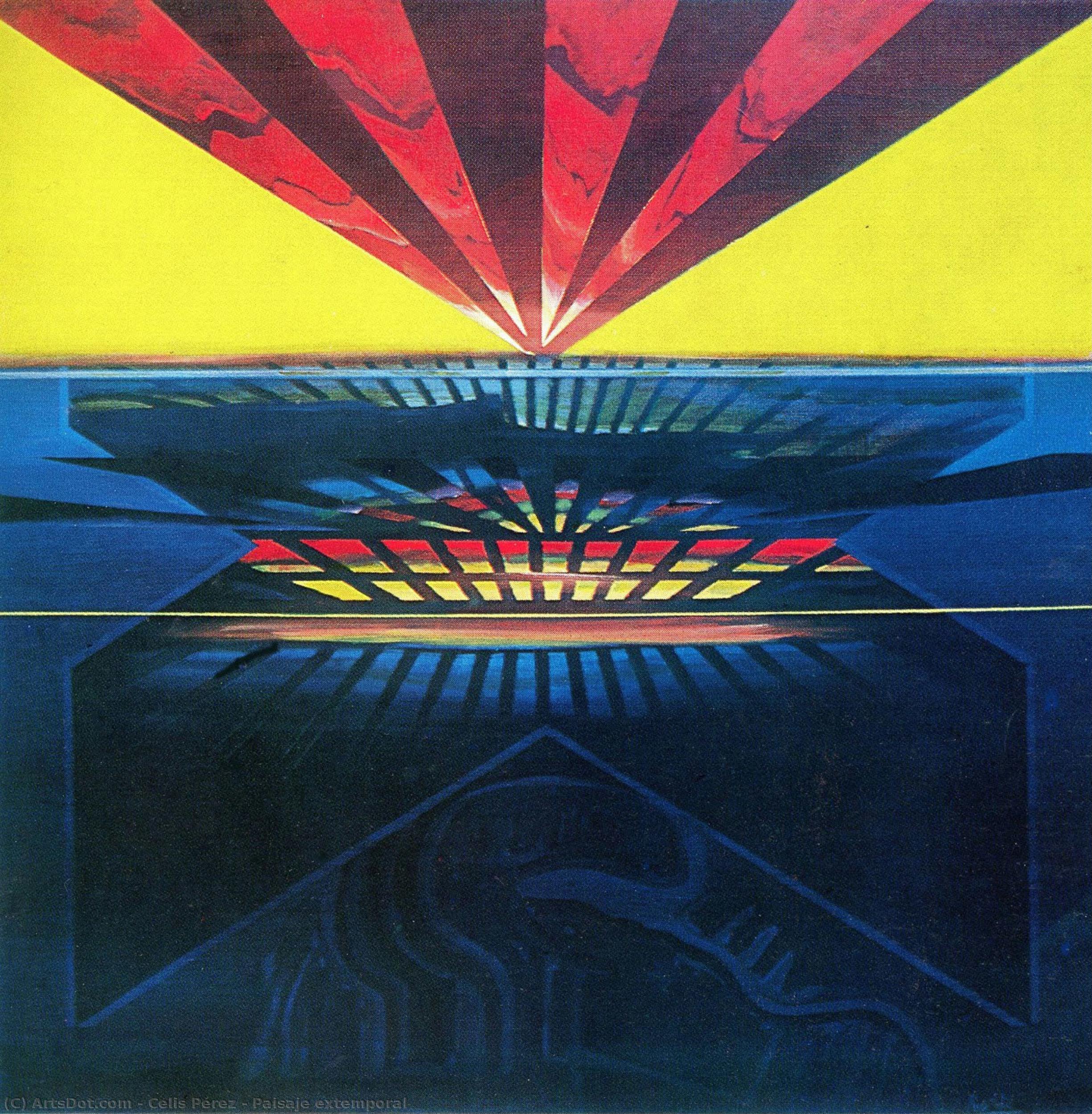
In the evocative masterpiece Paisaje extemporal, created in 1968, the Argentine master Celis Pérez invites us into a realm where the boundaries between landscape and abstraction dissolve into pure emotion. This work serves as a breathtaking meditation on the essence of light, capturing a moment that feels both timeless and fleeting. At first glance, the viewer is greeted by a radiant, sun-drenched atmosphere, dominated by a luminous yellow background that seems to pulse with the warmth of a rising or setting sun. Red accents dance across the canvas, injecting a rhythmic vitality that mimics the flickering heat of a summer twilight. It is not merely a depiction of a sunset, but an exploration of the very energy that light imparts to the world.
The composition is a masterful study in balance and structural intrigue. Pérez utilizes a sophisticated interplay of geometric forms to guide the eye through a dreamlike topography. A striking yellow triangle, accented with delicate red strokes, floats above the horizon line, acting as a celestial anchor that disrupts the traditional landscape perspective. This use of geometry creates a tension between the organic feeling of a sunset and the calculated precision of abstract art. The foreground is particularly captivating, featuring an intricate pattern of light and shadow that lends a profound sense of depth to the piece. These shadows are not merely dark spaces but are textured layers that invite the viewer to step into the painting, discovering new nuances with every glance.
The Legacy of Argentine Abstraction
To understand Paisaje extemporal, one must look toward the rich artistic heritage of Celis Pérez. Born in the historic San Telmo district of Buenos Aires, Pérez was a pivotal figure in the evolution of Latin American abstraction. His technique reflects a deep engagement with the visual language of his era, blending the structural rigor found in geometric abstraction with a soulful, almost lyrical approach to color. By 1968, when this piece was executed, Pérez had refined his ability to use color as a primary narrative tool, moving away from literal representation toward a more spiritualized version of reality. The painting stands as a testament to his ability to translate the physical sensation of light into a permanent, visual rhythm.
For the discerning collector or interior designer, this artwork offers much more than mere decoration; it provides a focal point of intellectual and emotional depth. The warm palette of golds, yellows, and reds makes it an ideal centerpiece for spaces designed to evoke warmth, creativity, and sophistication. Whether placed in a contemporary gallery setting or a curated residential lounge, the painting’s ability to manipulate light and space creates an atmosphere of serene contemplation. Owning a reproduction of such a significant work allows one to bring the vibrant spirit of Argentine modernism into the home, offering a daily encounter with the sublime beauty of a world captured in perfect, geometric harmony.
Biographie de l'artiste
A Life Immersed in Geometry and Light: The World of Celis Pérez
Celis Pérez, born in the vibrant heart of San Telmo, Argentina, in 1939, emerged as a significant voice in Latin American abstract art. His journey wasn’t one of immediate acclaim but rather a gradual unfolding, beginning with correspondence courses that ignited an early passion and blossoming through formal studies at the Belgrano School of Fine Arts in 1954. Even as a young boy, working as a newsboy, he was absorbing the visual world around him, unknowingly laying the foundation for his future explorations of form and color. Pérez wasn’t simply creating art; he was constructing a visual language rooted in both personal experience and a deep engagement with the artistic currents of his time. This formative period instilled within him a profound appreciation for observation and experimentation—qualities that would serve as guiding principles throughout his illustrious career.The Vasarely Spark and the Rise of Geometric Abstraction
A watershed moment in Pérez’s artistic development arrived with a 1957 retrospective dedicated to Victor Vasarely at the National Fine Arts Museum. This encounter proved transformative, igniting within him a fascination with geometric abstraction that would define much of his subsequent work. Vasarely’s precise and systematic approach resonated deeply, prompting Pérez to embark on his own exploration of this visual vocabulary. It wasn’t mere imitation; rather, he absorbed the principles of geometric construction and began to infuse them with his unique sensibility. This influence culminated in 1962 with *Fuerza América*, his first mural—a bold statement that signaled his arrival as a force within the Argentine art scene. This early work wasn’t just an aesthetic exercise; it was a declaration of intent, showcasing his commitment to pushing boundaries and forging a new visual language. The resulting composition—characterized by interlocking planes and vibrant hues—became emblematic of Pérez’s artistic vision for decades to come.A Global Dialogue: Exhibitions and Recognition
Pérez’s artistic ambition extended far beyond Argentina's borders, propelling him onto the international stage through a prolific schedule of solo exhibitions. These presentations spanned continents—from New York City to Paris—demonstrating the enduring appeal of his distinctive style and attracting critical acclaim from prominent art historians and curators alike. Notably, he participated in the Biennale di Venezia in 1964, cementing his reputation as one of Latin America’s foremost artists. His work was showcased at prestigious institutions such as Museo Nacional de Bellas Artes Buenos Aires and Museo Reina Sofía Madrid, establishing him as a figurehead within the broader context of modern art history. Furthermore, he received the Alba Award at the 61st Salón Nacional de Artes Plásticas Argentinos in 2001—a testament to his continued dedication to artistic excellence and recognition from fellow artists and critics.Beyond Canvas and Walls: Murals, Awards, and Lasting Legacy
Pérez’s creative endeavors transcended traditional mediums, resulting in monumental murals that graced public spaces throughout Argentina. Among these notable projects was *La Bombonera*, the stadium of Boca Juniors—a collaborative effort with sculptor Guido Di Tella that captured the spirit of Argentine football culture and solidified Pérez's place within popular artistic memory. His work became interwoven with the fabric of everyday life, demonstrating the transformative potential of art to engage audiences on a visceral level. He was honored as a distinguished citizen of Buenos Aires in 2001—a recognition that underscored his profound contribution to Argentine cultural heritage. Pérez’s legacy continues to inspire artists and scholars alike, ensuring that his pioneering explorations of geometric abstraction remain relevant and resonant for generations to come. His paintings—such as *Bird in the Space Gold*—stand as enduring symbols of artistic innovation and a testament to his unwavering commitment to pushing creative boundaries. His meticulous attention to detail and masterful use of color continue to captivate viewers today, securing his place among Argentina’s most celebrated artists.
Celis Pérez
1939 - 2008 , Argentine
L'essentiel de l'artiste
- Artistic Movement Or Style: Art abstrait, géométrique
- Artists Who Influenced This Artist: ['Victor Vasarely']
- Date Of Birth: 1939
- Date Of Death: 2008
- Full Name: Celis Pérez
- Nationality: Argentin
- Notable Artworks:
- Guerra Santa
- Bird in the Space Gold
- Place Of Birth (City And Country): San Telmo, Argentine
Articles connexes

Abstraction Géométrique : Les 10 Chefs-d'œuvre qui ont Marqué l'Histoire de l'Art
Plongez au cœur de l'abstraction géométrique avec OriginalUniqueArt.com ! Découvrez les 10 œuvres majeures de Mondrian, Malevitch et Kandinsky qui ont révolutionné l'art moderne. Inspirez votre décoration intérieure avec des reproductions de tableaux exceptionnelles. Explorez la collection en ligne !

Kandinsky : Les 25 Œuvres Maîtresses d'un Pionnier de l'Art Abstrait | OriginalUniqueArt
Plongez dans l'univers vibrant de Kandinsky ! Découvrez les 25 œuvres majeures du pionnier de l'art abstrait. Explorez son expressionnisme, ses couleurs audacieuses et l'histoire fascinante derrière chaque tableau. Reproductions d'exception sur OriginalUniqueArt.com.

Neo-Abstract Art: The High-Impact Evolution of Modern Visual Energy and Geometric Sophistication
Discover the power of Neo-Abstract art. Explore how bold geometric forms and high-impact visual energy are redefining modern design. Learn to curate sophisticated, high-energy spaces with the latest trends in contemporary abstraction and structural color.

Beyond Form & Color: Geometric Abstraction's Evolution in 20th/21st Century Art
Explore the evolution of geometric abstraction from Cubism to contemporary art. Discover key artists like Malevich & Mondrian, investment insights, and expert collecting advice at OriginalUniqueArt.

Mark Rothko : Les 25 Œuvres Maîtresses de l'Abstraction Coloriste | OriginalUniqueArt
Plongez dans l'univers émotionnel de Mark Rothko avec les 25 œuvres clés du maître de l'abstraction. Découvrez l'histoire, la technique et le pouvoir des couleurs de ces tableaux iconiques. Reproductions d'art de qualité musée sur OriginalUniqueArt.com

