Aperçu en situation
 Envoyer
 Partager
 Détails de l'œuvre
 Guide
Guide

 Télécharger l'image
 Articles similaires
 Radiographie
 Diaporama
 Questions et réponses
 Statistiques
Ernesta


 Lire la suite
Giclées et impressions d'art
Impressions giclées ou sur toile de qualité musée, avec une production rapide et des finitions au choix. ( Commander la reproduction peinte à la main Passer au format numérique)




P118B €10

P118H €10

P118W €10

P438Z €10

P508JH €12

P508YH €12

P805H €10

P805Z €10

P919BZ €10

P919G €10

P919XJ €10

P959ZH €10

P968JZ €12

W106C €8

W218G €10

W218JH €8

W218Y €10

W307PJ €10

W316G €10

W316PJ €8

W316Y €10

W398PJ €8

W4111J €10

W500HY €15

W500JH €15

W692G €12

W849H €8

W940BG €15

W953PJ €8




Choisissez parmi nos formats prédéfinis qui respectent les proportions originales de l’œuvre.

Saisissez la largeur et la hauteur souhaitées pour qu'elles s'adaptent à votre cadre ou à votre mur. Une impression peut être recadrée, mais jamais agrandie au-delà de l'image originale ; ainsi, un format de forme différente entraînera la perte d'une partie de l'image. Nous vous envoyons une maquette numérique pour approbation avant toute impression. L'image présentée sur cette page ne montre pas le recadrage réel — seule la maquette le permet.
Livraison dans le monde entier () en 2 semaines au lieu des 4/5 semaines habituelles. (5 novembre)

Livraison express gratuite dans le monde entier

Toile de lin de qualité supérieure

Assurance transport complète

Garantie de remboursement des droits de douane

Garantie de fidélité des couleurs

Politique de retour de 100 jours (uniquement en cas de défaut)

Garantie de remboursement à 100%

Offre de tarifs dégressifs
 L'option verre n'est disponible que pour les dimensions inférieures à 110 cm.

Ernesta
Giclées et impressions d'art
Format de la reproduction
-


Prix total
€ 72
Cecilia Beaux’s Ernesta: A Portrait of Quiet Dignity
Cecilia Beaux (1855-1942) stands as a monumental figure in American portraiture, particularly during the opulent era of the Gilded Age. Her artistic journey began amidst considerable personal hardship—the premature loss of her mother at just twelve days old profoundly influenced her worldview and subtly guided her creative path. Raised by her maternal grandmother and aunts in Philadelphia, Beaux experienced childhood marked by both stability and a poignant absence of parental presence; her father’s extended absences fostered a familial dynamic characterized by detachment. Yet, despite these challenges, Beaux nurtured her artistic inclinations through instruction with Catherine Ann Drinker, an accomplished artist who served as an early mentor—a connection that would prove invaluable to her burgeoning talent.The Painting's Subject and Composition
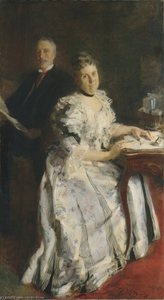
“Ernesta Beaux Drinker,” completed in 1914, depicts a woman seated gracefully on a chair before a table adorned with a vase of flowers – primarily white lilies—a deliberate choice reflecting purity and elegance. Beaux meticulously captured her subject’s posture: hands clasped together, conveying composure and inner reflection. The gaze directed towards the viewer suggests not merely observation but perhaps a subtle acknowledgment of connection, hinting at an unspoken intimacy. Behind Ernesta sits a couch, grounding the figure within a domestic setting, while another chair adds depth to the composition. Beaux skillfully utilizes light—primarily diffused natural illumination—to sculpt the woman’s form and illuminate the vase, enhancing its visual impact.Stylistic Influences and Technique
Beaux's style aligns closely with Impressionism, albeit tempered by a refined academic sensibility. Like her contemporaries, she prioritized capturing fleeting moments of light and color, yet eschewed the unrestrained spontaneity favored by some Impressionists. Beaux’s technique involved layering thin glazes over toned canvases—a hallmark of American Impressionism—resulting in luminous surfaces that convey subtle nuances of texture and tone. The artist's meticulous attention to detail is evident in the rendering of fabrics—particularly Ernesta’s dress—which appears to shimmer with understated brilliance, demonstrating Beaux’s mastery of color and brushwork.Historical Context and Symbolism
Painted during a period of considerable social change and artistic experimentation, “Ernesta” reflects Beaux's engagement with the prevailing aesthetic trends of her time. The portrait exemplifies Beaux’s commitment to portraying individuals within their environment—a stylistic choice that underscores the importance of context in interpreting art. White lilies symbolize purity, innocence, and remembrance – motifs frequently employed by Beaux to convey dignity and grace. Furthermore, Ernesta’s contemplative gaze speaks to a broader exploration of inner life and psychological depth—a characteristic ambition of Beaux's oeuvre.Emotional Resonance and Legacy
“Ernesta Beaux Drinker” transcends mere representation; it embodies Beaux’s profound understanding of human emotion and her ability to convey subtle nuances of character. The painting evokes a sense of serenity, quiet contemplation—a testament to Beaux's artistic vision. Beaux’s enduring legacy rests upon her unwavering dedication to portraying the complexities of human experience with sensitivity and grace—a contribution that continues to inspire artists and collectors alike. Her work stands as an emblem of American Impressionism’s elegance and intellectual rigor.Questions et réponses
De quel type d'œuvre s'agit-il pour «Ernesta» de Cecilia Beaux ?
« Ernesta » est une œuvre de type WallArt.
Dans quelle pièce recommanderiez-vous d'exposer «Ernesta» de Cecilia Beaux ?
«Ernesta» de Cecilia Beaux est recommandé pour une Living Room. Cette suggestion s'appuie sur le sujet, les couleurs et l'atmosphère de l'œuvre.
Où peut-on voir «Ernesta» de Cecilia Beaux actuellement ?
«Ernesta» de Cecilia Beaux est exposé au Metropolitan Museum of Art, New York, United States of America. La mention du musée se rapporte à l'œuvre originale et non aux reproductions.
Biographie de l'artiste
Premières années et formation
Née à Philadelphie le 1er mai 1855, Eliza Cecilia Beaux a connu une enfance marquée par la perte précoce de sa mère, Cecilia Kent Leavitt, peu après sa naissance. Elle fut élevée par sa grand-mère maternelle et ses tantes à Philadelphie. Son parcours artistique commença avec des leçons données par Catherine Ann Drinker Bowen, une parente et artiste talentueuse, dès l'âge de 16 ans. Elle poursuivit sa formation sous la direction de Francis Adolf van der Wielen pendant deux ans, se concentrant sur la perspective et le dessin d’après modèles. En raison des préjugés de l'époque à l'égard des femmes dans les études artistiques, elle ne put étudier l'anatomie directement avant plus tard.Carrière artistique
La percée de Beaux survint lorsqu'elle commença à fréquenter la Pennsylvania Academy of the Fine Arts en 1876, sous l’influence de Thomas Eakins. Bien qu'elle ait évité les partisans les plus fervents d'Eakins, son travail fut considérablement influencé par sa philosophie pédagogique progressive. Beaux remporta le prix Mary Smith à la Pennsylvania Academy of the Fine Arts en 1885, 1887, 1891 et 1892. Ses représentations empreintes d'empathie de l’élite sociale américaine firent d’elle l’une des portraitistes les plus prospères de son époque. Avec John Singer Sargent et William Merritt Chase, Beaux était une figure de proue du portrait en Amérique au tournant du XXe siècle. Chase la qualifiait de « non seulement la plus grande femme peintre vivante, mais aussi la meilleure qui ait jamais existé ».Œuvres notables et héritage
Parmi les œuvres les plus acclamées de Beaux figure son portrait de Harriet Sears Amory, qui met en valeur ses portraits de grand style des élites sociales et intellectuelles. Cette œuvre, exécutée avec les coups de pinceau audacieux et l'impasto épais de l’impressionnisme, témoigne de sa maîtrise du genre.- Découvrez plus d'œuvres de Cecilia Beaux sur OriginalUniqueArt.com :
- Cecilia Beaux : portrait de Harriet Sears Amory
- Explorez la page Cecilia Beaux pour une collection complète de ses œuvres d'art.
Musées et collections présentant son œuvre
- Le Westmoreland Museum of American Art (États-Unis) - présentant une collection impressionnante d'art américain, dont des œuvres de Beaux.
- Pennsylvania Academy of the Fine Arts (Philadelphie, États-Unis) - où Beaux a reçu sa formation et remporté plusieurs prix.

Cecilia Beaux
1855 - 1942 , États-Unis
L'essentiel de l'artiste
- Artistic Movement Or Style: Portraiture, Impressionnisme
- Artists Who Influenced This Artist:
- Tony Robert-Fleury
- William-Adolphe Bouguereau
- Édouard Manet
- Edgar Degas
- Date Of Birth: 1er mai 1855
- Date Of Death: 17 septembre 1942
- Full Name: Eliza Cecilia Beaux
- Nationality: Américaine
- Notable Artworks: ['Portrait de Harriet Sears Amory']
- Place Of Birth (City And Country): Philadelphie, États-Unis
Articles connexes

L'Art Académique au XIXe Siècle : Tradition, Technique et la Quête de la Forme Idéale
Explorez l'art académique du XIXe siècle : ses maîtres (Cabanel, Bouguereau), techniques et son influence durable. Découvrez l'histoire de ce courant artistique avec OriginalUniqueArt.

Réalisme Américain : 10 Chefs-d'œuvre Incontournables pour une Déco Inspirée
Plongez au cœur du Réalisme Américain avec 10 chefs-d'œuvre d'Edward Hopper, Andrew Wyeth et plus. Découvrez l'histoire et les techniques de ces artistes emblématiques. Reproductions de tableaux de qualité musée sur OriginalUniqueArt.com !

L'Académie et le Portrait : Tradition, Technique et Évolution de l'Art Représentationnel
Explorez l'évolution de l'art du portrait, des techniques académiques aux mouvements réalistes. Découvrez les maîtres comme Holbein et Millet avec OriginalUniqueArt.com.

Grant Wood & American Regionalism: Identity, Myth & the Rural Landscape
Explore the world of Grant Wood & American Regionalism with OriginalUniqueArt. Discover the symbolism behind 'American Gothic', recurring themes, and the movement's lasting impact on art history. High-quality reproductions available.

American Regionalism: The Soul of the Heartland and the Mastery of Grant Wood
Explore the profound history of American Regionalism. Discover how Grant Wood captured the heart of the Midwest through masterpieces like American Gothic. An expert guide to the movement, its cultural impact, and the enduring beauty of American Realism.