Aperçu en situation
 Envoyer
 Partager
 Détails de l'œuvre
 Guide
Guide

 Télécharger l'image
 Articles similaires
 Radiographie
 Diaporama
 Questions et réponses
 Statistiques
Cecil Kent Drinker


 Lire la suite
Giclées et impressions d'art
Impressions giclées ou sur toile de qualité musée, avec une production rapide et des finitions au choix. ( Commander la reproduction peinte à la main Passer au format numérique)




P118B €10

P118H €10

P118W €10

P438Z €10

P508JH €12

P508YH €12

P805H €10

P805Z €10

P919BZ €10

P919G €10

P919XJ €10

P959ZH €10

P968JZ €12

W106C €8

W218G €10

W218JH €8

W218Y €10

W307PJ €10

W316G €10

W316PJ €8

W316Y €10

W398PJ €8

W4111J €10

W500HY €15

W500JH €15

W692G €12

W849H €8

W940BG €15

W953PJ €8




Choisissez parmi nos formats prédéfinis qui respectent les proportions originales de l’œuvre.

Saisissez la largeur et la hauteur souhaitées pour qu'elles s'adaptent à votre cadre ou à votre mur. Une impression peut être recadrée, mais jamais agrandie au-delà de l'image originale ; ainsi, un format de forme différente entraînera la perte d'une partie de l'image. Nous vous envoyons une maquette numérique pour approbation avant toute impression. L'image présentée sur cette page ne montre pas le recadrage réel — seule la maquette le permet.
Livraison dans le monde entier () en 2 semaines au lieu des 4/5 semaines habituelles. (5 novembre)

Livraison express gratuite dans le monde entier

Toile de lin de qualité supérieure

Assurance transport complète

Garantie de remboursement des droits de douane

Garantie de fidélité des couleurs

Politique de retour de 100 jours (uniquement en cas de défaut)

Garantie de remboursement à 100%

Offre de tarifs dégressifs
 L'option verre n'est disponible que pour les dimensions inférieures à 110 cm.

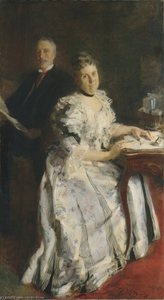
Cecil Kent Drinker
Giclées et impressions d'art
Format de la reproduction
-


Prix total
€ 72
A Portrait of Quiet Strength: Cecilia Beaux’s Cecil Kent Drinker
Cecilia Beaux's "Cecil Kent Drinker," painted in 1891, isn’t merely a portrait; it’s a carefully constructed study in observation and subtle emotion. The painting depicts a young boy, likely around eight or nine years old, dressed in the elaborate attire of a medieval knight – a helmet perched jauntily on his head, a simple tunic revealing a hint of youthful form beneath. He holds a wooden stick, not with aggressive intent, but with a gentle curiosity, and gazes out at the viewer with an expression that balances innocence and quiet contemplation. Beaux’s masterful handling of light and shadow immediately draws the eye, creating a sense of depth and realism within this fantastical scene. The boy isn't posed stiffly; instead, he appears caught in a moment of private reflection, suggesting a personality both spirited and thoughtful. This wasn’t simply a likeness; Beaux sought to capture the essence of her young subject, revealing something deeper than just his appearance.The Gilded Age and the Portraiture of Character
To fully appreciate "Cecil Kent Drinker," it's essential to understand the context in which it was created – the late 19th century American Gilded Age. This era witnessed unprecedented wealth and social change, marked by lavish displays of opulence and a burgeoning interest in capturing the lives of the elite through portraiture. Beaux, a prominent figure in this artistic milieu, specialized in depicting wealthy patrons and their families with remarkable sensitivity. Unlike many of her contemporaries who favored overtly formal and idealized representations, Beaux was known for her ability to imbue her subjects with genuine character. She wasn’t interested in creating mere images of wealth; she aimed to reveal the inner lives and personalities of those she painted. The choice of a medieval knight as the subject's costume is particularly significant – it speaks to a desire for adventure, chivalry, and perhaps even a touch of romantic idealism, all qualities Beaux skillfully conveyed through her brushstrokes.Technique and Impressionistic Nuances
Beaux’s technique in "Cecil Kent Drinker" exemplifies her distinctive style—a blend of realism and impressionism. She employed loose, visible brushstrokes to capture the play of light on the boy's clothing and skin, creating a sense of immediacy and movement. The background is deliberately muted, allowing the figure to dominate the composition and drawing attention to his expressive face. Beaux’s use of color is restrained yet effective, relying on subtle gradations of tone to create depth and volume. Notice how she uses highlights to accentuate the boy's features – the curve of his cheekbone, the sparkle in his eyes—and shadows to define his form. The painting demonstrates a remarkable ability to capture not just the outward appearance but also the fleeting emotions that flicker across a young face. Beaux’s approach was revolutionary for her time, prioritizing capturing the *impression* of a moment over strict adherence to academic rules.Symbolism and the Child's Inner World
Beyond its technical brilliance, "Cecil Kent Drinker" is rich in symbolic meaning. The medieval costume itself represents a yearning for adventure, a desire to transcend the limitations of everyday life. The boy’s contemplative gaze suggests an awareness of his own potential, hinting at a future filled with possibilities. Beaux was known for her ability to capture the inner lives of her subjects, and this painting is no exception. It's not simply a portrait of a child in costume; it’s a window into his imagination, a glimpse of the boy’s hopes and dreams. The stick he holds could be interpreted as a symbol of leadership or protection—perhaps representing his role as a knight in his own private world. The overall effect is one of quiet dignity and youthful promise.A Legacy of Elegance
Today, "Cecil Kent Drinker" resides at the Philadelphia Museum of Art, a testament to Beaux’s enduring legacy. It stands as a prime example of her ability to capture both the outward appearance and inner character of her subjects—a rare feat in portraiture. The painting continues to resonate with viewers today, offering a poignant reminder of childhood innocence, quiet strength, and the power of art to reveal the beauty within us all. Reproductions of this captivating work offer an accessible way to experience Beaux’s artistry and appreciate the subtle nuances of her masterful technique.Questions et réponses
L'œuvre « Cecil Kent Drinker » est-elle restée dans le pays d'origine de son artiste ?
Oui — l'œuvre est conservée dans le pays d'origine de l'artiste. Cecilia Beaux est né(e) en États-Unis, tandis que le musée qui conserve l'original de « Cecil Kent Drinker » se situe en États-Unis.
À quelle étape de la carrière de Cecilia Beaux correspond l'année 1891 pour « Cecil Kent Drinker » ?
Datée de 1891, l'œuvre « Cecil Kent Drinker » s'inscrit dans la période Gilded Age du développement de Cecilia Beaux.
Quelle est la date de création et le mouvement artistique de «Cecil Kent Drinker» de Cecilia Beaux ?
« Cecil Kent Drinker » a été créé en 1891, s'inscrivant dans le mouvement Gilded Age Portraiture. La date et le mouvement ancrent l'œuvre dans l'histoire de l'art.
Biographie de l'artiste
Premières années et formation
Née à Philadelphie le 1er mai 1855, Eliza Cecilia Beaux a connu une enfance marquée par la perte précoce de sa mère, Cecilia Kent Leavitt, peu après sa naissance. Elle fut élevée par sa grand-mère maternelle et ses tantes à Philadelphie. Son parcours artistique commença avec des leçons données par Catherine Ann Drinker Bowen, une parente et artiste talentueuse, dès l'âge de 16 ans. Elle poursuivit sa formation sous la direction de Francis Adolf van der Wielen pendant deux ans, se concentrant sur la perspective et le dessin d’après modèles. En raison des préjugés de l'époque à l'égard des femmes dans les études artistiques, elle ne put étudier l'anatomie directement avant plus tard.Carrière artistique
La percée de Beaux survint lorsqu'elle commença à fréquenter la Pennsylvania Academy of the Fine Arts en 1876, sous l’influence de Thomas Eakins. Bien qu'elle ait évité les partisans les plus fervents d'Eakins, son travail fut considérablement influencé par sa philosophie pédagogique progressive. Beaux remporta le prix Mary Smith à la Pennsylvania Academy of the Fine Arts en 1885, 1887, 1891 et 1892. Ses représentations empreintes d'empathie de l’élite sociale américaine firent d’elle l’une des portraitistes les plus prospères de son époque. Avec John Singer Sargent et William Merritt Chase, Beaux était une figure de proue du portrait en Amérique au tournant du XXe siècle. Chase la qualifiait de « non seulement la plus grande femme peintre vivante, mais aussi la meilleure qui ait jamais existé ».Œuvres notables et héritage
Parmi les œuvres les plus acclamées de Beaux figure son portrait de Harriet Sears Amory, qui met en valeur ses portraits de grand style des élites sociales et intellectuelles. Cette œuvre, exécutée avec les coups de pinceau audacieux et l'impasto épais de l’impressionnisme, témoigne de sa maîtrise du genre.- Découvrez plus d'œuvres de Cecilia Beaux sur OriginalUniqueArt.com :
- Cecilia Beaux : portrait de Harriet Sears Amory
- Explorez la page Cecilia Beaux pour une collection complète de ses œuvres d'art.
Musées et collections présentant son œuvre
- Le Westmoreland Museum of American Art (États-Unis) - présentant une collection impressionnante d'art américain, dont des œuvres de Beaux.
- Pennsylvania Academy of the Fine Arts (Philadelphie, États-Unis) - où Beaux a reçu sa formation et remporté plusieurs prix.

Cecilia Beaux
1855 - 1942 , États-Unis
L'essentiel de l'artiste
- Artistic Movement Or Style: Portraiture, Impressionnisme
- Artists Who Influenced This Artist:
- Tony Robert-Fleury
- William-Adolphe Bouguereau
- Édouard Manet
- Edgar Degas
- Date Of Birth: 1er mai 1855
- Date Of Death: 17 septembre 1942
- Full Name: Eliza Cecilia Beaux
- Nationality: Américaine
- Notable Artworks: ['Portrait de Harriet Sears Amory']
- Place Of Birth (City And Country): Philadelphie, États-Unis
Articles connexes

American Regionalism: The Soul of the Heartland and the Mastery of Grant Wood
Explore the profound history of American Regionalism. Discover how Grant Wood captured the heart of the Midwest through masterpieces like American Gothic. An expert guide to the movement, its cultural impact, and the enduring beauty of American Realism.

L'Huile sur Toile : Exploration Historique et Technique d'un Médium Artistique Intemporel
Explorez l'histoire fascinante de la peinture à l'huile, des techniques ancestrales aux maîtres flamands comme Van Eyck. Découvrez les secrets des pigments, liants et glacis pour comprendre cet art intemporel.

The Enduring Legacy of Oil on Canvas: Technique, History & Aesthetic Impact
Explore the rich history & techniques of oil painting – from Renaissance masters to Impressionism. Discover pigments, layering methods, and why this timeless medium endures. Expert insights for artists & art enthusiasts.

Grant Wood & American Regionalism: Identity, Myth & the Rural Landscape
Explore the world of Grant Wood & American Regionalism with OriginalUniqueArt. Discover the symbolism behind 'American Gothic', recurring themes, and the movement's lasting impact on art history. High-quality reproductions available.

Réalisme Américain : 10 Chefs-d'œuvre Incontournables pour une Déco Inspirée
Plongez au cœur du Réalisme Américain avec 10 chefs-d'œuvre d'Edward Hopper, Andrew Wyeth et plus. Découvrez l'histoire et les techniques de ces artistes emblématiques. Reproductions de tableaux de qualité musée sur OriginalUniqueArt.com !