

 Preview
 Commander l'impression Acheter l'image haute résolution
 Partager
 Partager
 Détails de l'œuvre
 Ajouter aux favoris

 Télécharger
 Articles similaires
 Radiographie
 Diaporama
Florence
 Oil On Canvas
- WallArt
- Futurist Painting
 Modern
 50.0 x 60.0 cm
 Museo MAGA
 Afficher la suite
Reproduction à l'huile faite à la main
Huile sur toile peinte à la main, avec cadre et dimensions personnalisés, réalisée sur commande par nos artistes.




P118B $10

P118H $10

P118W $10

P438Z $10

P508JH $12

P508YH $12

P805H $10

P805Z $10

P919BZ $10

P919G $10

P919XJ $10

P959ZH $10

P968JZ $12

W106C $8

W218G $10

W218JH $8

W218Y $10

W307PJ $10

W316G $10

W316PJ $8

W316Y $10

W398PJ $8

W4111J $10

W500HY $15

W500JH $15

W692G $12

W849H $8

W940BG $15

W953PJ $8




Choisissez parmi nos formats prédéfinis qui respectent les proportions originales de l’œuvre.

Vous pouvez saisir vos propres dimensions pour l'adapter à un cadre ou à un espace spécifique. Si la taille sélectionnée ne correspond pas aux proportions de l'image d'origine, nous recadrerons l'œuvre ou prolongerons la peinture avec des éléments peints à la main supplémentaires. Une maquette numérique vous sera envoyée pour approbation avant le début de la production.
Veuillez noter que l'aperçu à l'écran ne reflète pas le recadrage ou l'extension réels. Seule la maquette montrera fidèlement la composition finale.
Bien que des tailles personnalisées soient disponibles, nous vous recommandons de sélectionner une dimension dans la liste prédéfinie afin de préserver les proportions d'origine.
Après la commande, l’équipe OriginalUniqueArt.com contactera le client par e-mail pour obtenir ses instructions et lui fournira une maquette d’aperçu.
Livraison dans le monde entier () en 3 à 4 semaines au lieu des 5 semaines habituelles. (26 juillet). Aucune concession sur la qualité.

Livraison express gratuite dans le monde entier

Toile de lin de haute qualité

Assurance transport complète

Garantie de remboursement des frais de douane

Garantie de fidélité des couleurs

Politique de retour de 60 jours (uniquement en cas de défaut)

Garantie de remboursement à 100%

Réduction sur les achats groupés
 L'option verre n'est disponible que pour les dimensions inférieures à 110 cm.

Florence
Technique de reproduction
Format de reproduction
-


Prix total final
-
Description de l'œuvre
A Vision of Eternal Florence
To gaze upon this depiction of Florence is to step through a veil of time, into a moment suspended between vibrant history and quiet contemplation. Carlo Carrà’s vision captures more than just the magnificent dome of Santa Maria del Fiore; it encapsulates the very soul of Florentine artistry—a spirit rooted in the rigorous beauty of the Quattrocento. The composition itself feels like an archaeological discovery rendered in paint, presenting the city not as a mere collection of buildings, but as a unified, breathing volume. Carrà masterfully guides the eye across this aerial panorama, where every overlapping block and delicate curve speaks to centuries of human endeavor and artistic devotion.
Mastery in Light and Line: Technique and Form
Technically, the painting is a profound study in restraint. Carrà employs a technique characterized by light, quick brushstrokes and the exquisite layering of transparent glazes, or velature. This process allows the color to build up luminosity from within, giving the entire scene an ethereal, almost spiritual glow that seems to emanate from the very stone of the city. The structure is defined by thin, delicate black outlines—lines that are structural rather than restrictive. These lines serve to delineate the cubic forms of the architecture, suggesting a geometric order beneath the soft wash of color. It is this interplay between the rigid geometry suggested by the outlines and the atmospheric softness achieved through glazing that gives the piece its unique visual tension.
Historical Echoes: Carrà’s Late Period Synthesis
This work stands as a beautiful testament to the breadth of Carrà's artistic journey. Having navigated the turbulent waters of Futurism, Metaphysics, and various avant-garde movements throughout the twentieth century, here he finds a profound synthesis. In this later period, his focus turns inward, toward essential forms and pictorial simplicity. The painting moves away from overt naturalism or dramatic impressionism, instead achieving an equilibrium between concrete reality and sublime abstraction. It is Carrà distilling the monumental into its most fundamental visual components—a mature artist finding quiet power in elegant reduction.
Symbolism of Place and Spirit
The subject matter itself carries immense symbolic weight. Florence, particularly viewed through the lens of Brunelleschi’s dome, represents the pinnacle of Renaissance humanism and artistic revival. For Carrà, this city was not just a backdrop; it was a cultural touchstone. The muted palette—of soft blues, earthy grays, and pale terracotta—contributes to an overwhelming sense of tranquility. It invites the viewer into a meditative state, suggesting that true beauty lies in the enduring structure of culture itself. Owning this piece is acquiring not just art, but a tangible connection to the deep, abiding spirit of Italian artistic heritage.
Bringing the Masterpiece Home
For collectors and designers seeking an object imbued with history and quiet grandeur, this reproduction offers unparalleled depth. The soft luminosity achieved through Carrà’s glazing technique translates beautifully into interior spaces, acting as a focal point that uplifts any room without overwhelming it. It speaks to those who appreciate art that rewards close looking—a piece where the eye can wander from the defined geometry of the foreground blocks to the hazy, luminous expanse of the sky, finding continuous beauty in every subtle shift of tone.
Biographie de l'artiste
Premières années et carrière
carlo carrà est né le 11 février 1881 à Quargnento, près d'Alessandria en Italie. À l'âge de 15 ans, il travaille en tant que décorateur mural à Milan où il fréquente musées et galeries et découvre la peinture de Giovanni Segantini.Évolution artistique
Entre 1899 et 1900, Carlo Carrà est à Paris pour décorer des pavillons de l'exposition universelle. Il se familiarise avec l'art contemporain français, notamment, l'impressionnisme. Il passe six mois à Londres et fréquente des anarchistes italiens exilés. De retour à Milan, il intègre l'Académie des beaux-arts de Brera où il suit les cours de Cesare Tallone (1906).Le mouvement futuriste
En 1910, avec Umberto Boccioni, Luigi Russolo et Marinetti, il signe le Manifeste de la peinture futuriste. Cette période est caractérisée par le dynamisme, la vitesse, la technologie, la jeunesse, la violence et les objets industriels. Ses œuvres notables de cette période incluent :- Les Funérailles de Galli l'anarchiste (1911), huile sur toile
- Ritmi d'oggetti (1911), huile sur toile, Pinacothèque de Brera, Milan.
Périodes métaphysique et archaïque
À partir de 1917, son style incorpore l’imagerie des mannequins, influencé par Giorgio De Chirico. Son œuvre Les Filles de Loth (1919) illustre cette nouvelle direction. Dans les années 1920 et 1930, il se concentre sur la peinture de paysage, développant un style plus atmosphérique.- Le Pin sur la mer (1921), huile sur toile
- La Maîtresse de l'ingénieur (1921)
Héritage et vie ultérieure
Carrà a adopté des opinions réactionnaires jusqu'à devenir ultra-nationaliste et irrédentiste, soutenant le fascisme. Il est décédé à Milan le 13 avril 1966. Son œuvre témoigne d’une évolution significative dans l’art italien du XXe siècle, passant par les avant-gardes futuristes pour aboutir à une forme de réalisme atmosphérique.
Carlo Carrà
1881 - 1966 , Italie
En bref
- Artistic Movement Or Style:
- Futurisme
- Métaphysique
- Artists Or Movements Influenced By This Artist: ['Futurisme']
- Artists Who Influenced This Artist:
- Giovanni Segantini
- Giorgio De Chirico
- Date Of Birth: 11 février 1881
- Date Of Death: 13 avril 1966
- Full Name: Carlo Carrà
- Nationality: Italien
- Notable Artworks:
- Les funérailles de Galli l'anarchiste
- Ritmi d'oggetti
- Les filles de Loth
- Matin au bord de la mer
- Place Of Birth: Agrigente, Italie
Articles connexes

Alfred Worthington: Bridging Victorian Realism & Early Modern Landscape Painting
Explore the captivating landscapes of Alfred Worthington (1834-1927), a pivotal figure bridging Victorian realism & early Impressionism. Discover his Welsh hunting scenes, artistic evolution, and collecting guide.

Carlo Carrà: Futurist Visions & Metaphysical Transformations in Early 20th-Century Italian Painting
Explore the artistic journey of Carlo Carrà, a pivotal figure in Italian Futurism & Metaphysical painting. Discover his dynamic compositions, collaborations with de Chirico, and lasting influence on modern art history.

Concrete Visions: Exploring the Urban Landscape in Painting – From Realism to Contemporary Art
Explore the evolution of cityscape painting from Realism to contemporary art with OriginalUniqueArt. Discover key artists & invest in timeless urban visions. Expert guidance, museum-quality reproductions.

Évocations de Lieux : Un Voyage Historique à Travers l'Art du Paysage
Explorez l'histoire fascinante de la peinture de paysage romantique ! Découvrez les maîtres (Friedrich, Turner) et le concept du sublime. Conseils d'experts pour collectionner et apprécier cet art intemporel.
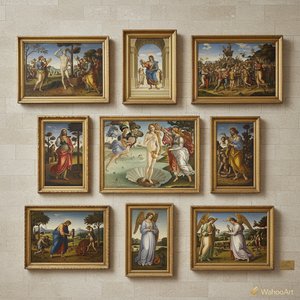
Les 10 Chefs-d'œuvre de la Renaissance Précoce : Artistes et Décor Intemporels
Plongez au cœur de la Renaissance italienne ! Découvrez les 10 chefs-d'œuvre de Botticelli, Léonard de Vinci et Raphaël. Histoire, techniques & inspiration déco. Reproductions tableaux sur


