Text size

() ·

A painting made for you, by hand

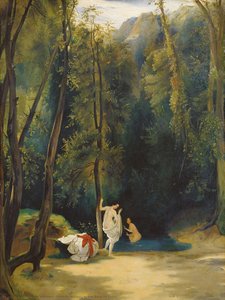
Bathers in Terni Park

Reproduction à l'huile faite à la main

Huile sur toile peinte à la main, avec cadre et dimensions personnalisés, réalisée sur commande par nos artistes. ( Passer au format impression Passer au format numérique)

Description de la pièce

Carl Blechen’s ‘Bathers in Terni Park,’ painted in 1836, captures a tranquil scene of people enjoying the outdoors. Featuring three central figures interacting with the natural environment alongside a bird perched on a branch, it exemplifies Romantic landscape painting and Blechen's fascination with industrialization.

Biographie de l'artiste

Carl Blechen (1798-1840) était un peintre romantique allemand célèbre pour ses paysages évocateurs et ses représentations pionnières de l'industrialisation précoce. Explorez ses croquis italiens et son influence durable.

from ·

Chapter 1

How large should it be?

Slide to change the size; the picture on the left shows the frame at its real width. The proportions of the original are kept.

Format standard
sur mesure
CM
INCH

Choisissez parmi nos formats prédéfinis qui respectent les proportions originales de l’œuvre.

largeur
hauteur

Saisissez la largeur et la hauteur souhaitées, pour s'adapter à votre cadre ou à votre mur. Cette œuvre est peinte à la main ; ainsi, pour un format de forme différente, l'artiste peut peindre un peu plus autour du tableau ou réduire légèrement les bords — c'est vous qui choisissez. Nous vous envoyons une maquette numérique pour approbation avant que la peinture ne commence. L'image présentée sur cette page ne reflète pas le résultat réel — seule la maquette le fait.

Chapter 2

How should it arrive?

Choose the edges of the stretched canvas

Choose your frame

Corner sample of the WhiteWrap canvas edge finish, stretched on bois massif bars
White €1
Corner sample of the BlurSideWrap canvas edge finish, stretched on bois massif bars
Blurside €1
Corner sample of the ExtendedWrap canvas edge finish, stretched on bois massif bars
Extended €1
Corner sample of the P118B picture frame: polystyrène moulé, 5 cm wide and 3 cm thick
P118B €10
Corner sample of the P118H picture frame: polystyrène moulé, 5 cm wide and 3 cm thick
P118H €10
Corner sample of the P118W picture frame: polystyrène moulé, 5 cm wide and 3 cm thick
P118W €10
Corner sample of the P438Z picture frame: polystyrène moulé, 5.5 cm wide and 3.5 cm thick
P438Z €10
Corner sample of the P508JH picture frame: polystyrène moulé, 7 cm wide and 3.5 cm thick
P508JH €12
Corner sample of the P508YH picture frame: polystyrène moulé, 7 cm wide and 3.5 cm thick
P508YH €12
Corner sample of the P805H picture frame: polystyrène moulé, 5 cm wide and 3.5 cm thick
P805H €10
Corner sample of the P805Z picture frame: polystyrène moulé, 5 cm wide and 3.5 cm thick
P805Z €10
Corner sample of the P919BZ picture frame: polystyrène moulé, 7 cm wide and 3.5 cm thick
P919BZ €10
Corner sample of the P919G picture frame: polystyrène moulé, 7 cm wide and 3.5 cm thick
P919G €10
Corner sample of the P919XJ picture frame: polystyrène moulé, 7 cm wide and 3.5 cm thick
P919XJ €10
Corner sample of the P959ZH picture frame: polystyrène moulé, 5 cm wide and 3 cm thick
P959ZH €10
Corner sample of the P968JZ picture frame: polystyrène moulé, 6 cm wide and 4 cm thick
P968JZ €12
Corner sample of the W106C picture frame: bois massif, 5 cm wide and 3 cm thick
W106C €8
Corner sample of the W218G picture frame: bois massif, 5 cm wide and 3 cm thick
W218G €10
Corner sample of the W218JH picture frame: bois massif, 5 cm wide and 3 cm thick
W218JH €8
Corner sample of the W218Y picture frame: bois massif, 5 cm wide and 3 cm thick
W218Y €10
Corner sample of the W307PJ picture frame: bois massif, 6 cm wide and 3 cm thick
W307PJ €10
Corner sample of the W316G picture frame: bois massif, 6 cm wide and 3 cm thick
W316G €10
Corner sample of the W316PJ picture frame: bois massif, 6 cm wide and 3 cm thick
W316PJ €8
Corner sample of the W316Y picture frame: bois massif, 6 cm wide and 3 cm thick
W316Y €10
Corner sample of the W398PJ picture frame: bois massif, 5 cm wide and 3 cm thick
W398PJ €8
Corner sample of the W4111J picture frame: bois massif, 6.5 cm wide and 3.5 cm thick
W4111J €10
Corner sample of the W500HY picture frame: bois massif, 7 cm wide and 5 cm thick
W500HY €15
Corner sample of the W500JH picture frame: bois massif, 7 cm wide and 5 cm thick
W500JH €15
Corner sample of the W692G picture frame: bois massif, 8 cm wide and 4 cm thick
W692G €12
Corner sample of the W849H picture frame: bois massif, 5 cm wide and 3 cm thick
W849H €8
Corner sample of the W940BG picture frame: bois massif, 7.5 cm wide and 4.5 cm thick
W940BG €15
Corner sample of the W953PJ picture frame: bois massif, 6 cm wide and 3.5 cm thick
W953PJ €8
Corner sample of the H24-GOLD picture frame: bois sculpté et apprêté au gesso, 10 cm wide and 6 cm thick
H24-GOLD €30
Corner sample of the H24-SILVER picture frame: bois sculpté et apprêté au gesso, 10 cm wide and 6 cm thick
H24-SILVER €30
Corner sample of the H36-GOLD picture frame: bois sculpté et apprêté au gesso, 15 cm wide and 6.5 cm thick
H36-GOLD €45
Corner sample of the H36-SILVER picture frame: bois sculpté et apprêté au gesso, 15 cm wide and 6.5 cm thick
H36-SILVER €45
Aperçu du cadre
Sous cadre

Moulding: . Overall size with the frame: .

Chapter 3

Who paints it, and should anything change?

Examples of what can be changed: Replace face with customer photo; Add pet (e.g., replace cat with dog); Include hidden message in background; Change background landscape or elements.
After order, OriginalUniqueArt.com team will email client for instructions and provide a mockup preview

Livraison dans le monde entier () en 3 à 4 semaines au lieu des 5 semaines habituelles. (2 novembre). Aucun compromis sur la qualité.

Chapter 4

The finishing touches

A nameplate, as in a museum?

Détails de la plaque en bronze gravée

This elegant plaque features the artist's name and the title of the artwork, finely engraved for a timeless presentation.

It is made from bronze with a refined, elegant finish. The text is precisely laser-engraved for a sharp and permanent result. Measuring 9x2 cm, the plaque is compact yet easy to read. It's built to be durable and scratch-resistant, offering a professional, museum-quality look. Mounting is simple thanks to the included adhesive backing.

Détails de la plaque en acrylique transparent

The plaque includes essential engraved details such as the artist's name, the title of the artwork, the date it was created, the type of media used-like oil on canvas or watercolor-a brief description of the piece, and a QR code that links to the complete artwork information.

It is crafted from clear acrylic, offering a sleek, modern appearance. The text is UV-engraved in black to ensure strong visual contrast. With a size of 10x15 cm, it ensures optimal readability. It comes equipped with two metal hooks for secure wall mounting. The plaque is designed to be weather-resistant, making it suitable for various environments, and it includes interactive features that work seamlessly with smartphone scanning.

Détails de la plaque en acrylique noir

This elegant plaque includes engraved information such as the artist's name, the title of the artwork, the date it was created, the type of media used (like oil on canvas or watercolor), a short description of the artwork, and a QR code for quick access to more information.

The plaque itself is made from refined black acrylic with a premium finish. The text is laser-engraved in white for high contrast and readability. Its size is 10x15 cm, designed to be easy to read. It comes with two metal hooks for professional mounting. The design is sleek and fits any interior style. It is also weather-resistant and durable, with built-in digital integration for mobile compatibility.

A protective varnish?

When do you need it?

Chapter 5

Your painting, as you ordered it

Bathers in Terni Park

Technique de reproduction

Format de la reproduction

-

Artiste de prestige

Plus de détails, de finesse et un temps de production accru

-

Cadre de reproduction

-

-

Pour les œuvres ou reproductions dont un côté mesure plus de 105 cm (environ 41 pouces), le cadre sera expédié sous forme de kit démonté. Cette méthode garantit une livraison sécurisée et prévient tout dommage pendant le transport.

Assemblage professionnel requis - ce produit n'est pas destiné au bricolage (DIY).
Le kit doit être assemblé et la toile tendue par un encadreur professionnel expérimenté, en utilisant de la colle à bois (non fournie), une pince à tendre la toile et des serre-joints pour maintenir les traverses d'équerre pendant le séchage de la colle. Un assemblage incorrect ou une tension inégale de la toile peut endommager l'œuvre de manière irréversible et n'est pas couvert par notre garantie.

  • Toutes les baguettes en bois massif sont incluses, découpées avec précision à la taille requise.

  • À assembler avec les vis fournies, ainsi qu'avec de la colle à bois pour les assemblages d'angles (non fournie), à prévoir par votre encadreur.

  • L'utilisation d'outils professionnels est requise et non incluse : une pince à tendre la toile (tendeur) et des serre-joints pour maintenir les baguettes bien d'équerre pendant le séchage de la colle.

Important :
L'assemblage des angles nécessite de la colle à bois, les barres doivent être maintenues avec des serre-joints jusqu'au séchage complet de la colle, et le tendage de la toile sur le châssis assemblé nécessite une pince à tendre la toile. Aucun de ces éléments n'est inclus dans le kit. Veuillez consulter un encadreur professionnel expérimenté avant de commander ce format.

Cartel

-

-

Vernis de protection

Vernis brillant (intensifie les couleurs, protège de la lumière et de l'humidité)

-

Personnaliser mon œuvre

Exemples de personnalisation : remplacer le visage par une photo du client ; ajouter un animal de compagnie (par exemple, remplacer un chat par un chien) ; inclure un message caché en arrière-plan ; modifier le paysage ou les éléments d'arrière-plan.

-

Livraison urgente

Livraison dans le monde entier () en 3 à 4 semaines au lieu des 5 semaines habituelles. (2 novembre). Aucune concession sur la qualité.

-

Livraison express

Livraison dans le monde entier () sous 5 semaines. (9 novembre).

Inclus

Prix total

€ 267

Prix total € 267

L'option verre n'est disponible que pour les dimensions inférieures à 110 cm.

Included with every order

  • Livraison express gratuite dans le monde entier

  • Toile de lin de qualité supérieure
  • Assurance transport complète
  • Garantie de remboursement des droits de douane
  • Garantie de fidélité des couleurs
  • Politique de retour de 100 jours (uniquement en cas de défaut)
  • Garantie de remboursement à 100%
  • Offre de tarifs dégressifs

A Moment of Tranquility: Carl Blechen’s ‘Bathers in Terni Park’

Carl Blechen's “Bathers in Terni Park,” painted in 1836, is more than just a picturesque depiction of figures enjoying a woodland retreat; it’s a poignant meditation on the burgeoning relationship between humanity and the natural world at a pivotal moment in European history. Measuring 107 x 78 cm, this work offers a captivating glimpse into the Romantic era's fascination with both sublime beauty and the unsettling realities of industrialization – a theme subtly woven throughout Blechen’s oeuvre.

  • Subject Matter: The scene unfolds within the Terni Park, a location that provided Blechen with ample opportunity to observe and capture the evolving landscape. Three figures are centrally positioned, engaged in an activity suggestive of leisure – perhaps contemplation or simply appreciating the serenity of their surroundings. A delicate bird adds a layer of natural detail, enhancing the sense of peaceful observation.
  • Style & Technique: Blechen’s style aligns firmly with Romanticism, yet he distinguishes himself through his acute awareness of the changing world around him. The brushwork is loose and expressive, characteristic of the period, but tempered by a meticulous attention to detail in rendering the foliage and light. He employs atmospheric perspective skillfully, creating depth and emphasizing the vastness of the park.

Historical Context: Romantic Industrialization

Painted in 1836, “Bathers in Terni Park” emerges from a fascinating historical context – the dawn of industrialization. Carl Blechen was one of the first artists to confront this new reality head-on. While many Romantic painters idealized untouched nature, Blechen recognized that human activity was already beginning to reshape the landscape. The presence of figures enjoying the park subtly acknowledges this shift, prompting reflection on humanity’s role within a world undergoing profound transformation. This painting can be viewed as a visual document of this transition, capturing a moment before the full impact of industrialization irrevocably altered the natural environment.

Interestingly, Blechen's work echoes themes explored in “Woman Bathing in the Park of Terni” (1829), demonstrating a consistent engagement with the intersection of nature and human experience. This connection is further reinforced by the bird motif – often associated with freedom and spirituality – adding another layer of symbolic resonance to the composition.

Symbolism & Emotional Impact

The painting’s emotional impact lies in its quiet contemplation. The figures, seemingly lost in their own thoughts or simply enjoying the beauty around them, evoke a sense of tranquility and connection with nature. Blechen masterfully captures a fleeting moment of peace – a sentiment deeply valued within the Romantic movement. The composition invites the viewer to share in this serenity, offering a respite from the anxieties of an era defined by rapid change.

Provenance & Reproduction

This hand-painted reproduction faithfully recreates Blechen’s original vision, capturing the nuances of light and color that define his distinctive style. A testament to Blechen's artistic legacy, this artwork is ideal for enhancing any interior space, bringing a touch of Romantic elegance and thoughtful reflection to your home or office.

Questions et réponses

Quelle taille est recommandée pour "Bathers in Terni Park" dans un(e) Living Room ?

L'association recommandée pour «Bathers in Terni Park» de Carl Blechen : une impression de Medium dans un(e) Living Room.

À quel mouvement artistique appartient « Bathers in Terni Park » ?

«Bathers in Terni Park» de Carl Blechen appartient au mouvement Romantic Industrialization. Ce mouvement apporte le contexte stylistique de l'œuvre.

Quel est le niveau de contraste de «Bathers in Terni Park» de Carl Blechen ?

Le niveau de contraste de «Bathers in Terni Park» de Carl Blechen est Statement.

More about this painting

Aperçu en situation Visualiser en RA Passer au format impression Passer au format numérique Envoyer
Détails de l'œuvre Guide Ajouter aux favoris Télécharger l'image Articles similaires Radiographie Diaporama Q&A Statistiques

In numbers

  • 1836the year it was painted
  • 29frames to choose from
  • standard sizes, in its own proportions
  • 5weeks to paint and deliver it
Carl Blechen

Carl Blechen

1798 - 1840, Allemagne

Quick facts about Carl Blechen

  • Artistes Influençant:
    • Caspar David Friedrich
    • Johann Christian Dahl
  • Date De Décès: 23 juillet 1840
  • Date De Naissance: 29 juillet 1798
  • Lieu De Naissance: Cottbus, Allemagne
  • Mouvement Artistique: Romantisme
  • Nationalité: Allemand
  • Nom Complet: Carl Eduard Ferdinand Blechen
  • Œuvres Notables:
    • Im Berliner Tiergarten
    • Waldweg bei Spandau
    • Bau der Teufelsbrücke

Biographie de l'artiste

Un Précurseur de l'Industrialisation Romantique : La Vie et l’Œuvre de Carl Blechen

Carl Eduard Ferdinand Blechen, né à Cottbus en Allemagne en 1798, occupe une place singulière et souvent négligée au sein de la tradition du paysage. Sa vie fut marquée par un brillant talent artistique et des troubles personnels, une dualité qui façonna profondément son œuvre évocatrice et novatrice. Initialement destiné à une carrière pragmatique dans le secteur bancaire en raison des contraintes financières familiales, les inclinations artistiques innées de Blechen finirent par l’emporter. Il poursuivit ses études à l'Académie des Arts de Berlin en 1822, s'engageant sur une voie qui le verrait devenir l'un des premiers artistes à aborder les défis esthétiques – et les possibilités – présentés par la première industrialisation.

Les premières années de Blechen furent imprégnées des idéaux romantiques qui balayaient l’Europe. Cependant, contrairement à beaucoup de ses contemporains qui se concentraient uniquement sur la beauté naturelle idéalisée ou la grandeur historique, le regard de Blechen fut attiré par un monde en mutation. Un voyage déterminant en Italie entre 1828 et 1829 s'avéra transformateur. Immersé dans la lumière et l’atmosphère de la campagne italienne, il perfectionna ses compétences en esquissant sur le motif, capturant des moments fugaces et des effets dramatiques avec une sensibilité remarquable. Ces esquisses n’étaient pas de simples études préparatoires ; elles étaient imprégnées d'une énergie vibrante qui caractériserait son style mature. Il retourna à Berlin non seulement comme un peintre techniquement compétent mais aussi comme un artiste doté d'une vision distincte – une vision cherchant à concilier la beauté sublime de la nature avec les réalités croissantes de la modernité.

Naviguer entre Tradition et Transformation

L’œuvre artistique de Blechen se caractérise par une tension captivante entre sensibilité romantique et réalisme naissant. Il n'hésita pas à représenter le paysage industriel en plein essor, mais ne le célébra pas non plus aveuglément. Des œuvres comme Bau der Teufelsbrücke (Construction du Pont du Diable), peinte entre 1830 et 1832, illustrent parfaitement cette approche. La peinture ne glorifie pas l’exploit d'ingénierie ; au lieu de cela, elle présente une scène de labeur ardu sur un fond dramatique, laissant entrevoir à la fois l’ambition humaine et le potentiel de perturbation de l’ordre naturel. Cette volonté de confronter les complexités de son époque le distingue de beaucoup de ses contemporains.

Ses paysages sont souvent imprégnés d'une atmosphère mélancolique, reflétant non seulement l'évolution de l'environnement physique mais aussi ses propres luttes intérieures. Waldweg bei Spandau (Chemin Forestier près de Spandau), par exemple, évoque un sentiment de solitude et d’introspection, tout en démontrant la maîtrise de Blechen de la lumière et de l’ombre. Il utilisa habilement la perspective atmosphérique pour créer de la profondeur et de l'ambiance, attirant le spectateur dans la scène et invitant à la contemplation. Il ne se contentait pas d'enregistrer ce qu'il voyait ; il transmettait une réponse émotionnelle à cela.

Un Génie Tourmenté et un Héritage Durable

Malgré ses réalisations artistiques, la vie de Blechen fut tragiquement interrompue par la maladie mentale. Nommé professeur de peinture de paysage à l'Académie de Berlin en 1831 – témoignage de sa réputation croissante – son état commença à se détériorer rapidement après 1835. Forcé de prendre un congé et finalement hospitalisé, il continua à créer de l’art même au milieu de ses souffrances, produisant des dessins poignants qui offrent un aperçu de son monde intérieur tourmenté. Il mourut à Berlin en 1840 à l'âge de 41 ans.

Bien que sa carrière ait été relativement brève, l’influence de Carl Blechen sur les générations d’artistes suivantes est indéniable. Ses représentations pionnières des paysages industriels ont ouvert la voie aux peintres réalistes et impressionnistes ultérieurs qui cherchaient à capturer le visage changeant de la vie moderne. Il a démontré qu'il était possible de trouver la beauté – et du sens – même au milieu de la transformation, une leçon qui continue d’inspirer les artistes aujourd’hui. Son œuvre reste un puissant rappel de la relation complexe entre l’humanité, la nature et le progrès.

Œuvres Clés & Collections

  • Im Berliner Tiergarten (Le Jardin Zoologique de Berlin), 1825 : Un exemple précoce de sa capacité à capturer les effets atmosphériques et les scènes quotidiennes avec une sensibilité romantique.
  • Waldweg bei Spandau (Chemin Forestier près de Spandau) : Un paysage hantant qui illustre sa maîtrise de la lumière, de l’ombre et de l'ambiance.
  • Bau der Teufelsbrücke (Construction du Pont du Diable), 1830–32 : Une représentation novatrice de la première industrialisation, mettant en évidence à la fois l’ambition humaine et son impact sur le monde naturel.

Aujourd'hui, les œuvres de Blechen se trouvent dans des collections de musées prestigieux du monde entier, notamment la Kunsthalle Bielefeld en Allemagne, le Fitzwilliam Museum à Cambridge et la National Gallery à Londres. Ces institutions préservent son héritage pour les générations futures, garantissant que sa vision innovante continue d’inspirer et de défier les spectateurs.

Informations clés

  • Artistic style: Evocative Romanticism
  • Year: 1836
  • Location: Nationalgalerie, Berlin
  • Dimensions: 107 x 78 cm
  • Medium: Oil on canvas
  • Influences: German Romanticism

Quiz d'art

Chaque question ne comporte qu'une seule bonne réponse.

Question 1:
What artistic movement is Carl Blechen primarily associated with?
Question 2:
The painting depicts a scene of:
Question 3:
What is notable about Blechen's approach to portraying the natural world?
Question 4:
In what year was ‘Bathers in Terni Park’ created?
Question 5:
Carl Blechen's style is considered a pioneering example of what artistic trend?