
 Aperçu en situation
 Envoyer
 Partager
 Détails de l'œuvre
 Guide
Guide

 Télécharger l'image
 Articles similaires
 Radiographie
 Diaporama
 Questions et réponses
 Statistiques
Place Saint-Marc

- 115.0 x 154.0 cm


 Lire la suite
Giclées et impressions d'art
Impressions giclées ou sur toile de qualité musée, avec une production rapide et des finitions au choix. ( Commander la reproduction peinte à la main Passer au format numérique)




P118B €10

P118H €10

P118W €10

P438Z €10

P508JH €12

P508YH €12

P805H €10

P805Z €10

P919BZ €10

P919G €10

P919XJ €10

P959ZH €10

P968JZ €12

W106C €8

W218G €10

W218JH €8

W218Y €10

W307PJ €10

W316G €10

W316PJ €8

W316Y €10

W398PJ €8

W4111J €10

W500HY €15

W500JH €15

W692G €12

W849H €8

W940BG €15

W953PJ €8




Choisissez parmi nos formats prédéfinis qui respectent les proportions originales de l’œuvre.

Saisissez la largeur et la hauteur souhaitées pour qu'elles s'adaptent à votre cadre ou à votre mur. Une impression peut être recadrée, mais jamais agrandie au-delà de l'image originale ; ainsi, un format de forme différente entraînera la perte d'une partie de l'image. Nous vous envoyons une maquette numérique pour approbation avant toute impression. L'image présentée sur cette page ne montre pas le recadrage réel — seule la maquette le permet.
Livraison dans le monde entier () en 2 semaines au lieu des 4/5 semaines habituelles. (7 novembre)

Livraison express gratuite dans le monde entier

Toile de lin de qualité supérieure

Assurance transport complète

Garantie de remboursement des droits de douane

Garantie de fidélité des couleurs

Politique de retour de 100 jours (uniquement en cas de défaut)

Garantie de remboursement à 100%

Offre de tarifs dégressifs
 L'option verre n'est disponible que pour les dimensions inférieures à 110 cm.

Place Saint-Marc
Giclées et impressions d'art
Format de la reproduction
-


Prix total
€ 72
Une fenêtre sur la vie vénitienne : La Piazza San Marco de Canaletto
Giovanni Antonio Canal, universellement connu sous le nom de Canaletto, possédait un don singulier : la capacité de figer des instants dans le temps avec une précision époustouflante et un sens de l'atmosphère presque palpable. Sa « Piazza San Marco », peinte en 1735, est sans doute son œuvre la plus célèbre, offrant aux spectateurs un aperçu inégalé du cœur vibrant de Venise au XVIIIe siècle. Ce paysage urbain méticuleusement rendu n'est pas seulement la représentation d'une place publique ; c'est un récit soigneusement construit de la vie quotidienne, de la grandeur architecturale et de l'esprit éternel d'une ville imprégnée d'histoire. L'impact du tableau provient de la maîtrise de Canaletto dans l'art topographique — son dévouement à dépeindre avec exactitude les paysages urbains avec un réalisme presque photographique. La richesse des détails, des pavés individuels sous nos pieds aux expressions sur les visages de la citoyenneté en mouvement, invite le spectateur à s'immerger directement dans la scène pour expérimenter Venise telle qu'elle fut.
Brillance technique : L'huile sur toile – Un héritage d'observation
- Médium : Huile sur toile – une combinaison traditionnelle qui permettait à Canaletto de superposer les couches de couleur avec une subtilité et une profondeur remarquables.
- Technique : Exécutée avec un soin infini, la peinture illustre l'utilisation emblématique par Canaletto de la perspective linéaire et du clair-obscur (le contraste dramatique entre l'ombre et la lumière). Le rendu méticuleux des éléments architecturaux — l'imposante tour de l'horloge, les façades ornées des bâtiments environnants — démontre une compréhension profonde des relations spatiales.
- Échelle : Mesurant 115 x 154 cm, la taille substantielle du tableau renforce encore sa qualité immersive, permettant une appréciation intime des choix artistiques de Canaletto.
Contexte historique et résonance symbolique
Peinte durant une période de changements politiques et sociaux importants à Venise — une république aux prises avec l'ascension des puissances européennes — la « Piazza San Marco » sert de précieux document historique. La place elle-même, cœur même de la vie vénitienne, est représentée grouillante d'activité : des marchands menant leurs affaires, des citoyens engagés dans la conversation et des chevaux tirant des calèches le long des rues pavées. La tour de l'horloge, symbole de l'autorité civique et de l'ordre temporel, domine la composition, ancrant la scène et renforçant l'importance du temps dans le rythme de la cité. La présence de personnages engagés dans diverses activités témoigne du dynamisme de la société vénitienne — un carrefour bouillonnant de commerce, de culture et d'interactions sociales. Ce tableau n'est pas seulement un enregistrement de Venise ; c'est une fenêtre ouverte sur son âme.
Collectionner un chef-d'œuvre : Options de reproduction
La « Piazza San Marco » de Canaletto demeure un chef-d'œuvre intemporel, admiré pour sa signification historique et son mérite artistique. OriginalUniqueArt propose des reproductions méticuleusement élaborées, peintes à la main à l'huile, de cette œuvre emblématique, permettant aux amateurs d'art de posséder un fragment de l'histoire vénitienne. Ces reproductions sont créées à l'aide de techniques traditionnelles, reflétant l'approche originale de Canaletto, garantissant ainsi une représentation authentique de cet ouvrage remarquable. Que ce soit pour orner un grand salon ou pour ajouter une touche d'élégance éternelle à un espace plus restreint, une reproduction de la « Piazza San Marco » est assurément destinée à devenir un point focal captivant.
Questions et réponses
Que représente « Place Saint-Marc » ?
L'œuvre « Place Saint-Marc » représente place vénitienne, tour de l'horloge, style canaletto, paysage urbain, art baroque, détail architectural, vie vénitienne.
L'œuvre « Place Saint-Marc » est-elle restée dans le pays d'origine de son artiste ?
Non - l'œuvre est conservée à l'étranger. Giovanni Antonio Canal est né(e) en Italie, tandis que le musée qui conserve l'original de « Place Saint-Marc » se situe en USA.
Est-il possible de télécharger l'image de « Place Saint-Marc » ?
L'image de «Place Saint-Marc» de Giovanni Antonio Canal peut être téléchargée sur la page de téléchargement de l'œuvre : Téléchargement (téléchargement d'une image numérique haute résolution).
Biographie de l'artiste
Giovanni Antonio Canal
Giovanni Antonio Canal, commonly known as canaletto, was born in Venice on October 18, 1697, to Bernardo Canal, a painter of theatrical scene settings, and Artemisia Barbieri. He was the son of a noble family steeped in artistic tradition—Bernardo Canal himself had been a respected artist, establishing a lineage dedicated to visual representation. Canaletto’s early training commenced with his father, who instilled within him the fundamental principles of painting, shaping his formative years into an immersion in artistic craftsmanship. This familial influence would prove pivotal in nurturing his innate talent and guiding his subsequent artistic pursuits.The Making of a Master
In 1718, Canaletto embarked on a transformative journey to Rome—a city renowned for its artistic fervor and intellectual dynamism. During this period, he actively participated in the production of scenery for two operas by Alessandro Scarlatti, immersing himself in the theatrical world and honing his skills in designing immersive environments. This experience profoundly impacted his artistic development, exposing him to innovative techniques and fostering a keen understanding of visual storytelling—a cornerstone of his distinctive style. The collaboration with Scarlatti wasn’t merely professional; it was an encounter with the very essence of Baroque aesthetics. Upon returning to Venice, Canaletto swiftly established himself as a leading figure in Venetian landscape painting, adopting a technique that would soon earn him international acclaim: *veduta*. He meticulously crafted detailed depictions of the city's architectural grandeur and bustling public life—capturing not just what was seen but conveying an emotional resonance. His preparatory drawings were remarkably precise, reflecting his unwavering commitment to accuracy while simultaneously allowing for artistic interpretation. Canaletto’s method mirrored that of Giovanni Paolo Pannini, a Venetian artist who pioneered topographical art, emphasizing observation and meticulous documentation.Notable Works and Collaborations
Canaletto's oeuvre comprises numerous masterpieces that exemplify the zenith of Venetian landscape painting—a genre characterized by its luminous palette and masterful perspective. Among his most celebrated works are “The Stonemason’s Yard” (c. 1725), a captivating portrayal of Venetian craftsmanship, and “Regatta on the Grand Canal” (c. 1730), which vividly captures the splendor of Venice's ceremonial processions—a testament to Canaletto’s ability to convey both visual accuracy and emotional depth. His depiction of Eton College (1746-1756) stands as a poignant reminder of his influence in England, where he collaborated closely with Bernardo Bellotto, who became an equally accomplished artist. Together, they produced breathtaking panoramas of Dresden and Vienna—works that continue to inspire admiration for their compositional elegance and technical virtuosity.Artistic Style and Technique
Canaletto’s distinctive artistic style is inextricably linked to his pioneering use of the camera obscura—a darkened room equipped with a lens that projects an inverted image of the outside world onto a surface illuminated by candlelight. This ingenious device allowed him to achieve unparalleled topographical accuracy, ensuring that his paintings faithfully reproduced the contours and textures of Venice and London. However, Canaletto’s artistic vision extended beyond mere replication; he skillfully manipulated perspective and employed subtle tonal variations to create atmospheric effects—transforming ordinary scenes into emotionally evocative landscapes. His meticulous attention to detail—from the reflections in windows to the folds of drapery—elevated his paintings to levels of artistic sophistication rarely achieved by his contemporaries. Canaletto’s legacy resides not only in his technical prowess but also in his ability to imbue his works with a palpable sense of place and time—capturing the spirit of an era with remarkable sensitivity and artistry.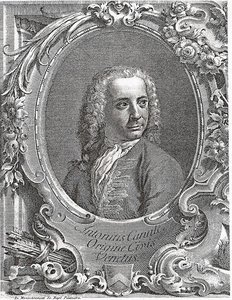
Giovanni Antonio Canal
1697 - 1768 , Italie
L'essentiel de l'artiste
- Artistic Movement Or Style: Vedute Venice
- Artists Or Movements Influenced By This Artist: ['Tintoretto']
- Artists Who Influenced This Artist: ['Giovanni Paolo Pannini']
- Date Of Birth: October 18, 1697
- Date Of Death: April 19, 1768
- Full Name: Giovanni Antonio Canal
- Nationality: Italian
- Notable Artworks:
- The Stonemason's Yard
- Regatta on the Grand Canal
- Eton College
- Place Of Birth: Venice, Italy
Articles connexes

Canaletto : Lumière, Espace et Observation Sociale dans la Venise du XVIIIe Siècle
Explorez l'œuvre de Canaletto et découvrez la magie de Venise au XVIIIe siècle. Analyse approfondie de sa technique, son observation sociale et son héritage artistique. Un voyage visuel incontournable pour les amateurs d'art.

Venetian Renaissance: The Mastery of Color, Light, and the Art of Colorito
Explore the luminous mastery of the Venetian Renaissance. Discover how masters like Titian and Giorgione revolutionized art through colorito, light, and atmosphere. An expert guide to the golden age of Italian painting for collectors and enthusiasts.

Maître du Drame : Les 25 Plus Grands Chefs-d'œuvre de Jacopo Tintoretto
Explorez le génie de Tintoretto et ses 25 chefs-d'œuvre de la Renaissance. Découvrez toute la collection sur OriginalUniqueArt.com.

L’Héritage du Colorito : Lumière et Chromatisme dans la Renaissance Vénitienne
Explorez le génie du colorito vénitien et ses maîtres. Plongez dans l'éclat de la Renaissance avec notre expertise.

Pietro Longhi's Venetian Scenes: A Study of Rococo Society & Domestic Life
Explore the captivating world of Pietro Longhi's Venetian scenes! Discover insightful analysis of his Rococo masterpieces & social commentary on 18th-century life. Learn about this 'Venetian Hogarth' and his lasting artistic legacy.


