

 Aperçu en situation
 Partager
 Partager
 Détails

 Télécharger
 Articles similaires
 Radiographie
 Voir le diaporama
 Statistiques
John Bunyan's 'The Pilgrim's Progress' 'Ignorance, Having Been Ferried Over the River by Vainhope, is Cast into Hell Because He Has Not a Certificate'
 291.0 x 119.0 cm
 Afficher la suite
Reproduction à l'huile faite à la main
Huile sur toile peinte à la main, avec cadre et dimensions personnalisés, réalisée sur commande par nos artistes. ( Passer au format impression Passer au format image numérique)




































Choisissez parmi nos formats prédéfinis qui respectent les proportions originales de l’œuvre.

Vous pouvez saisir vos propres dimensions pour l'adapter à un cadre ou à un espace spécifique. Si la taille sélectionnée ne correspond pas aux proportions de l'image d'origine, nous recadrerons l'œuvre ou prolongerons la peinture avec des éléments peints à la main supplémentaires. Une maquette numérique vous sera envoyée pour approbation avant le début de la production.
Veuillez noter que l'aperçu à l'écran ne reflète pas le recadrage ou l'extension réels. Seule la maquette montrera fidèlement la composition finale.
Bien que des tailles personnalisées soient disponibles, nous vous recommandons de sélectionner une dimension dans la liste prédéfinie afin de préserver les proportions d'origine.
Après la commande, l’équipe OriginalUniqueArt.com contactera le client par e-mail pour recueillir ses instructions et lui fournira une maquette d’aperçu
Livraison dans le monde entier () en 3 à 4 semaines au lieu des 5 semaines habituelles. (18 septembre). Aucun compromis sur la qualité.

Livraison express gratuite dans le monde entier

Toile de lin de haute qualité

Assurance transport complète

Garantie de remboursement des droits de douane

Garantie de fidélité des couleurs

Garantie de retour de 100 jours (uniquement en cas de défaut)

Garantie de remboursement à 100%

Tarifs dégressifs sur quantité
 L'option verre n'est disponible que pour les dimensions inférieures à 110 cm.

John Bunyan's 'The Pilgrim's Progress' 'Ignorance, Having Been Ferried Over the River by Vainhope, is Cast into Hell Because He Has Not a Certificate'
Technique de reproduction
Format de la reproduction
-


Prix total final
$ 300
Biographie de l'artiste
Brian Dick Lauder Thomas: A Master of Sacred Narrative
Brian Dick Lauder Thomas (1912-1989) wasn’t merely a British artist; he was a visual storyteller, meticulously crafting narratives within the sacred spaces of churches across England and beyond. His career, spanning nearly seven decades, is defined by an extraordinary dedication to detail, a profound understanding of symbolism, and a remarkable ability to breathe life into stained glass – transforming static panels into dynamic windows that resonated with both historical weight and contemporary spirituality. Born in London, Thomas’s artistic journey began at the Byam Shaw School of Drawing and Painting, where he honed his skills before embarking on a career deeply intertwined with the restoration and embellishment of historic churches. His work wasn't simply decorative; it was an active engagement with religious iconography, demanding both technical mastery and a sensitive interpretation of complex theological themes.Early Life and Artistic Foundations
Thomas’s formative years were marked by a growing awareness of the power of visual communication. He initially pursued illustration before finding his true calling in stained glass. This background proved invaluable, imbuing his work with a keen eye for composition, color theory, and the subtle nuances of storytelling – skills he later applied to his commission work. Crucially, Thomas’s artistic development was shaped by a deep appreciation for the Victorian era's fascination with symbolism and narrative imagery. He inherited this legacy from his mentor, William Richmond, a prominent figure in the British stained glass movement, who instilled in him a rigorous approach to design and execution. This influence is evident throughout Thomas’s oeuvre – particularly in his meticulous attention to detail and his preference for complex, multi-layered compositions.The St Paul's Cathedral Commission: A Defining Moment
Perhaps the most significant chapter in Thomas’s career unfolded during his involvement with the restoration of St Paul’s Cathedral in London. Appointed as a key designer for the ambitious project undertaken after World War II, he was tasked with creating new windows to complement the existing architecture and reflect the cathedral's enduring significance. This commission demanded an extraordinary level of skill and sensitivity. Thomas didn’t simply replicate traditional designs; instead, he developed entirely original compositions that seamlessly integrated historical references, biblical narratives, and contemporary concerns. The ‘Spread of the Church’ series, a monumental undertaking comprising dozens of panels, stands as a testament to his vision – a vibrant tapestry of figures and symbols illustrating the propagation of Christianity across time and continents. His work on these windows, particularly those depicting scenes from the Book of Genesis, is considered a landmark achievement in British stained glass art.Beyond St Paul’s: A Diverse Portfolio
While his work at St Paul's Cathedral cemented his reputation, Thomas’s artistic output extended far beyond this single commission. He undertook numerous projects across England and Wales, including the restoration of churches in Peterborough, Islington, Fulham Palace, and Stevenage. Each project presented unique challenges and opportunities, allowing him to explore a wide range of subjects and techniques. His designs for St John the Baptist Church in Peterborough, for example, showcased his ability to capture the energy and drama of biblical scenes with remarkable clarity. Similarly, his work at Fulham Palace demonstrated his versatility, encompassing both monumental murals and intricate stained glass panels. He also produced independent works, such as "A View in the Roman Campagna," a charming depiction of rural life that reveals a softer side to his artistic sensibility.Technique and Legacy
Thomas’s technical skill was unparalleled. He possessed an intimate knowledge of glassmaking techniques, meticulously overseeing every stage of the process – from design and cutting to painting and firing. His use of color was particularly noteworthy – he employed a rich palette of hues, carefully balanced to create depth, luminosity, and emotional resonance. Furthermore, Thomas’s work is characterized by its exceptional detail—every figure, every garment, every architectural element rendered with painstaking accuracy. He left behind a substantial body of work that continues to inspire artists and scholars alike. His legacy lies not only in the beauty of his creations but also in his profound understanding of how art can communicate complex ideas and evoke powerful emotions within sacred spaces. His meticulous approach and dedication to narrative storytelling have ensured his place as one of the most important figures in British stained glass history, a master who transformed light and color into enduring expressions of faith and human experience.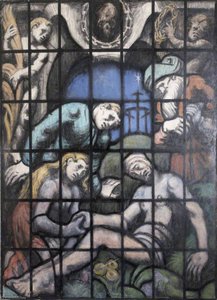
brian dick lauder thomas
1912 - 1989
En bref
- Artistic Movement Or Style: Cartoonist, Illustrator
- Artists Or Movements Influenced By This Artist: ['John Bunyan']
- Artists Who Influenced This Artist: ['Howard Mallitte']
- Date Of Birth: 1912
- Date Of Death: 1989
- Full Name: Brian Dick Lauder Thomas
- Nationality: British
- Notable Artworks:
- The Entombment
- A View in the Roman Campagna
- Ascension of Christ
- Place Of Birth: England