Passer au format impression
 Lire la suite







































 Pour les œuvres ou reproductions dont un côté mesure plus de 105 cm (environ 41 pouces), le cadre sera expédié sous forme de kit démonté. Cette méthode garantit une livraison sécurisée et prévient tout dommage pendant le transport.


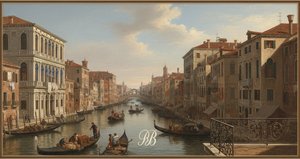
A Glimpse of Pienza’s Heart: Bernardo Rossellino's Courtyard
Bernardo Rossellino’s “Courtyard,” painted in 1459, isn’t merely a depiction of an outdoor space; it’s a carefully orchestrated tableau of Renaissance ideals – a harmonious blend of classical geometry, humanist philosophy, and the burgeoning spirit of civic pride. Created during his tenure as Master of Works for the Palazzo Piccolomini in Pienza, Italy, this painting offers a serene window into the heart of a planned city, reflecting the ambition and artistic vision of Pope Pius II.
The scene unfolds within a meticulously designed courtyard, its proportions echoing the principles of Vitruvius’s architectural treatise. The dominant form is a square, bisected by an elegant arcade – a deliberate nod to Roman precedents, yet imbued with a distinctly Florentine sensibility. Notice the careful balance between the solid strength of the stone arches and the lightness suggested by their open spaces; this interplay speaks directly to the Renaissance fascination with achieving perfect harmony between opposing forces.
Architectural Echoes: The Palazzo Piccolomini and its Context
To fully appreciate “Courtyard,” one must understand its setting. Pienza, envisioned as a new humanist city by Pope Pius II, was designed to emulate the grandeur of ancient Rome. Rossellino’s work here wasn't isolated; it was integral to the overall urban plan. The Palazzo Piccolomini, with its carefully considered layout and architectural details, served as a model for the entire city. The courtyard itself became a focal point, a space designed for contemplation, social interaction, and a connection to nature – values deeply rooted in humanist thought.
Rossellino’s design incorporates elements of both Gothic and Renaissance styles. The robust arches, reminiscent of Roman structures, are softened by the delicate detailing of the columns— Corinthian capitals, a hallmark of classical architecture. This fusion reflects the artistic trends of the time, where older traditions were reinterpreted through a new humanist lens. The light filtering through the arches creates an atmosphere of tranquility and invites the viewer to step into this idealized space.
Symbolism and Humanist Ideals
Beyond its architectural merits, “Courtyard” is rich in symbolism. The courtyard represents more than just a physical space; it embodies the humanist ideal of *vita activa* – an active life focused on civic engagement and intellectual pursuits. The open space encourages interaction and dialogue, reflecting the Renaissance emphasis on human potential and the importance of community.
Furthermore, the painting’s composition subtly references classical mythology. The careful arrangement of elements—the arches, the columns, the light—evokes images of Roman gardens and temples, suggesting a connection to the glories of antiquity. Rossellino was deeply influenced by the rediscovery of classical texts and art during the Renaissance, and this influence is evident in every detail of the painting.
A Masterpiece of Realism and Light
Rossellino’s skill as a painter is equally impressive. He captures the textures of stone, the play of light on surfaces, and the subtle nuances of color with remarkable precision. The scene feels remarkably real, inviting the viewer to step into this idealized space. The soft lighting, diffused by the arches, creates an atmosphere of serenity and tranquility – a testament to Rossellino’s mastery of chiaroscuro, the technique of using light and shadow to create depth and drama.
“Courtyard” is more than just a painting; it's a window into the Renaissance mind—a celebration of human ingenuity, civic pride, and the enduring beauty of classical ideals. Reproductions of this masterpiece offer a chance to bring this serene vision into your own home, serving as a constant reminder of the power of art to inspire and uplift.
Questions et réponses
L'œuvre «Courtyard» de Bernardo Rossellino, conservée au Palazzo Piccolomini, peut-elle faire l'objet de reproductions légales ?
Le statut des droits d'auteur de «Courtyard» de Bernardo Rossellino est clair : l'œuvre est dans le dans le domaine public - ses droits d'auteur sont tombés dans le domaine public. Sa présence au Palazzo Piccolomini ne modifie pas ce statut.
L'œuvre « Courtyard » présente-t-elle des contrastes ombre et lumière marqués ?
Le contraste clair-obscur de « Courtyard » est évalué à Bold. Le contraste décrit l'intensité de la différence entre les zones claires et les zones sombres.
Qui a créé « Courtyard » et dans quel style s'inscrit cette œuvre ?
« Courtyard » a été créé par Bernardo Rossellino dans le style Early Renaissance. L'artiste et le mouvement définissent la tradition de l'œuvre.
 Aperçu en situation
 Envoyer
 Partager
 Détails de l'œuvre
 Guide
Guide

 Télécharger l'image
 Articles similaires
 Radiographie
 Diaporama
 Questions et réponses
 Statistiques