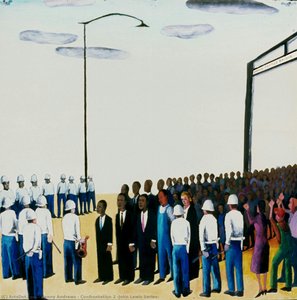
Aperçu en situation
 Envoyer
 Partager
 Détails de l'œuvre
 Guide
Guide

 Télécharger l'image
 Articles similaires
 Radiographie
 Diaporama
 Questions et réponses
 Statistiques
Attackers (John Lewis Series)


 Lire la suite
L’œuvre d'art présentée sur cette page est protégée par le droit d'auteur, ce qui signifie que nous ne pouvons légalement créer ou vendre de reproduction identique. Cette protection est appliquée en vertu d'accords internationaux tels que la Convention de Berne et par les lois nationales, notamment celles énoncées par le Loi américaine sur le droit d'auteur - Titre 17.
Cette méthode est pleinement conforme aux réglementations sur le droit d'auteur car elle ne repose pas sur la copie ou la duplication de l'œuvre protégée. Il s'agit plutôt d'une réinterprétation créative — une nouvelle peinture qui s'inspire de l'original sans pour autant lui être identique.
Giclées et impressions d'art
Impressions giclées ou sur toile de qualité musée, avec une production rapide et des finitions au choix. ( Commander la reproduction peinte à la main Passer au format numérique)




P118B €10

P118H €10

P118W €10

P438Z €10

P508JH €12

P508YH €12

P805H €10

P805Z €10

P919BZ €10

P919G €10

P919XJ €10

P959ZH €10

P968JZ €12

W106C €8

W218G €10

W218JH €8

W218Y €10

W307PJ €10

W316G €10

W316PJ €8

W316Y €10

W398PJ €8

W4111J €10

W500HY €15

W500JH €15

W692G €12

W849H €8

W940BG €15

W953PJ €8




Choisissez parmi nos formats prédéfinis qui respectent les proportions originales de l’œuvre.

Saisissez la largeur et la hauteur souhaitées pour qu'elles s'adaptent à votre cadre ou à votre mur. Une impression peut être recadrée, mais jamais agrandie au-delà de l'image originale ; ainsi, un format de forme différente entraînera la perte d'une partie de l'image. Nous vous envoyons une maquette numérique pour approbation avant toute impression. L'image présentée sur cette page ne montre pas le recadrage réel — seule la maquette le permet.
Livraison dans le monde entier () en 2 semaines au lieu des 4/5 semaines habituelles. (4 novembre)

Livraison express gratuite dans le monde entier

Toile de lin de qualité supérieure

Assurance transport complète

Garantie de remboursement des droits de douane

Garantie de fidélité des couleurs

Politique de retour de 100 jours (uniquement en cas de défaut)

Garantie de remboursement à 100%

Offre de tarifs dégressifs
 L'option verre n'est disponible que pour les dimensions inférieures à 110 cm.

Attackers (John Lewis Series)
Giclées et impressions d'art
Format de la reproduction
-


Prix total
€ 72
Benny Andrews' "Attackers" (John Lewis Series): A Study in Raw Human Conflict
Benny Andrews’ “Attackers” (John Lewis Series), painted in 2005, is not merely a depiction of a street brawl; it’s a visceral exploration of human aggression and the potential for chaos lurking beneath the surface of everyday life. Executed with Andrews' signature bold brushstrokes and a palette dominated by earthy tones – browns, grays, and flashes of crimson – the painting immediately confronts the viewer with an unsettling scene: thirteen individuals engaged in a violent confrontation using baseball bats. The composition is deliberately chaotic, mirroring the energy of the event itself. Andrews masterfully captures the physicality of the struggle, emphasizing the tension in the figures’ postures and the dynamic angles of the bats.
Artistic Style and Technique
- Realism with Expressionist Undertones: Andrews employs a realist style to render the subjects with remarkable detail – the sweat on their brows, the strained muscles in their arms, the worn leather of the bats. However, he injects an expressionistic quality through his exaggerated brushwork and distorted perspectives, amplifying the emotional intensity of the scene.
- Impasto Technique: The artist utilizes a thick impasto technique, building up layers of paint to create a tactile surface that adds depth and texture to the work. This technique further enhances the sense of physicality and immediacy, drawing the viewer into the heart of the conflict.
- Color Palette: Andrews’ deliberate use of muted colors – primarily browns, grays, and splashes of red – contributes significantly to the painting's unsettling atmosphere. The limited color range focuses attention on the figures and their actions, while the crimson accents symbolize violence and danger.
Historical Context and the John Lewis Series
"Attackers" belongs to Andrews’ “John Lewis Series,” a body of work that emerged during a period of heightened social and political awareness in the United States. The series, named after the civil rights icon, often engaged with themes of struggle, injustice, and resistance. While the specific context of this particular painting remains somewhat ambiguous – it doesn't directly reference a documented event – it resonates with broader historical narratives of conflict and confrontation. Andrews’ work during this time reflected his deep concern for social justice and equality, subtly embedding these values within his artistic explorations.
Symbolism and Emotional Impact
The painting's power lies not just in its depiction of a physical altercation but in its exploration of deeper symbolic themes. The baseball bats, traditionally associated with sport and recreation, are transformed into instruments of violence, representing the corruption of innocence and the destructive potential within human nature. The anonymity of the figures – their faces obscured, their identities undefined – elevates them to archetypes, suggesting that this conflict could represent any number of struggles for power or control. “Attackers” evokes a profound sense of unease and tension, prompting viewers to confront uncomfortable questions about violence, aggression, and the fragility of social order. It’s a work that lingers in the mind long after viewing, a testament to Andrews' ability to capture raw emotion and translate it onto canvas.
Questions et réponses
Qui est l'auteur de « Attackers (John Lewis Series) » et de quel mouvement artistique est-il issu ?
Benny Andrews a créé « Attackers (John Lewis Series) » au sein du mouvement Contemporary Realism.
Quelle émotion «Attackers (John Lewis Series)» de Benny Andrews dégage-t-il ?
«Attackers (John Lewis Series)» est empreint d'un sentiment Tense. La tonalité émotionnelle décrit l'impression qui se dégage de l'œuvre.
Où puis-je voir un aperçu de « Attackers (John Lewis Series) » ?
Un aperçu de «Attackers (John Lewis Series)» de Benny Andrews est disponible sur la page Aperçu en situation de l'œuvre.
Biographie de l'artiste
Benny Andrews : Vie et Héritage
Jeunesse et Formation
- Né le : 13 novembre 1930, à Plainview, en Géorgie.
- Andrews a grandi dans une famille nombreuse de dix enfants. Sa mère, Viola, lui inculqua l’importance de l’éducation, de la religion et de la liberté d’expression.
- Premières Influences : Son père, George Andrews, était un artiste autodidacte connu localement sous le nom de « l'homme aux points », qui a suscité l'intérêt initial de Benny pour l'art.
- Il fréquenta Fort Valley College sur une bourse de deux ans mais la quitta en raison de contraintes financières et de difficultés scolaires.
- Andrews servit dans la U.S. Air Force de 1950 avant de poursuivre une formation artistique formelle.
Développement Artistique et Carrière
- Andrews obtint son BFA à la School of the Art Institute of Chicago.
- Il organisa sa première exposition individuelle à New York City en 1962, marquant une étape importante dans sa carrière.
- De 1968 à 1997, Andrews se consacra à l’enseignement à Queens College, City University of New York.
- Programme d'Arts en Prison : Il fonda et dirigea un programme révolutionnaire d'arts en prison qui devint un modèle national de réhabilitation par l'expression artistique.
- Son travail évolua vers un style expressif caractérisé par des couleurs et des formes audacieuses utilisées pour transmettre des émotions puissantes et des commentaires sociaux.
Thèmes et Influences
- Thèmes Clés : L’art d’Andrews abordait fréquemment les thèmes de la souffrance, de l'injustice, des inégalités raciales et de l'expérience afro-américaine.
- Son travail servait souvent de protestation visuelle contre les problèmes sociaux et politiques de son époque.
- Il puisait son inspiration dans ses expériences personnelles, ses observations de la vie quotidienne et des événements historiques.
- Influences Artistiques : Tout en développant son style unique, Andrews fut influencé par divers mouvements artistiques, notamment l'expressionnisme et le réalisme social.
Œuvres Notables
- Confrontation 2 (Série John Lewis) : Une peinture puissante qui médite sur le mouvement des droits civiques et les luttes pour l'égalité.
- Plus de Jeux : Une œuvre qui confronte les problèmes d’injustice sociale et d’inégalité avec une émotion brute.
- Mort du Corbeau (1965) : Un exemple précoce de son style expressif, réalisé à l'huile sur toile en noir et blanc.
Héritage et Importance Historique
- L’œuvre de Benny Andrews est présentée dans des collections de musées telles que la Collection du Musée Hugo Fischer (Bühl, Allemagne) et l'Ogden Museum of Southern Art à La Nouvelle-Orléans.
- Impact sur l'Éducation Artistique : Son programme d'arts en prison a démontré le pouvoir transformateur de l'art pour les personnes incarcérées.
- Les contributions artistiques d’Andrews ont contribué à sensibiliser aux problèmes sociaux et à promouvoir le dialogue autour de la race, des inégalités et de la justice.
- Il est décédé le 10 novembre 2006, laissant derrière lui un héritage durable en tant qu'artiste, éducateur et défenseur du changement social.

Benny Andrews
1930 - 2006 , États-Unis d'Amérique
L'essentiel de l'artiste
- Artistic Movement Or Style: Expressionisme
- Artists Or Movements Influenced By This Artist: ['']
- Artists Who Influenced This Artist: ['']
- Date Of Birth: 13 novembre 1930
- Full Name: Benny Andrews
- Nationality: Américain
- Notable Artworks:
- Confrontation 2 (John Lewis Series)
- No More Games
- Death of the Crow
- Place Of Birth: Plainview, États-Unis d'Amérique
Articles connexes

Les 25 chefs-d'œuvre de John Constable : l'âme du paysage anglais
Explorez les 25 chefs-d'œuvre de John Constable et l'âme du romantisme anglais. Découvrez toute la collection sur OriginalUniqueArt.com.

Edward Morland Lewis: A Rising Star of Victorian Narrative Realism
Explore the captivating works of Edward Morland Lewis, a key figure in Victorian genre painting. Discover his realistic depictions of everyday life, artistic influences, and current market value with OriginalUniqueArt.
From Walls to Galleries: The Bold Evolution of Street Art and Its Rise into High-End Collectibles
Explore the captivating journey of street art from urban walls to prestigious galleries. Discover how contemporary graffiti has evolved into a high-end collectible movement, redefining modern interior design and global art culture.

John Singer Sargent : Les 25 Œuvres Maîtresses d'un Portraitiste Éminent | OriginalUniqueArt
Plongez dans l'univers de John Singer Sargent : découvrez les 25 œuvres qui ont marqué l'histoire de l'art. Portraits impressionnants, réalisme exquis et couleurs vibrantes. Retrouvez ces chefs-d'œuvre en reproduction haute définition sur OriginalUniqueArt.com.

John Frederick Lewis: Orientalism, Detail & Genre Painting in 19th-Century British Art
Explore the captivating Orientalist paintings of John Frederick Lewis! Discover his mastery of detail, genre scenes & influence on 19th-century British art. Learn about his life, techniques & legacy at OriginalUniqueArt.