

 Aperçu en situation
 Partager
 Partager
 Détails

 Télécharger l'image
 Articles similaires
 Radiographie
 Voir le diaporama
Annunciation

 Afficher la suite
Reproduction à l'huile faite à la main
Huile sur toile peinte à la main, avec cadre et dimensions personnalisés, réalisée sur commande par nos artistes. ( Acheter l'impression Acheter l'image)




P118B $10

P118H $10

P118W $10

P438Z $10

P508JH $12

P508YH $12

P805H $10

P805Z $10

P919BZ $10

P919G $10

P919XJ $10

P959ZH $10

P968JZ $12

W106C $8

W218G $10

W218JH $8

W218Y $10

W307PJ $10

W316G $10

W316PJ $8

W316Y $10

W398PJ $8

W4111J $10

W500HY $15

W500JH $15

W692G $12

W849H $8

W940BG $15

W953PJ $8




Choisissez parmi nos formats prédéfinis qui respectent les proportions originales de l’œuvre.

Vous pouvez saisir vos propres dimensions pour l'adapter à un cadre ou à un espace spécifique. Si la taille sélectionnée ne correspond pas aux proportions de l'image d'origine, nous recadrerons l'œuvre ou prolongerons la peinture avec des éléments peints à la main supplémentaires. Une maquette numérique vous sera envoyée pour approbation avant le début de la production.
Veuillez noter que l'aperçu à l'écran ne reflète pas le recadrage ou l'extension réels. Seule la maquette montrera fidèlement la composition finale.
Bien que des tailles personnalisées soient disponibles, nous vous recommandons de sélectionner une dimension dans la liste prédéfinie afin de préserver les proportions d'origine.
Après la commande, l’équipe OriginalUniqueArt.com contactera le client par e-mail pour recueillir ses instructions et lui fournira une maquette d’aperçu
Livraison dans le monde entier () en 3 à 4 semaines au lieu des 5 semaines habituelles. (23 août). Aucun compromis sur la qualité.

Livraison express gratuite dans le monde entier

Toile de lin de haute qualité

Assurance transport complète

Garantie de remboursement des droits de douane

Garantie de fidélité des couleurs

Politique de retour de 60 jours (uniquement en cas de défaut)

Garantie de remboursement à 100%

Tarifs dégressifs sur quantité
 L'option verre n'est disponible que pour les dimensions inférieures à 110 cm.

Annunciation
Technique de reproduction
Format de la reproduction
-


Prix total final
$ 300
Description de l'œuvre
A Divine Encounter: Exploring Murillo’s Annunciation
Bartolomé Esteban Murillo's *Annunciation* is a quintessential example of Spanish Baroque painting, capturing the pivotal moment when the Angel Gabriel announces to Mary that she will conceive and bear the Son of God. This scene, central to Christian belief, is rendered with a grace and tenderness characteristic of Murillo’s mature style. The composition typically features the Virgin Mary, often depicted in modest attire, receiving the angelic visitation – frequently within an interior space suggesting both humility and sacredness. While variations exist across multiple versions attributed to Murillo, common elements include a kneeling or seated Mary, a serenely poised Gabriel, and symbolic details that enrich the narrative.Style & Technique: The Luminous Touch of Murillo
Murillo’s artistic journey evolved from early realism influenced by Zurbarán and Ribera to a more refined and emotionally resonant Baroque style. In *The Annunciation*, this is evident in his masterful use of light and shadow – chiaroscuro – which creates a sense of drama and emphasizes the divine nature of the event. His brushwork is typically soft and fluid, lending a luminous quality to the figures and drapery. He was renowned for his ability to imbue his subjects with a gentle humanity, avoiding the stark austerity sometimes found in other Baroque painters. The inclusion of seemingly simple details – like the three birds often present in these compositions – adds layers of symbolic meaning and visual interest. Murillo’s technique aimed not just to depict but to evoke faith and piety.Symbolism & Historical Context
The *Annunciation* scene is rich with symbolism. The lily often held by the Angel Gabriel represents Mary's purity, while a book held by Mary signifies her devotion to scripture and knowledge. The enclosed garden or interior space frequently symbolizes Mary’s virginity and protected innocence. Painted during Spain’s Golden Age (Siglo de Oro), Murillo’s work reflects the deeply religious climate of the time. The Counter-Reformation spurred a demand for devotional art, and Murillo skillfully catered to this need by creating images that were both aesthetically beautiful and spiritually uplifting. His paintings were immensely popular with private patrons and churches alike, solidifying his reputation as one of Spain’s most beloved artists. The Cordoba Fine Arts Museum holds several examples of his work, demonstrating the enduring legacy of his art within Spanish culture.Emotional Resonance & Contemporary Appeal
Beyond its religious significance, Murillo's *Annunciation* possesses a universal emotional appeal. The painting evokes feelings of serenity, reverence, and hope. The tender interaction between Mary and Gabriel invites contemplation on themes of faith, acceptance, and divine grace. For collectors and interior designers, a reproduction of this masterpiece offers an opportunity to introduce a touch of Old World elegance and spiritual depth into any space. Its soft palette and graceful composition lend themselves well to a variety of décor styles, from traditional to contemporary. The enduring beauty of Murillo’s Annunciation lies in its ability to transcend time and speak to the human spirit.Biographie de l'artiste
Premières années et formation
Bartolomé Esteban Murillo, un peintre baroque espagnol de premier plan, est né à Séville, en Espagne, fin décembre 1617 et a été baptisé le 1er janvier 1618. Il était le plus jeune des quatorze enfants de Gaspar Esteban et María Pérez. Après la mort de ses parents en 1627 et 1628, Murillo devint l'ami de son beau-frère, Juan Agustín Lagares. Murillo commença ses études artistiques à Séville sous la direction de Juan del Castillo, un parent de sa mère qui était également artiste. Ses premières œuvres furent influencées par l’approche réaliste et forte de Zurbarán, Jusepe de Ribera et Alonzo Cano.Évolution artistique et style
Le style artistique de Murillo évolua au fil du temps, initialement influencé par la peinture flamande et le « traité sur les images sacrées » de Molanus. À mesure qu'il mûrit, son travail développa un style raffiné qui convenait aux goûts bourgeois et aristocratiques de l’époque, en particulier dans ses œuvres religieuses catholiques romaines.- Jeune homme avec un panier de fruits ou Personification de l'été (c. 1640-50), illustrant son approche réaliste précoce.
- Le Jeune Mendiant (c. 1645, Musée du Louvre, Paris, France), démontrant l’influence de Velázquez.
- Saint Jérôme (c. 1650-52), exemplifiant son style mature, doucement lumineux.
Œuvres majeures et thèmes
Murillo est particulièrement connu pour ses représentations touchantes de l'Enfant Jésus, souvent dépeint comme un enfant jouant ou distribuant de la nourriture aux pauvres. Ces œuvres, empreintes d’une tendresse particulière, captivent par leur réalisme et leur émotion. Il a également peint des scènes de la Vierge Marie avec l'Enfant Jésus, ainsi que des saints et des figures religieuses, toujours caractérisées par une lumière douce et une composition harmonieuse. Ses tableaux de genre, comme Le Jeune Mendiant, témoignent de son intérêt pour les sujets contemporains et de sa capacité à capturer la vie quotidienne avec réalisme et compassion.Collections et héritage
Les peintures de Murillo se trouvent dans divers musées du monde entier, notamment :- Le Museo del Prado (Madrid, Espagne)
- L’Ermitage (Saint-Pétersbourg, Russie)
- La Wallace Collection (Londres)
- Le Timken Museum of Art (San Diego, présentant le Christ sur la croix)
- Le Krannert Art Museum (Champaign, Illinois, présentant le Christ après la flagellation)

Bartolomé Esteban Murillo
1618 - 1682 , Espagne
En bref
- Artistic Movement Or Style: Baroque espagnol
- Artists Or Movements Influenced By This Artist:
- Gainsborough
- Greuze
- Artists Who Influenced This Artist:
- Zurbarán
- Jusepe de Ribera
- Alonzo Cano
- Velázquez
- Date Of Birth: 1618
- Date Of Death: 1682
- Full Name: Bartolomé Esteban Murillo
- Nationality: Espagnol
- Notable Artworks:
- Jeune homme avec un panier de fruits
- Le Jeune Mendiant
- Saint Jérôme
- L'Adoration des bergers
- Place Of Birth (City And Country): Séville, Espagne
Articles similaires

The Golden Age Reforged: Dramatic Realism & Religious Zeal in Spanish Baroque Art
Explore the dramatic world of Spanish Baroque art! Discover masters like Zurbarán & the powerful influence of religious zeal on painting techniques – a guide for collectors and enthusiasts.

Bartolomé Esteban Murillo: Divine Light & Social Commentary in Golden Age Seville
Explore the captivating world of Bartolomé Esteban Murillo, a master of Spanish Baroque painting. Discover his luminous religious scenes, tender genre paintings & lasting legacy in Golden Age Seville. Learn more at OriginalUniqueArt.

The Dramatic Flourish: Exploring the Baroque Movement's Enduring Legacy in Art History
Explore the dramatic world of Baroque art! Discover iconic artists like Caravaggio & Rubens, defining techniques, and its lasting impact on art history. Expert insights for collectors & enthusiasts at OriginalUniqueArt.

The Visceral Stage: Exploring Dramatic Narratives & Emotional Intensity in Baroque Art
Explore the dramatic world of Baroque art! Discover iconic masters like Caravaggio & Rembrandt, their techniques, and the movement's lasting impact. Expert insights for collectors & enthusiasts at OriginalUniqueArt.
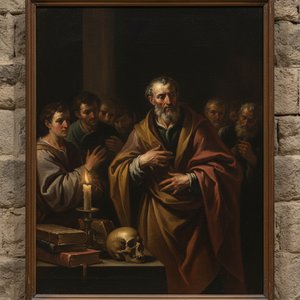
Spanish Baroque Art: The Dramatic Mastery of Light and Shadow in the Age of Velázquez
Explore the profound drama of Spanish Baroque art. Delve into the mastery of light, shadow, and realism through the legendary works of Diego Velázquez and the Spanish Golden Age.



