Partager
 Partager
 Détails
 Guide imprimable

 Télécharger
 Articles similaires
 Voir le diaporama
 Statistiques
Wave


 Afficher la suite
Reproduction à l'huile faite à la main
Huile sur toile peinte à la main, avec cadre et dimensions personnalisés, réalisée sur commande par nos artistes. ( Passer au format impression Passer au format image numérique)




































Choisissez parmi nos formats prédéfinis qui respectent les proportions originales de l’œuvre.

Vous pouvez saisir vos propres dimensions pour l'adapter à un cadre ou à un espace spécifique. Si la taille sélectionnée ne correspond pas aux proportions de l'image d'origine, nous recadrerons l'œuvre ou prolongerons la peinture avec des éléments peints à la main supplémentaires. Une maquette numérique vous sera envoyée pour approbation avant le début de la production.
Veuillez noter que l'aperçu à l'écran ne reflète pas le recadrage ou l'extension réels. Seule la maquette montrera fidèlement la composition finale.
Bien que des tailles personnalisées soient disponibles, nous vous recommandons de sélectionner une dimension dans la liste prédéfinie afin de préserver les proportions d'origine.
Après la commande, l’équipe OriginalUniqueArt.com contactera le client par e-mail pour recueillir ses instructions et lui fournira une maquette d’aperçu
Livraison dans le monde entier () en 3 à 4 semaines au lieu des 5 semaines habituelles. (26 septembre). Aucun compromis sur la qualité.

Livraison express gratuite dans le monde entier

Toile de lin de haute qualité

Assurance transport complète

Garantie de remboursement des droits de douane

Garantie de fidélité des couleurs

Garantie de retour de 100 jours (uniquement en cas de défaut)

Garantie de remboursement à 100%

Tarifs dégressifs sur quantité
 L'option verre n'est disponible que pour les dimensions inférieures à 110 cm.

Wave
Technique de reproduction
Format de la reproduction
-


Prix total final
$ 300
The Enduring Echoes of the Sea: Barbara Hepworth’s “Wave”
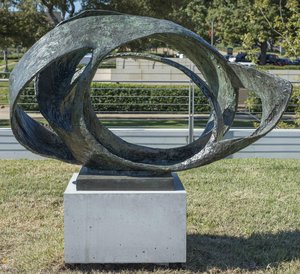
Dame Barbara Hepworth's "Wave," created in 1943 during a pivotal period of artistic and personal transformation, is more than just a sculpture; it’s a profound meditation on movement, form, and the elemental power of nature. Born amidst the turmoil of World War II, Hepworth sought refuge and inspiration in the rugged Cornish coastline, a landscape that profoundly shaped her evolving aesthetic. “Wave” embodies this connection, capturing not merely the visual appearance of a breaking wave but its very essence – the dynamic tension between potential energy and released force, the suggestion of ceaseless motion frozen in stone.
The sculpture itself is remarkably understated in its execution. Crafted primarily from wood, meticulously polished to a luminous sheen, it’s a deceptively simple form: a gently curving line extending outwards from a central, circular core. This isn't an attempt at literal representation; rather, Hepworth employed a reductive approach, stripping away extraneous detail to reveal the underlying structure and rhythm of the subject. The wood, chosen for its warmth and inherent grain, provides a tactile counterpoint to the smooth, almost ethereal quality of the polished surface. The subtle variations in tone within the wood itself – hints of amber, ochre, and grey – subtly mimic the shifting hues of the sea under different lighting conditions.
Modernism’s Embrace: Form and Abstraction
“Wave” firmly establishes Hepworth as a key figure within the burgeoning movement of Modern sculpture. Rejecting traditional representational approaches, she embraced abstraction, prioritizing the exploration of form, texture, and spatial relationships. Influenced by Cubism and Surrealism, Hepworth sought to capture not just what something *looked* like but how it *felt*, translating internal experiences into tangible three-dimensional forms. This approach aligns with the broader modernist ethos of breaking away from established conventions and forging new paths in artistic expression.
The sculpture’s design reflects a conscious engagement with geometric principles, yet it avoids rigid formality. The curve is organic and flowing, suggesting the unpredictable nature of water – its capacity to both crash against the shore with violent force and gently lap at the sand. Hepworth's use of negative space—the areas surrounding and between the form—is equally crucial, creating a sense of lightness and airiness that further emphasizes the sculpture’s dynamic quality. It is this careful balance between positive and negative forms that gives “Wave” its remarkable visual power.
A Symbol of Resilience and Renewal
Beyond its purely formal qualities, "Wave" carries significant symbolic weight. Created during a time of global conflict and uncertainty, the sculpture can be interpreted as an emblem of resilience – a testament to the enduring strength and adaptability of nature. The wave itself represents constant change, ceaseless movement, and the cyclical rhythms of life and death. The polished surface reflects light, suggesting hope and renewal, while the underlying structure hints at the potential for transformation.
Hepworth’s personal experiences also informed the sculpture's meaning. Following her divorce from John Skeaping in 1933, she sought solace and creative rejuvenation in Cornwall, a landscape that offered both beauty and emotional depth. “Wave” can be seen as an expression of this journey – a celebration of freedom, independence, and the power to overcome adversity. The work’s inherent dynamism mirrors Hepworth's own evolving artistic practice, reflecting her willingness to experiment with new materials and techniques.
Collecting the Essence: Reproductions and Interior Design
Reproductions of “Wave” offer a compelling opportunity to bring this iconic sculpture into your home or office. The meticulous detail captured in high-quality reproductions allows you to appreciate Hepworth’s masterful use of form, texture, and space. Consider placing a reproduction within a light-filled room to maximize its reflective qualities, creating a focal point that draws the eye and evokes a sense of tranquility.
“Wave”’s understated elegance makes it exceptionally versatile for interior design. Its clean lines and subtle color palette complement a wide range of styles, from minimalist modern spaces to more traditional settings. The sculpture's inherent dynamism adds visual interest and energy to any room, serving as a constant reminder of the beauty and power of the natural world.
Biographie de l'artiste
Premières années et formation
Dame Barbara Hepworth, une artiste et sculptrice anglaise de renom, est née le 10 janvier 1903 à Wakefield, dans le Yorkshire. Elle a fréquenté la Leeds School of Art à partir de 1920 puis a remporté une bourse du comté pour étudier à la Royal College of Art (RCA) à Londres de 1921 jusqu'à ce qu'elle obtienne le diplôme en 1924.Carrière artistique
- L’œuvre de Dame Barbara Hepworth exemplifie le modernisme, en particulier la sculpture moderne. Elle était l'une des rares artistes féminines à atteindre une reconnaissance internationale.
- En 1933, elle a cofondé le mouvement artistique Unit One avec Ben Nicholson, Paul Nash et d'autres, cherchant à unir le surréalisme et l'abstraction dans l'art britannique.
- Le travail précoce de Hepworth était caractérisé par l'abstraction et son implication avec le mouvement artistique parisien, Abstraction-Création.
Œuvres notables et expositions
- Oval Form (Trezion), une sculpture en bronze, fait partie de la collection du Kimball Art Museum à Fort Worth, aux États-Unis. (voir sur OriginalUniqueArt)
- Two Forms, une sculpture, est exposée au Hepworth Wakefield à Wakefield, dans le Yorkshire. (voir sur OriginalUniqueArt)
- Totem, une sculpture en marbre, fait également partie de la collection du Hepworth Wakefield. (voir sur OriginalUniqueArt)
Évolution artistique et influences
L'œuvre de Hepworth a évolué au fil des ans, passant d'abstractions influencées par le cubisme et le surréalisme à des formes plus organiques et abstraites. Son séjour en France dans les années 1930, où elle a rencontré des artistes comme Brancusi et Arp, a été déterminant pour son développement artistique. Elle s’est intéressée aux formes naturelles, notamment celles trouvées dans la mer et le paysage de Cornouailles, où elle a vécu pendant une grande partie de sa carrière.
Héritage et collections muséales
L'œuvre de Barbara Hepworth est largement reconnue, ses sculptures et peintures faisant partie de diverses collections de musées dans le monde. Le Hepworth Wakefield, du nom de l'artiste, abrite de nombreux chefs-d'œuvre d'artistes renommés, dont les propres œuvres de Hepworth. (découvrez davantage sur le Hepworth Wakefield sur OriginalUniqueArt)Conclusion
Dame Barbara Hepworth’s pioneering work in modern British sculpture has left an indelible mark on the art world. Her legacy continues to inspire artists and art enthusiasts alike, with her works remaining a testament to her innovative spirit and artistic genius. more about barbara hepworth on wikipedia
Barbara Hepworth
1903 - 1975 , Royaume-Uni
En bref
- Artistes Influents:
- Brancusi
- Henry Moore
- Ben Nicholson
- Date De Naissance: 10 janvier 1903
- Lieu De Naissance: Wakefield, Royaume-Uni
- Mouvement Artistique: Modernisme, Sculpture abstraite
- Nationalité: Britannique
- Nom Complet: Barbara Hepworth
- Oeuvres Notables:
- Oval Form (Trezion)
- Two Forms
- Totem
Articles similaires

Les 10 Chefs-d'œuvre en Bronze qui ont Révolutionné l'Art : Collection OriginalUniqueArt
Plongez dans l'univers fascinant des 10 chefs-d'œuvre en bronze qui ont marqué l'histoire de l'art. Découvrez Rodin, Degas et les secrets de ces sculptures iconiques. Reproductions d'art exceptionnelles sur OriginalUniqueArt.com – Explorez la collection !

Abstraction Géométrique : Les 10 Chefs-d'œuvre qui ont Marqué l'Histoire de l'Art
Plongez au cœur de l'abstraction géométrique avec OriginalUniqueArt.com ! Découvrez les 10 œuvres majeures de Mondrian, Malevitch et Kandinsky qui ont révolutionné l'art moderne. Inspirez votre décoration intérieure avec des reproductions de tableaux exceptionnelles. Explorez la collection en ligne !

The Enduring Legacy of Bronze: A Historical & Artistic Exploration for the Collector
Explore the rich history & enduring appeal of bronze sculpture with expert insights for collectors at OriginalUniqueArt. Learn about casting techniques, iconic artists, collecting tips & contemporary interpretations.

Les 10 Chefs-d'œuvre Bronzes Qui Ont Révolutionné la Sculpture | OriginalUniqueArt
Plongez dans l'univers fascinant des 10 sculptures en bronze les plus emblématiques de l'histoire de l'art. Rodin, Degas et autres maîtres révélés ! Découvrez leur histoire, leurs techniques et trouvez l'œuvre parfaite pour sublimer votre intérieur sur OriginalUniqueArt.com.
Barbara Hepworth: A Sculptural Dialogue with Form, Space & the Human Condition
Explore the profound world of Barbara Hepworth's sculpture. Discover her artistic evolution, iconic forms, and lasting influence on modern art. A guide for collectors & enthusiasts.