Aperçu en situation
 Envoyer
 Partager
 Détails de l'œuvre
 Guide
Guide

 Télécharger l'image
 Articles similaires
 Radiographie
 Diaporama
 Q&A
Q&A Statistiques
The white skirt

- 130.0 x 162.0 cm


 Lire la suite
L’œuvre d'art présentée sur cette page est protégée par le droit d'auteur, ce qui signifie que nous ne pouvons légalement créer ou vendre de reproduction identique. Cette protection est appliquée en vertu d'accords internationaux tels que la Convention de Berne et par les lois nationales, notamment celles énoncées par le Loi américaine sur le droit d'auteur - Titre 17.
Cette méthode est pleinement conforme aux réglementations sur le droit d'auteur car elle ne repose pas sur la copie ou la duplication de l'œuvre protégée. Il s'agit plutôt d'une réinterprétation créative — une nouvelle peinture qui s'inspire de l'original sans pour autant lui être identique.
Giclées et impressions d'art
Impressions giclées ou sur toile de qualité musée, avec une production rapide et des finitions au choix. ( Commander la reproduction peinte à la main Passer au format numérique)




P118B €10

P118H €10

P118W €10

P438Z €10

P508JH €12

P508YH €12

P805H €10

P805Z €10

P919BZ €10

P919G €10

P919XJ €10

P959ZH €10

P968JZ €12

W106C €8

W218G €10

W218JH €8

W218Y €10

W307PJ €10

W316G €10

W316PJ €8

W316Y €10

W398PJ €8

W4111J €10

W500HY €15

W500JH €15

W692G €12

W849H €8

W940BG €15

W953PJ €8




Choisissez parmi nos formats prédéfinis qui respectent les proportions originales de l’œuvre.

Saisissez la largeur et la hauteur souhaitées pour qu'elles s'adaptent à votre cadre ou à votre mur. Une impression peut être recadrée, mais jamais agrandie au-delà de l'image originale ; ainsi, un format de forme différente entraînera la perte d'une partie de l'image. Nous vous envoyons une maquette numérique pour approbation avant toute impression. L'image présentée sur cette page ne montre pas le recadrage réel — seule la maquette le permet.
Livraison dans le monde entier () en 2 semaines au lieu des 4/5 semaines habituelles. (1 novembre)

Livraison express gratuite dans le monde entier

Toile de lin de qualité supérieure

Assurance transport complète

Garantie de remboursement des droits de douane

Garantie de fidélité des couleurs

Politique de retour de 100 jours (uniquement en cas de défaut)

Garantie de remboursement à 100%

Offre de tarifs dégressifs
 L'option verre n'est disponible que pour les dimensions inférieures à 110 cm.

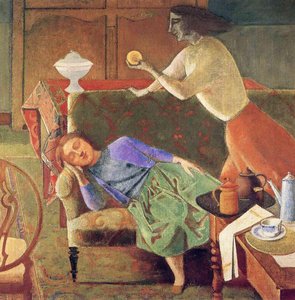
The white skirt
Giclées et impressions d'art
Format de la reproduction
-


Prix total
€ 71
A Quiet Encounter with Balthus
In the hushed atmosphere of Balthus’s 1937 masterpiece, The White Skirt, we are invited into a moment of profound stillness. The painting presents a solitary young woman seated within the embrace of an armchair, her presence commanding yet deeply introspective. There is an undeniable gravity to the composition; the figure does not merely sit, she exists in a state of quiet contemplation that seems to suspend time itself. As one gazes upon this portrait, the viewer is drawn into a private world where the boundaries between the subject and the observer blur, creating an intimate connection that is both haunting and deeply dignified.
The artist’s mastery of light and shadow serves as the heartbeat of the work. Emerging from a soft illumination directed from above and slightly to the left, the light dances across the textures of the scene, carving out the delicate curves of the woman's form and the heavy folds of her attire. This interplay of light creates a sense of three-dimensional depth, pulling the subject forward from the muted, somber background. The palette, a sophisticated arrangement of whites, beiges, and earthy browns, avoids the distraction of vibrant color to focus instead on the subtle nuances of tone, evoking a mood that is at once melancholic and serene.
Technique and the Language of Texture
Balthus, a painter deeply reverent of the Old Masters, utilizes an oil on canvas technique that bridges the gap between classical realism and a modern, almost impressionistic, sensibility. Upon closer inspection, the surface of the painting reveals a rich tapestry of brushstrokes. These are not merely marks of pigment but are deliberate gestures that suggest the tactile reality of the world: the smoothness of porcelain-like skin, the coarse grain of wooden furniture, and the heavy, flowing drapery of the white fabric. This meticulous attention to texture lends the piece an organic vitality, making the stillness of the subject feel even more palpable.
The composition is a masterclass in balance and organic form. The rounded contours of the chair and the fluid, sweeping lines of the woman's clothing create a rhythmic harmony that guides the eye throughout the frame. There is no jarring movement here; instead, the viewer’s gaze wanders softly through the layers of fabric and shadow, mirroring the slow, meditative pace of the subject herself. For the collector or interior designer, this piece offers a sophisticated anchor for a room, providing a focal point that commands respect without overwhelming its surroundings.
Symbolism and Emotional Resonance
Beyond its technical brilliance, The White Skirt is a vessel for profound symbolic meaning. The heavy, draped fabric that dominates the lower portion of the composition can be interpreted as a symbol of modesty, concealment, or perhaps the protective layers we wrap around our inner selves. The subject’s gaze, while not directly meeting the viewer's, suggests a deep interiority—a vulnerability shielded by a stoic exterior. This tension between what is revealed and what is hidden is what gives the painting its enduring psychological power.
For those seeking to bring a sense of history and intellectual depth into their living spaces, this reproduction offers more than just aesthetic beauty; it offers an emotional journey. It is a piece that invites conversation, prompting reflections on solitude, identity, and the quiet strength found in moments of introspection. Whether placed in a contemporary gallery-style setting or a classic study, The White Skirt serves as a timeless window into the enigmatic vision of one of the 20th century's most captivating artists.
Questions et réponses
Puis-je visionner « The white skirt » sous forme de diaporama en plein écran ?
Un diaporama est disponible : la page Diaporama de «The white skirt» de Balthus.
D'où viennent les visiteurs de «The white skirt» de Balthus ?
Les statistiques concernant «The white skirt» de Balthus sont disponibles sur la page Statistiques de l'œuvre : nombre de visites mensuelles, consultations des autres œuvres de l'artiste, ainsi que la répartition des visiteurs récents par pays et par langue.
L'œuvre « The white skirt » dispose-t-elle d'un aperçu en réalité augmentée ?
Visualisez «The white skirt» de Balthus sur votre propre mur grâce à la page Aperçu en RA de l'œuvre, en utilisant la réalité augmentée sur un appareil compatible.
Biographie de l'artiste
Premières années et influences
Balthasar Klossowski de Rola, plus connu sous le nom de Balthus, est né à Paris le 29 février 1908. Son enfance fut marquée par un environnement culturel riche et stimulant. Son père, Erich Klossowski, était historien de l'art, spécialiste d’Honoré Daumier, et sa mère, Elisabeth Dorothée Spiro (connue sous le nom de Baladine Klossowska), était elle-même peintre. La maison familiale accueillait régulièrement des figures importantes du monde artistique et littéraire comme André Gide et Pierre Bonnard.
Carrière artistique
La carrière artistique de Balthus a débuté sérieusement avec sa première exposition à Paris en 1934, présentant des œuvres telles que La Leçon de guitare, qui suscita une vive controverse en raison de sa représentation sensuelle et explicite. Son style était influencé par les peintres pré-Renaissance et par les écrits d'Emily Brontë, Lewis Carroll et Simone Martini.
- La Rue (1933) et La Toilette de Cathy (1933) sont des œuvres notables de cette période, illustrant le style unique de Balthus.
- Il avait une profonde affection pour Wolfgang Amadeus Mozart, ce qui reflète son appréciation pour les aspects classiques et sensuels de l'art.
Controverses et vie ultérieure
La vie ultérieure de Balthus a été marquée par des controverses concernant ses origines familiales. Bien qu’il ait nié avoir des ascendance juive, la véritable lignée de sa mère reste un sujet de débat.
- Son mariage avec Setsuko Ideta, une Japonaise, en 1967, a ajouté au mystère qui entourait sa personne.
- La Fondation Balthus, créée par sa veuve, la Comtesse Setsuko Klossowska de Rola, en 1998, continue de promouvoir son œuvre et son héritage.
Héritage et influence
L'influence de Balthus se retrouve dans divers artistes contemporains tels que Jan Saudek, Will Barnet, Duane Michals, John Currin, Eli Levin, Emile Chambon et Elena Zolotnitsky.
- Son style, principalement classique, a été influencé par de nombreux artistes, notamment Masaccio, Piero della Francesca, Simone Martini, Poussin, Jean-Baptiste Camille Corot, Courbet, Edgar Degas, Félix Vallotton et Paul Cézanne.
- En tant qu'artiste majeur du XXe siècle, son œuvre continue d’être largement reconnue et admirée.
Œuvres notables et expositions
- Girl at a Window (1957), présentée dans le film de François Truffaut, Domicile conjugal (Bed & Board, 1970).
- Des expositions au Museum of Modern Art (1956) et à la Galerie Pierre Matisse (1934) ont mis en valeur son style unique.
- Découvrez plus d'œuvres de Balthus sur OriginalUniqueArt : https://OriginalUniqueArt.com/@/balthasar-klossowski
- Explorez la collection du Museum of Modern Art sur OriginalUniqueArt : https://OriginalUniqueArt.com/@@/a@d3aqwm-the-museum-of-modern-art-(united-states)-a-comprehensive-overview
- Découvrez plus sur la vie et l'œuvre de Balthus sur Wikipédia : https://en.wikipedia.org/wiki/balthazar_klossowski

Balthus
1908 - 2001 , France
L'essentiel de l'artiste
- Artistes Influents:
- Piero della Francesca
- Simone Martini
- Courbet
- Date De Naissance: 29 février 1908
- Influence Sur D'Autres Artistes:
- Jan Saudek
- John Currin
- Lieu De Naissance: Paris, France
- Nationalité: Français
- Nom Complet: Balthasar Klossowski de Rola
- Oeuvres Notables:
- La rue
- Roberte devant le miroir
- Garçon avec Chat
- Style Artistique: Classique, surréaliste
Articles connexes
Les 10 Chefs-d'œuvre du Néoclassicisme : Artistes et Décor Intemporels
Plongez au cœur du Néoclassicisme avec les 10 chefs-d'œuvre incontournables de David, Ingres et autres maîtres. Découvrez l'histoire fascinante de ces tableaux célèbres et trouvez l'inspiration déco classique sur !

The Poetic Truth of Observation: Exploring 19th-Century Realism in Painting
Explore the captivating world of 19th-century Realism! Discover key artists like Courbet & Millet, masterpieces, and the powerful social commentary behind this influential art movement. Expert insights at OriginalUniqueArt.

10 chefs-d'œuvre du Réalisme Romantique qui capturent l'âme humaine
Plongez dans l'émotion du Réalisme Romantique. Explorez 10 chefs-d'œuvre iconiques, de Constable à Homer, mêlant vérité et passion. Trouvez l'inspiration pour votre décor avec nos reproductions de qualité musée sur OriginalUniqueArt.com. Découvrez toute la collection en ligne.
L'Héritage Durable du Classicisme : Principes, Évolution et Influence dans l'Art Occidental
Explorez l'héritage durable du classicisme français : ses principes fondateurs, les grands maîtres (Poussin, Lorrain), et son influence sur l'art occidental. Analyse approfondie pour passionnés d'histoire de l'art.

Blancs Sublimes : Les 10 Chefs-d'œuvre de la Peinture Révélés par
Plongez dans l'univers fascinant des 10 plus beaux tableaux blancs de l'histoire de l'art ! Découvrez Monet, Whistler, Kandinsky et d'autres maîtres. Inspirez votre décoration intérieure avec : reproductions de qualité muséale en ligne.