Aperçu en situation
 Partager
 Partager
 Détails
 Guide imprimable

 Télécharger
 Articles similaires
 Radiographie
 Voir le diaporama
 Statistiques
Guitar lesson
 Oil On Canvas
- WallArt
- Surrealist Art
 1934
1934 161.0 x 138.0 cm
 Afficher la suite
L’œuvre d'art présentée sur cette page est protégée par le droit d'auteur, ce qui signifie que nous ne pouvons légalement créer ou vendre de reproduction identique. Cette protection est appliquée en vertu d'accords internationaux tels que la Convention de Berne et par les lois nationales, notamment celles énoncées par le Loi américaine sur le droit d'auteur - Titre 17.
En tant qu'alternative respectueuse et légale, nous proposons des œuvres d'art personnalisées, peintes à la main et inspirées de l'original. Nos artistes talentueux et professionnels étudient avec soin le style, l'ambiance et l'essence artistique de l'œuvre originale pour créer une pièce nouvelle et unique qui évoque la même émotion — tout en restant une création originale en soi.
Cette méthode est pleinement conforme aux réglementations sur le droit d'auteur car elle ne repose pas sur la copie ou la duplication de l'œuvre protégée. Il s'agit plutôt d'une réinterprétation créative — une nouvelle peinture qui s'inspire de l'original sans pour autant lui être identique.
Reproduction à l'huile faite à la main
Huile sur toile peinte à la main, avec cadre et dimensions personnalisés, réalisée sur commande par nos artistes. ( Passer au format impression Passer au format image numérique)




P118B €10

P118H €10

P118W €10

P438Z €10

P508JH €12

P508YH €12

P805H €10

P805Z €10

P919BZ €10

P919G €10

P919XJ €10

P959ZH €10

P968JZ €12

W106C €8

W218G €10

W218JH €8

W218Y €10

W307PJ €10

W316G €10

W316PJ €8

W316Y €10

W398PJ €8

W4111J €10

W500HY €15

W500JH €15

W692G €12

W849H €8

W940BG €15

W953PJ €8




Choisissez parmi nos formats prédéfinis qui respectent les proportions originales de l’œuvre.

Saisissez la largeur et la hauteur souhaitées, pour s'adapter à votre cadre ou à votre mur. Cette œuvre est peinte à la main ; ainsi, pour un format de forme différente, l'artiste peut peindre un peu plus autour du tableau ou réduire légèrement les bords — c'est vous qui choisissez. Nous vous envoyons une maquette numérique pour approbation avant que la peinture ne commence. L'image présentée sur cette page ne reflète pas le résultat réel — seule la maquette le fait.
Après la commande, l’équipe OriginalUniqueArt.com contactera le client par e-mail pour recueillir ses instructions et lui fournira une maquette d’aperçu
Livraison dans le monde entier () en 3 à 4 semaines au lieu des 5 semaines habituelles. (25 octobre). Aucun compromis sur la qualité.

Livraison express gratuite dans le monde entier

Toile de lin de haute qualité

Assurance transport complète

Garantie de remboursement des droits de douane

Garantie de fidélité des couleurs

Garantie de retour de 100 jours (uniquement en cas de défaut)

Garantie de remboursement à 100%

Tarifs dégressifs sur quantité
 L'option verre n'est disponible que pour les dimensions inférieures à 110 cm.

Guitar lesson
Technique de reproduction
Format de la reproduction
-


Prix total final
€ 263
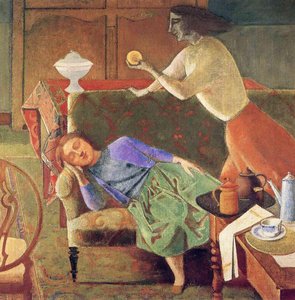
A Portrait of Intimacy: Exploring Balthus’s “Guitar Lesson”
The painting "Guitar Lesson," created by Polish-French artist Balthus in 1934, stands as an arresting testament to surrealist art's ability to delve beneath surface appearances and confront viewers with profound psychological complexities. Measuring 161 x 138 cm and executed in oil on canvas, it’s more than just a depiction of two women; it’s a carefully constructed tableau brimming with symbolic resonance and reflecting the anxieties of its time. Balthus deliberately eschewed the prevailing stylistic conventions of his era, prioritizing meticulous observation and capturing fleeting moments of human emotion—a characteristic that distinguishes him from many of his contemporaries.Style and Technique: Classical Revival Infused with Modern Sensibility
Balthus’s approach to painting was rooted in a deep admiration for the Old Masters, particularly Rembrandt and Vermeer. However, he wasn't simply replicating their techniques; rather, he skillfully adapted them to express his own distinctive vision. The artist employed a technique characterized by subtle gradations of color and painstaking brushwork—a hallmark of his oeuvre—creating an illusionistic depth that draws the eye into the scene. Unlike Impressionists who sought to capture atmospheric effects, Balthus focused on portraying figures with unflinching realism, prioritizing anatomical accuracy and conveying psychological nuance rather than superficial beauty. The muted palette contributes to the painting’s contemplative mood, emphasizing texture and form over vibrant hues.Historical Context: Navigating Uncertainty Amidst Artistic Shifts
“Guitar Lesson” emerged during a period of significant artistic upheaval in Europe—the aftermath of World War I and the burgeoning influence of Surrealism. While Surrealists championed dreamlike imagery and irrational juxtapositions, Balthus resisted these trends, opting for a more restrained aesthetic that nonetheless conveyed a palpable sense of unease. The painting reflects the anxieties surrounding gender roles and societal expectations prevalent in the 1930s—a time when women’s liberation movements were gaining momentum but traditional norms persisted. This tension is subtly communicated through the posture of the seated woman, whose expansive legs suggest vulnerability while simultaneously embodying a quiet defiance.Symbolism: Music, Vulnerability, and Hidden Narratives
The inclusion of a guitar and violin serves as more than just decorative elements; they are potent symbols representing harmony and creativity—concepts that Balthus consistently explored in his work. The woman playing the guitar embodies artistic expression and perhaps hints at an unspoken desire for connection. Simultaneously, her posture conveys vulnerability, mirroring the psychological complexities inherent in human relationships. The empty chair beside her underscores the solitude of experience and invites contemplation about unspoken emotions. These subtle visual cues elevate “Guitar Lesson” beyond a simple portrait, transforming it into a meditation on intimacy and emotional truth.Emotional Impact: A Masterpiece of Psychological Observation
Ultimately, "Guitar Lesson" succeeds in capturing a moment of profound psychological observation—a feat rarely achieved by artists of its time. Balthus’s masterful rendering of human anatomy and emotion compels viewers to confront uncomfortable truths about desire, vulnerability, and the unspoken dynamics of interpersonal connections. It's a painting that lingers in the mind long after viewing, prompting reflection on the complexities of human experience and reaffirming Balthus’s enduring legacy as one of the most perceptive and unsettlingly beautiful artists of the 20th century.Questions et réponses
Quel est le niveau de contraste dans «Guitar lesson» de Balthus ?
«Guitar lesson» de Balthus présente un contraste Statement entre ses zones claires et ses zones sombres.
Quelle couleur domine la composition de «Guitar lesson» de Balthus ?
La couleur dominante de «Guitar lesson» de Balthus est le Walnut (#7e471e).
Qui vend des reproductions peintes à la main de «Guitar lesson» de Balthus ?
Les reproductions peintes à la main de «Guitar lesson» de Balthus sont vendues sur ce site web : une reproduction à l'huile peinte à la main sur toile de lin, via sa page Reproduction peinte à la main.
Biographie de l'artiste
Premières années et influences
Balthasar Klossowski de Rola, plus connu sous le nom de Balthus, est né à Paris le 29 février 1908. Son enfance fut marquée par un environnement culturel riche et stimulant. Son père, Erich Klossowski, était historien de l'art, spécialiste d’Honoré Daumier, et sa mère, Elisabeth Dorothée Spiro (connue sous le nom de Baladine Klossowska), était elle-même peintre. La maison familiale accueillait régulièrement des figures importantes du monde artistique et littéraire comme André Gide et Pierre Bonnard.
Carrière artistique
La carrière artistique de Balthus a débuté sérieusement avec sa première exposition à Paris en 1934, présentant des œuvres telles que La Leçon de guitare, qui suscita une vive controverse en raison de sa représentation sensuelle et explicite. Son style était influencé par les peintres pré-Renaissance et par les écrits d'Emily Brontë, Lewis Carroll et Simone Martini.
- La Rue (1933) et La Toilette de Cathy (1933) sont des œuvres notables de cette période, illustrant le style unique de Balthus.
- Il avait une profonde affection pour Wolfgang Amadeus Mozart, ce qui reflète son appréciation pour les aspects classiques et sensuels de l'art.
Controverses et vie ultérieure
La vie ultérieure de Balthus a été marquée par des controverses concernant ses origines familiales. Bien qu’il ait nié avoir des ascendance juive, la véritable lignée de sa mère reste un sujet de débat.
- Son mariage avec Setsuko Ideta, une Japonaise, en 1967, a ajouté au mystère qui entourait sa personne.
- La Fondation Balthus, créée par sa veuve, la Comtesse Setsuko Klossowska de Rola, en 1998, continue de promouvoir son œuvre et son héritage.
Héritage et influence
L'influence de Balthus se retrouve dans divers artistes contemporains tels que Jan Saudek, Will Barnet, Duane Michals, John Currin, Eli Levin, Emile Chambon et Elena Zolotnitsky.
- Son style, principalement classique, a été influencé par de nombreux artistes, notamment Masaccio, Piero della Francesca, Simone Martini, Poussin, Jean-Baptiste Camille Corot, Courbet, Edgar Degas, Félix Vallotton et Paul Cézanne.
- En tant qu'artiste majeur du XXe siècle, son œuvre continue d’être largement reconnue et admirée.
Œuvres notables et expositions
- Girl at a Window (1957), présentée dans le film de François Truffaut, Domicile conjugal (Bed & Board, 1970).
- Des expositions au Museum of Modern Art (1956) et à la Galerie Pierre Matisse (1934) ont mis en valeur son style unique.
- Découvrez plus d'œuvres de Balthus sur OriginalUniqueArt : https://OriginalUniqueArt.com/@/balthasar-klossowski
- Explorez la collection du Museum of Modern Art sur OriginalUniqueArt : https://OriginalUniqueArt.com/@@/a@d3aqwm-the-museum-of-modern-art-(united-states)-a-comprehensive-overview
- Découvrez plus sur la vie et l'œuvre de Balthus sur Wikipédia : https://en.wikipedia.org/wiki/balthazar_klossowski

Balthus
1908 - 2001 , France
En bref
- Artistes Influents:
- Piero della Francesca
- Simone Martini
- Courbet
- Date De Naissance: 29 février 1908
- Influence Sur D'Autres Artistes:
- Jan Saudek
- John Currin
- Lieu De Naissance: Paris, France
- Nationalité: Français
- Nom Complet: Balthasar Klossowski de Rola
- Oeuvres Notables:
- La rue
- Roberte devant le miroir
- Garçon avec Chat
- Style Artistique: Classique, surréaliste
Articles connexes
The Soul of Impressionism: Why Oil on Canvas Captures Eternal Light and Timeless Emotion
Discover the enchanting alchemy of Impressionism. Explore how the mastery of oil on canvas, through glazing and impasto, captures eternal light and emotion. Perfect for lovers of Monet and Van Gogh seeking the profound depth of hand-painted fine art.

L'héritage durable de la peinture à l'huile : technique, histoire et pratique contemporaine
Explorez l'histoire fascinante de la peinture à l'huile, des techniques ancestrales aux pratiques contemporaines. Découvrez les maîtres, apprenez et trouvez votre œuvre d'art idéale chez .

Top 10 Chefs-d'œuvre à l'Huile : L'Art qui a Révolutionné le Décor Intérieur
Plongez dans l'histoire de 10 chefs-d'œuvre à l'huile qui ont révolutionné l'art : Monet, Van Gogh, Rembrandt et plus. Découvrez les techniques, les émotions et trouvez l'inspiration déco sur ! Explorez la collection.

The Enduring Legacy of Oil on Canvas: Technique, History & Aesthetic Impact
Explore the rich history & techniques of oil painting – from Renaissance masters to Impressionism. Discover pigments, layering methods, and why this timeless medium endures. Expert insights for artists & art enthusiasts.

L'Huile sur Toile : Exploration Historique et Technique d'un Médium Artistique Intemporel
Explorez l'histoire fascinante de la peinture à l'huile, des techniques ancestrales aux maîtres flamands comme Van Eyck. Découvrez les secrets des pigments, liants et glacis pour comprendre cet art intemporel.