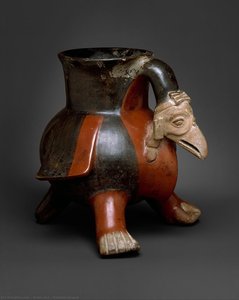
Peinture à l'huile
 Tout sur Pipe







































 Pour les œuvres ou reproductions dont un côté mesure plus de 105 cm (environ 41 pouces), le cadre sera expédié sous forme de kit démonté. Cette méthode garantit une livraison sécurisée et prévient tout dommage pendant le transport.


The Quietude of Clay
In the dim light of a private collection, this ceramic pipe from 1521 reveals itself through its deep, dark tones. It is a somber object, rendered in shades of brown and black that suggest the earth from which it was shaped. The surface is not merely colored but deeply worked, with geometric patterns carved directly into the clay. These lines—zigzags, curves, and circles—wrap around the body of the pipe, creating a rhythmic texture that catches the light softly. It is a piece of functional art, designed for the ritual of smoking, yet it carries a weight that transcends its utility.
Form and Symbolism
The craftsmanship speaks to a specific moment in the final years of the Aztec Empire. The artisan used hand-carving and burnishing to achieve a surface that is smooth to the touch, despite the intentional roughness of the incised patterns. There is a deliberate precision in the way the shapes repeat, reflecting a worldview where geometry and cosmology were inseparable.
- Material: Ceramic or terracotta
- Technique: Hand-carving and burnishing
- Motifs: Repeating zigzags, curves, and circles
- Color: Limited palette of brown and black
The patterns likely held ritualistic significance, perhaps connecting the user to the cosmic order through the very act of inhalation. The angularity of the shapes reflects the aesthetic conventions of Mesoamerican craftsmanship, where every line serves a purpose.
A Fragment of History
To hold such an object is to touch the edge of a vanished era. Created in 1521, this pipe belongs to the twilight of the Aztec civilization in Tenochtitlan, Mexico. It exists as a physical remnant of a culture that expressed its complex social and religious hierarchies through material objects. The simplicity of its composition—a single object against a neutral void—forces a direct encounter with the hand of the maker. It is a quiet, heavy presence that speaks of the rituals of the past without the need for ornament.
Questions et réponses
Est-ce que Pipe est peint à la main ou est-ce une impression ?
Peint à la main : un peintre professionnel reproduit Pipe à l'huile sur une toile en lin.
Quelle taille choisir pour Pipe ?
Les tailles vont de 24.2 x 41.3 cm (€179) à 141.6 x 241.7 cm (€1168) ; le tableau sur cette page présente les principales étapes et leurs prix respectifs.
Quel est le délai de livraison ?
La livraison prend 4 à 5 semaines, avec une expédition express mondiale gratuite ; une option de production urgente est proposée sur cette page. Vous pouvez la retourner sous 100 jours pour un remboursement intégral, sans condition.
Où se trouve l'original de Pipe ?
L'original fait partie de la collection du Metropolitan Museum of Art, à New York.
Quelle technique Aztec a-t-il utilisée pour Pipe ?
Ceramic
 Envoyer
 Partager
 Détails de l'œuvre
 Fiche pédagogique


 Télécharger l'image
 Articles similaires
 Diaporama
 Questions et réponses

 Statistiques