Envoyer
 Partager
 Détails de l'œuvre

 Télécharger
 Articles similaires
 Diaporama
Erwartung, op. 17
 Giclée Print
- Digital
- Expressionist Modernism
 1909
1909- 19th Century
 36.0 x 28.0 cm
 Arnold Schönberg Center
 Lire la suite
Reproduction à l'huile faite à la main
Huile sur toile peinte à la main, avec cadre et dimensions personnalisés, réalisée sur commande par nos artistes. ( Commander l'impression Télécharger l'image haute résolution)




































Choisissez parmi nos formats prédéfinis qui respectent les proportions originales de l’œuvre.

Vous pouvez saisir vos propres dimensions pour l'adapter à un cadre ou à un espace spécifique. Si la taille sélectionnée ne correspond pas aux proportions de l'image d'origine, nous recadrerons l'œuvre ou prolongerons la peinture avec des éléments peints à la main supplémentaires. Une maquette numérique vous sera envoyée pour approbation avant le début de la production.
Veuillez noter que l'aperçu à l'écran ne reflète pas le recadrage ou l'extension réels. Seule la maquette montrera fidèlement la composition finale.
Bien que des tailles personnalisées soient disponibles, nous vous recommandons de sélectionner une dimension dans la liste prédéfinie afin de préserver les proportions d'origine.
Après la commande, l’équipe OriginalUniqueArt.com contactera le client par e-mail pour recueillir ses instructions et lui fournira une maquette d’aperçu
Livraison dans le monde entier () en 3 à 4 semaines au lieu des 5 semaines habituelles. (21 août). Aucun compromis sur la qualité.

Livraison express gratuite dans le monde entier

Toile de lin de qualité supérieure

Assurance transport complète

Garantie de remboursement des droits de douane

Garantie de fidélité des couleurs

Politique de retour de 60 jours (uniquement en cas de défaut)

Garantie de remboursement à 100%

Offre de tarifs dégressifs
 L'option verre n'est disponible que pour les dimensions inférieures à 110 cm.

Erwartung, op. 17
Technique de reproduction
Format de la reproduction
-


Prix total
$ 300
Description de l'œuvre
A Fragment of Anxiety: Schoenberg's "Erwartung" – A Window into Musical Angst
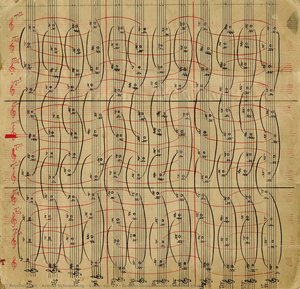
This meticulously crafted hand-painted reproduction offers an unparalleled glimpse into the genesis of Arnold Schoenberg’s groundbreaking monodrama, “Erwartung” (Expectation), composed in 1909. More than just a musical score, it is a tangible embodiment of intense creative struggle and a profound exploration of human emotion – a testament to Schoenberg's revolutionary approach to composition. The image captures the very document upon which this pivotal work was born, revealing the raw, almost frantic energy that fueled its creation.
- The Score as Canvas: The reproduction faithfully replicates the original score, a chaotic yet meticulously organized collection of notes, symbols, and handwritten annotations. Schoenberg’s characteristic use of short scores – a technique designed to capture fleeting moments of heightened emotion – is strikingly evident.
- A Moment Frozen in Time: The inclusion of two clocks within the image adds another layer of significance. These aren't merely decorative elements; they represent the relentless passage of time, a key thematic concern within “Erwartung,” where suspense and anticipation build to unbearable tension.
- Technical Detail: Notice the varying levels of detail – fully notated pitches and rhythms alongside fragmented dynamics and phrasing, reflecting Schoenberg’s initial approach. This reveals the composer's iterative process, constantly refining his vision as he wrestled with translating psychological states into musical form.
The Birth of Atonality: Contextualizing "Erwartung"
"Erwartung," created in Steinakirchen (Lower Austria), marked a radical departure from traditional tonal music. Schoenberg, alongside Alban Berg and Anton Webern, spearheaded the development of atonality – a system where no single note held inherent harmonic significance. This wasn't simply about discarding established rules; it was an attempt to represent the subjective experience of emotion with unprecedented directness. The monodrama’s narrative, centered around a woman’s increasingly paranoid and unsettling wait for a lover, perfectly mirrored this new musical landscape.
Schoenberg himself articulated his intent brilliantly: “I have written something for the theatre: a monodrama. By that I mean a piece in which only one person appears…” This focus on singular experience, amplified by the dramatic tension of the score, is central to understanding "Erwartung’s" enduring power.
Symbolism and Emotional Resonance
The black-and-white aesthetic of the original photograph lends itself powerfully to the drama unfolding within the score. The stark contrast emphasizes the fragmented nature of the musical ideas and the unsettling atmosphere of anticipation. The handwritten annotations, often corrections or fleeting thoughts, contribute to a sense of vulnerability and intellectual struggle – mirroring the protagonist’s descent into paranoia.
The image isn't just a representation of music; it is an invitation to experience the raw emotional core of Schoenberg’s masterpiece. It speaks to themes of anxiety, isolation, and the fragility of human perception—themes that continue to resonate with audiences today.
Specifications
Title: Erwartung, op. 17 Description: As detailed in the artwork information. Size: 36 x 28 cm Date: 1909 Artist: Arnold Schoenberg Birth Year: 1874 Death Year: 1951Biographie de l'artiste
Early Life and Musical Beginnings
Arnold Schoenberg, Austrian-American composer who created new methods of musical composition involving atonality, namely serialism and the twelve-tone row. He was also one of the most influential teachers of the 20th century; among his most significant pupils were Alban Berg and Anton Webern. He was born on September 13, 1874, in Vienna, Austria. His early life was marked by a humble beginning, with his father being a shoe-shopkeeper. Despite this, Schoenberg’s innate passion for music led him to largely self-educate himself in the field. Schoenberg's early works showcased a Brahmsian–Wagnerian synthesis. As he progressed, he became the central figure of the second Viennese School, alongside Anton Webern and Alban Berg. His compositions, including String Quartet No. 2 (1907–1908), Erwartung (1909), and Pierrot Lunaire (1912), exemplified his innovative approach to atonality.Notable Works
Schoenberg’s oeuvre is remarkably diverse, encompassing orchestral music, chamber ensembles, vocal works, piano pieces, and film scores. However, he is undeniably best known for his groundbreaking explorations of atonality and serialism—methods that fundamentally reshaped the landscape of musical composition. Among his most celebrated achievements are: Suite No. 2 (1930), which showcases a masterful blend of tonal and dissonant elements; Music Typewriter (1928), an experimental piece utilizing a typewriter as a musical instrument; String Quartet No. 2 (1907–1908), considered a cornerstone of Viennese Expressionism; Erwartung (1909), a dramatic opera exploring themes of anxiety and anticipation; Pierrot Lunaire (1912), a song cycle that utilizes Sprechstimme—a vocal technique combining speech and singing—to convey profound emotional depth. Furthermore, Schoenberg’s film music includes scores for films such as “The Seven Deadly Sins” and “Moses and Aaron,” demonstrating his versatility as a composer across various genres.Influence and Legacy
Schoenberg's musical innovations exerted an indelible influence on subsequent generations of composers. His pioneering use of serialism—a compositional technique based on mathematical sequences—established a new paradigm for tonal music, prompting composers like Alban Berg and Anton Webern to develop their own distinctive styles rooted in Schoenberg’s principles. Beyond the realm of composition, Schoenberg's aesthetic and music-historical views profoundly impacted musicologists Theodor W. Adorno and Carl Dahlhaus, shaping debates about musical interpretation and artistic expression. His uncompromising stance against prevailing musical conventions solidified his reputation as a visionary artist who challenged accepted norms and paved the way for radical experimentation in music.Later Life and Recognition
Following the rise of Nazism in Germany, Schoenberg reluctantly abandoned Austria and emigrated to the United States in 1933, where he taught at Yale University until 1944. During World War II, he continued his musical pursuits while grappling with the horrors of the Holocaust—a profound experience that inspired him to create Survivor from Warsaw (1947), a poignant memorial to victims of Nazi persecution. In 1951, Schoenberg received honorary citizenship in Vienna and was elected president of the Israel Conservatory and Academy of Music, cementing his enduring legacy as one of the most influential figures in twentieth-century music history.
Arnold Schoenberg
1874 - 1951 , Autriche
L'essentiel de l'artiste
- Artistic Movement Or Style: Technique à douze tons; Expressionnisme
- Artists Or Movements Influenced By This Artist:
- Anton Webern
- Alban Berg
- Artists Who Influenced This Artist:
- Johannes Brahms
- Richard Wagner
- Date Of Birth: Septembre 13, 1874
- Full Name: Arnold Schoenberg
- Nationality: Autrichien-Américain
- Notable Artworks:
- Suite, op. 29
- Music Typewriter
- Staffliner
- Place Of Birth: Vienne, Autriche
Articles connexes
Harmonies on Canvas: Exploring the Visual Representation of Music in Art History
Explore the fascinating history of music's visual representation in art! From ancient symbolism to modern abstraction, discover how artists have captured sound and emotion on canvas. Expert insights & stunning examples.
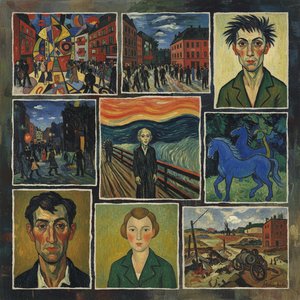
Expressionnisme : 10 Chefs-d'œuvre Révolutionnaires pour une Décoration d'Art
Plongez au cœur de l'expressionnisme avec 10 chefs-d’œuvre emblématiques : Munch, Kirchner, Kandinsky… Découvrez les histoires et émotions derrière ces peintures révolutionnaires. Reproductions d'art de qualité muséale sur OriginalUniqueArt.com !
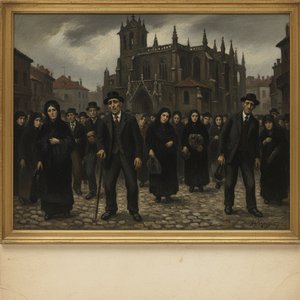
José Gutiérrez Solana: A Chronicle of Spanish Society Through Expressionist Vision
Explore the captivating world of José Gutiérrez Solana, a pivotal Spanish Expressionist painter. Discover his haunting depictions of early 20th-century Spain, influenced by Goya & El Greco. Learn about his key works and lasting legacy.
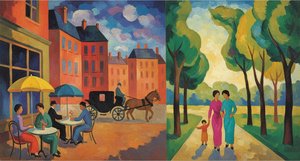
August Macke : Visions expressionnistes d'harmonie et de vie moderne
Explorez l'univers vibrant d'August Macke, figure clé de l'Expressionnisme allemand et du Blaue Reiter. Découvrez son parcours artistique, ses thèmes emblématiques et conseils pour collectionner ses œuvres avec OriginalUniqueArt.

The Visceral Self: Exploring Emotion & Identity in Expressionist Portraiture
Explore the powerful world of Expressionist portraiture with OriginalUniqueArt. Discover how artists captured raw emotion & identity through bold color and distortion. Expert insights for collectors.