Peinture à l'huile
 Tout sur Navigation







































 Pour les œuvres ou reproductions dont un côté mesure plus de 105 cm (environ 41 pouces), le cadre sera expédié sous forme de kit démonté. Cette méthode garantit une livraison sécurisée et prévient tout dommage pendant le transport.


Identification of the Artwork and Artist
In this work, titled Navigation, we encounter the hand of Antonio Zucchi, a painter and printmaker who emerged from the artistic traditions of Venice, Italy. Created in 1769, the piece reflects the aesthetic shifts of the Neoclassic period, a time when the exuberant styles of the past began to settle into more structured and restrained forms. Zucchi’s presence in the art world was marked by this transition, moving from the fluidities of his Venetian upbringing toward the clarity favored by the emerging Neoclassical movement.
Antonio Zucchi brought a specific sensibility to his compositions, often blending the warmth of his Italian training with the precision required for detailed figural work. His ability to navigate between the roles of a painter and a printmaker allowed him to approach the canvas with a keen understanding of line and light. This particular work, Navigation, captures a moment of quietude, characteristic of the artist's ability to render human connection within a composed setting.
Visual Composition and Subject Matter
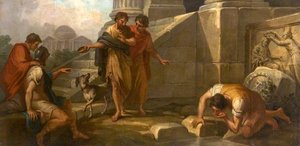
In this intimate scene, a man and a woman are positioned on the ground, facing one another in a quiet moment of connection. The woman holds a pink ribbon, a delicate detail that draws the eye to her hands, while the man appears absorbed in reading. They are dressed in old-fashioned clothing, which places the interaction within a specific, historical context. Between them, a bowl rests on the ground, serving as a central point in their shared space.
The composition is populated by various objects that suggest a lived-in environment. A chair sits nearby, and in the background, a boat is visible, hinting at a maritime or coastal setting. These elements, combined with the relaxed postures of the figures, create a sense of unhurried conversation. The arrangement of the figures and the surrounding items suggests a narrative of quiet companionship, captured in a moment of stillness.
Related Works by Antonio Zucchi
To understand the breadth of Zucchi’s output, one might look toward his decorative commissions from the late 1760s. In 1768, he produced a set of three decorative wall panels titled Mitellus Ordering a Marble Crow to Be Put on the Tomb of His Former Master, Diodorus Siculus. These panels reflect his ability to handle narrative themes within a structured, ornamental framework. His work during this period often balanced the requirements of architectural integration with a clear, classical sensibility.
The year 1769 saw the artist exploring different facets of the natural and seasonal world. He produced a work titled Spring, which demonstrates his command of light and the interplay of warmth and cool tones. This piece captures a sense of idyllic repose through a delicate application of color. It is a quiet study in atmosphere, much like the way he approached the landscapes and figural groups that defined his career.
In that same year, Zucchi also completed Agriculture. This work, alongside his other compositions from the period, highlights his versatility in moving between mythological subjects and more grounded, pastoral themes. His ability to adapt his technique to the specific needs of a scene—be it a formal portrait or a landscape—remains a defining characteristic of his practice.
Questions et réponses
Est-ce que Navigation est peint à la main ou est-ce une impression ?
Peint à la main : un peintre professionnel reproduit Navigation à l'huile sur une toile en lin.
Quelle taille choisir pour Navigation ?
L'original mesure 48 x 98 cm. Les tailles vont de 22.4 x 44.6 cm (€179) à 120.3 x 239.6 cm (€1012) ; le tableau sur cette page présente les principales étapes et leurs prix respectifs.
Quel est le délai de livraison ?
La livraison prend 4 à 5 semaines, avec une expédition express mondiale gratuite ; une option de production urgente est proposée sur cette page. Vous pouvez la retourner sous 100 jours pour un remboursement intégral, sans condition.
Où se trouve l'original de Navigation ?
L'original fait partie de la collection du English Heritage, à Londres.
Quelle technique Antonio Zucchi a-t-il utilisée pour Navigation ?
Oil
 Aperçu en situation

 Envoyer
 Partager
 Détails de l'œuvre
 Fiche pédagogique


 Télécharger l'image
 Articles similaires
 Radiographie
 Diaporama
 Questions et réponses

 Statistiques