

 Aperçu en situation
 Partager
 Partager
 Détails
 Guide imprimable

 Télécharger
 Articles similaires
 Radiographie
 Voir le diaporama
 Statistiques
Nemo


 Afficher la suite
L’œuvre d'art présentée sur cette page est protégée par le droit d'auteur, ce qui signifie que nous ne pouvons légalement créer ou vendre de reproduction identique. Cette protection est appliquée en vertu d'accords internationaux tels que la Convention de Berne et par les lois nationales, notamment celles énoncées par le Loi américaine sur le droit d'auteur - Titre 17.
En tant qu'alternative respectueuse et légale, nous proposons des œuvres d'art personnalisées, peintes à la main et inspirées de l'original. Nos artistes talentueux et professionnels étudient avec soin le style, l'ambiance et l'essence artistique de l'œuvre originale pour créer une pièce nouvelle et unique qui évoque la même émotion — tout en restant une création originale en soi.
Cette méthode est pleinement conforme aux réglementations sur le droit d'auteur car elle ne repose pas sur la copie ou la duplication de l'œuvre protégée. Il s'agit plutôt d'une réinterprétation créative — une nouvelle peinture qui s'inspire de l'original sans pour autant lui être identique.
Reproduction à l'huile faite à la main
Huile sur toile peinte à la main, avec cadre et dimensions personnalisés, réalisée sur commande par nos artistes. ( Passer au format impression Passer au format image numérique)




P118B €10

P118H €10

P118W €10

P438Z €10

P508JH €12

P508YH €12

P805H €10

P805Z €10

P919BZ €10

P919G €10

P919XJ €10

P959ZH €10

P968JZ €12

W106C €8

W218G €10

W218JH €8

W218Y €10

W307PJ €10

W316G €10

W316PJ €8

W316Y €10

W398PJ €8

W4111J €10

W500HY €15

W500JH €15

W692G €12

W849H €8

W940BG €15

W953PJ €8




Choisissez parmi nos formats prédéfinis qui respectent les proportions originales de l’œuvre.

Saisissez la largeur et la hauteur souhaitées, pour s'adapter à votre cadre ou à votre mur. Cette œuvre est peinte à la main ; ainsi, pour un format de forme différente, l'artiste peut peindre un peu plus autour du tableau ou réduire légèrement les bords — c'est vous qui choisissez. Nous vous envoyons une maquette numérique pour approbation avant que la peinture ne commence. L'image présentée sur cette page ne reflète pas le résultat réel — seule la maquette le fait.
Après la commande, l’équipe OriginalUniqueArt.com contactera le client par e-mail pour recueillir ses instructions et lui fournira une maquette d’aperçu
Livraison dans le monde entier () en 3 à 4 semaines au lieu des 5 semaines habituelles. (22 octobre). Aucun compromis sur la qualité.

Livraison express gratuite dans le monde entier

Toile de lin de haute qualité

Assurance transport complète

Garantie de remboursement des droits de douane

Garantie de fidélité des couleurs

Garantie de retour de 100 jours (uniquement en cas de défaut)

Garantie de remboursement à 100%

Tarifs dégressifs sur quantité
 L'option verre n'est disponible que pour les dimensions inférieures à 110 cm.

Nemo
Technique de reproduction
Format de la reproduction
-


Prix total final
€ 263
Nemo – A Symphony of Geometric Form and Chance
Alexander Milne Calder’s “Nemo” stands as a testament to the enduring fascination with abstraction—a captivating exploration of color, shape, and movement that transcends mere visual representation. Created in 1947, this striking piece embodies Calder's signature approach: eschewing realism for a deliberate embrace of spontaneity and serendipity, mirroring the very essence of his celebrated mobiles.
The Visual Language of Equilibrium
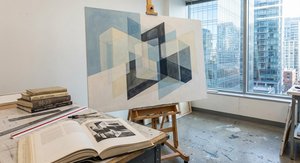
Dominating the canvas is an intricate composition featuring overlapping circles and squares—a bold declaration of geometric principles. The palette bursts with vibrant hues—primarily reds, yellows, and blues—that harmonize to create a dynamic visual experience. Calder meticulously crafted these shapes using a flat painting technique, prioritizing form over texture; there’s no visible brushwork, reflecting his unwavering commitment to precision and control despite the illusion of movement.
A Reflection of Constructivism's Legacy
“Nemo” firmly roots itself within the influential Constructivist movement of the early 20th century. Like its contemporaries—artists who sought to liberate art from traditional conventions—Calder aimed to convey emotion and ideas through simplified geometric forms, rejecting decorative embellishments in favor of intellectual rigor. This stylistic choice underscores Calder’s belief that art should communicate directly with the viewer's intellect as well as their senses.
Symbolism Embedded in Motionless Form
Despite its apparent stillness, “Nemo” pulsates with an underlying sense of dynamism—a subtle suggestion of movement achieved through the careful arrangement of shapes and colors. Calder’s genius lies in transforming static form into a conduit for conveying emotion; the overlapping circles and squares evoke feelings of balance, harmony, and perhaps even controlled chaos. The artist deliberately avoided explicit symbolism, allowing viewers to interpret the artwork's impact on their own emotional landscape.
A Monumental Contribution to Modern Art
Alexander Milne Calder’s “Nemo” represents more than just a beautiful painting—it embodies a pivotal moment in artistic history. His pioneering exploration of kinetic sculpture and his unwavering dedication to geometric abstraction paved the way for subsequent generations of artists, establishing him as one of the most influential sculptors of the 20th century. This artwork continues to inspire admiration for its elegance, innovation, and profound engagement with fundamental principles of visual art.
Questions et réponses
Dans quel mouvement et à quelle époque s'inscrit «Nemo» de Alexander Milne Calder ?
Dans «Nemo» de Alexander Milne Calder, le mouvement Modernism rencontre l'époque Époque moderne.
Quel est le niveau de contraste dans «Nemo» de Alexander Milne Calder ?
Le niveau de contraste de «Nemo» de Alexander Milne Calder est Statement.
Dans quel musée se trouve l'original de « Nemo » ?
Vous pouvez admirer l'original de « Nemo » au Biennale Internazionale dell'Antiquariato di Firenze, Florence, Italie.
Biographie de l'artiste
Introduction à Alexander Milne Calder
Alexander Milne Calder était un sculpteur américano-écossais né à Aberdeen, en Écosse, en 1846. Il est surtout connu pour ses sculptures architecturales du Philadelphia City Hall, et tant son fils, Alexander Stirling Calder, que son petit-fils, Alexander 'Sandy' Calder, sont devenus des sculpteurs importants au XXe siècle.Jeunesse et carrière
Alexander Milne Calder a commencé sa carrière en Écosse, travaillant pour le sculpteur John Rhind tout en étudiant à la Royal Academy d'Édimbourg. Il a déménagé à Londres et travaillé sur le mémorial Albert. Calder a immigré aux États-Unis en 1868 et s’est installé à Philadelphie, où il a étudié avec Joseph A. Bailly et a suivi des cours avec Thomas Eakins à la Pennsylvania Academy of the Fine Arts.Œuvres notables
Voici quelques-unes des œuvres notables d’Alexander Milne Calder :- Philadelphia City Hall : une commande impliquant plus de 250 pièces en marbre et en bronze, qui a pris à Calder 20 ans pour être achevée.
- William Penn : une statue en bronze colossale qui devait couronner la tour de l’hôtel de ville.
- Figure indienne : une sculpture avant son installation sur l'hôtel de ville.
- Portail sud et portail ouest : illuminés de lumières colorées, mettant en valeur l’attention aux détails de Calder.
Héritage et influence familiale
L'héritage d’Alexander Milne Calder s’étend au-delà de son propre travail, car tant son fils que son petit-fils sont devenus des sculpteurs renommés. Son influence est visible dans divers musées, notamment le Smithsonian American Art Museum et la Galleria Civica di Arte Moderna e Contemporanea Torino. Son œuvre a jeté les bases pour l'innovation artistique de ses descendants, contribuant à une lignée familiale d’artistes sculpturaux reconnus.Signification historique
Alexander Milne Calder a laissé une marque durable sur l’histoire de l’art américain, en particulier grâce à son travail monumental sur le Philadelphia City Hall. Son attention aux détails et sa maîtrise des matériaux ont fait de lui un sculpteur respecté de son époque. Son héritage continue d'inspirer les artistes et les amateurs d'art aujourd'hui, témoignant de l’importance durable de ses contributions au monde de la sculpture.
Alexander Milne Calder
1898 - 1976 , Royaume-Uni
En bref
- Artists Or Movements Influenced By This Artist:
- Alexander Stirling Calder
- Alexander 'Sandy' Calder
- Artists Who Influenced This Artist: ['John Rhind']
- Date Of Birth: 23 août 1846
- Date Of Death: 4 juin 1923
- Full Name: Alexander Milne Calder
- Nationality: Écossais-Américain
- Notable Artworks:
- Philadelphia City Hall
- Statue de William Penn
- Figure Indienne
- Portail Sud et Portail Ouest
- Place Of Birth (City And Country): Aberdeen, Royaume-Uni
Articles connexes

Beyond Form & Color: Geometric Abstraction's Evolution in 20th/21st Century Art
Explore the evolution of geometric abstraction from Cubism to contemporary art. Discover key artists like Malevich & Mondrian, investment insights, and expert collecting advice at OriginalUniqueArt.

Neo-Abstract Art: The High-Impact Evolution of Modern Visual Energy and Geometric Sophistication
Discover the power of Neo-Abstract art. Explore how bold geometric forms and high-impact visual energy are redefining modern design. Learn to curate sophisticated, high-energy spaces with the latest trends in contemporary abstraction and structural color.
Beyond Form & Color: Geometric Abstraction's Enduring Legacy in Art History
Explore the captivating world of geometric abstraction! Discover its origins, key artists like Malevich & Mondrian, and why this movement remains highly valued by art collectors today. Expert insights at OriginalUniqueArt.

Kandinsky : Les 25 Œuvres Maîtresses d'un Pionnier de l'Art Abstrait | OriginalUniqueArt
Plongez dans l'univers vibrant de Kandinsky ! Découvrez les 25 œuvres majeures du pionnier de l'art abstrait. Explorez son expressionnisme, ses couleurs audacieuses et l'histoire fascinante derrière chaque tableau. Reproductions d'exception sur OriginalUniqueArt.com.

Abstraction Géométrique : Les 10 Chefs-d'œuvre qui ont Marqué l'Histoire de l'Art
Plongez au cœur de l'abstraction géométrique avec OriginalUniqueArt.com ! Découvrez les 10 œuvres majeures de Mondrian, Malevitch et Kandinsky qui ont révolutionné l'art moderne. Inspirez votre décoration intérieure avec des reproductions de tableaux exceptionnelles. Explorez la collection en ligne !


