
 Aperçu en situation
 Envoyer
 Partager
 Détails de l'œuvre
 Guide
Guide

 Télécharger l'image
 Articles similaires
 Radiographie
 Diaporama
 Questions et réponses
 Statistiques
Lobster Trap and Fish Tail


 Lire la suite
L’œuvre d'art présentée sur cette page est protégée par le droit d'auteur, ce qui signifie que nous ne pouvons légalement créer ou vendre de reproduction identique. Cette protection est appliquée en vertu d'accords internationaux tels que la Convention de Berne et par les lois nationales, notamment celles énoncées par le Loi américaine sur le droit d'auteur - Titre 17.
Cette méthode est pleinement conforme aux réglementations sur le droit d'auteur car elle ne repose pas sur la copie ou la duplication de l'œuvre protégée. Il s'agit plutôt d'une réinterprétation créative — une nouvelle peinture qui s'inspire de l'original sans pour autant lui être identique.
Giclées et impressions d'art
Impressions giclées ou sur toile de qualité musée, avec une production rapide et des finitions au choix. ( Commander la reproduction peinte à la main Passer au format numérique)




P118B €10

P118H €10

P118W €10

P438Z €10

P508JH €12

P508YH €12

P805H €10

P805Z €10

P919BZ €10

P919G €10

P919XJ €10

P959ZH €10

P968JZ €12

W106C €8

W218G €10

W218JH €8

W218Y €10

W307PJ €10

W316G €10

W316PJ €8

W316Y €10

W398PJ €8

W4111J €10

W500HY €15

W500JH €15

W692G €12

W849H €8

W940BG €15

W953PJ €8




Choisissez parmi nos formats prédéfinis qui respectent les proportions originales de l’œuvre.

Saisissez la largeur et la hauteur souhaitées pour qu'elles s'adaptent à votre cadre ou à votre mur. Une impression peut être recadrée, mais jamais agrandie au-delà de l'image originale ; ainsi, un format de forme différente entraînera la perte d'une partie de l'image. Nous vous envoyons une maquette numérique pour approbation avant toute impression. L'image présentée sur cette page ne montre pas le recadrage réel — seule la maquette le permet.
Livraison dans le monde entier () en 2 semaines au lieu des 4/5 semaines habituelles. (8 novembre)

Livraison express gratuite dans le monde entier

Toile de lin de qualité supérieure

Assurance transport complète

Garantie de remboursement des droits de douane

Garantie de fidélité des couleurs

Politique de retour de 100 jours (uniquement en cas de défaut)

Garantie de remboursement à 100%

Offre de tarifs dégressifs
 L'option verre n'est disponible que pour les dimensions inférieures à 110 cm.

Lobster Trap and Fish Tail
Giclées et impressions d'art
Format de la reproduction
-


Prix total
€ 72
Alexander Milne Calder’s Minimalist Dance of the Deep
Alexander Milne Calder's "Lobster Trap and Fish Tail," created in 1939, isn’t merely a depiction of marine life; it’s an embodiment of movement captured within a strikingly reductive aesthetic. This captivating abstract composition, rendered in the restrained palette of black, white, and varying shades of grey against a subtly lit expanse of pale gray, immediately draws the eye into its dynamic arrangement. The artwork speaks to a profound sense of fluidity and grace, achieved through the elongated, curving forms that dominate the canvas – stylized fish tails intertwined with what appears to be a lobster trap, creating an intriguing visual dialogue.
Calder’s approach leans heavily towards geometric abstraction, prioritizing line and form over realistic representation. The technique employed suggests a deliberate fusion of digital painting and illustration, resulting in a remarkably clean and precise execution. Notice the careful delineation of shapes – ovals morphing into elongated teardrops, culminating in simplified fins—each element contributing to the overall sense of controlled motion. Texture is subtly implied through variations in line weight and shading, rather than relying on literal surface detail, adding depth without sacrificing the artwork’s inherent minimalism.
A Reflection of Calder's Artistic Evolution
Understanding "Lobster Trap and Fish Tail" requires a brief journey into the life and work of Alexander Milne Calder. Born in Aberdeen, Scotland, in 1846, Calder initially trained as a sculptor under John Rhind, honing his skills at the Royal Academy in Edinburgh before migrating to London and working on the Albert Memorial. His subsequent move to Philadelphia in 1868 marked a pivotal moment, where he studied with Joseph A. Bailly and Thomas Eakins at the Pennsylvania Academy of Fine Arts. This period saw him gain recognition for monumental works like the Philadelphia City Hall sculpture – a complex undertaking involving over 250 individual pieces—and the colossal bronze statue of William Penn. Calder’s later career embraced kinetic art, experimenting with mobiles that responded to air currents and gravity, pushing the boundaries of sculptural form.
Interestingly, his grandson, Alexander “Sandy” Calder, continued this legacy, further developing the principles of chance and movement within sculpture. The influence of Joan Miró's biomorphic surrealism and Martha Graham’s choreography is palpable in Calder’s approach to motion – a deliberate harnessing of mechanical forces to evoke a sense of organic fluidity.
Symbolic Currents and Spatial Dynamics
Beyond its formal qualities, "Lobster Trap and Fish Tail" invites contemplation on deeper symbolic meanings. The arrangement of the fish tails, diagonally intersecting with a central mobile element, creates a powerful visual rhythm, suggesting an ongoing, almost perpetual movement. The lobster trap itself adds a layer of complexity, hinting at themes of capture, vulnerability, and perhaps even the precariousness of existence within the vastness of the ocean. The predominantly light gray background serves as a crucial anchor, emphasizing the shapes and contributing to the artwork’s serene yet dynamic mood.
Calder's masterful use of negative space—the expansive light gray field—is integral to the composition’s balance and overall impact. It allows the abstracted forms to breathe, preventing the piece from feeling cluttered or overwhelming. The flattened perspective, typical of abstract art, further enhances this sense of spaciousness, inviting viewers to lose themselves within the sculpture's graceful dance.
A Timeless Piece for Interior Spaces
"Lobster Trap and Fish Tail" is more than just a beautiful artwork; it’s a testament to Calder’s innovative spirit and his ability to capture the essence of movement. A hand-painted reproduction offers an exceptional opportunity to bring this captivating piece into your home or office, adding a touch of sophisticated serenity and visual intrigue. Its minimalist design complements a wide range of interior styles, while its subtle dynamism injects a sense of life and energy into any space. Consider it not just as decoration, but as a thoughtful meditation on form, motion, and the enduring beauty of the natural world.
Questions et réponses
Quelle pièce est recommandée pour «Lobster Trap and Fish Tail» de Alexander Milne Calder, compte tenu de ses couleurs ?
Les nuances Neutrals de «Lobster Trap and Fish Tail» de Alexander Milne Calder s'accordent parfaitement avec l'espace recommandé : une Living Room.
«Lobster Trap and Fish Tail» de Alexander Milne Calder est-il une œuvre célèbre ?
«Lobster Trap and Fish Tail» de Alexander Milne Calder affiche un niveau de popularité Recognized. Cette classification témoigne de la reconnaissance de l'œuvre auprès du public.
Comment le médium et le mouvement se conjuguent-ils dans « Lobster Trap and Fish Tail » ?
Dans « Lobster Trap and Fish Tail », la technique du Acrylic On Canvas rencontre le mouvement Geometric Abstraction.
Biographie de l'artiste
Introduction à Alexander Milne Calder
Alexander Milne Calder était un sculpteur américano-écossais né à Aberdeen, en Écosse, en 1846. Il est surtout connu pour ses sculptures architecturales du Philadelphia City Hall, et tant son fils, Alexander Stirling Calder, que son petit-fils, Alexander 'Sandy' Calder, sont devenus des sculpteurs importants au XXe siècle.Jeunesse et carrière
Alexander Milne Calder a commencé sa carrière en Écosse, travaillant pour le sculpteur John Rhind tout en étudiant à la Royal Academy d'Édimbourg. Il a déménagé à Londres et travaillé sur le mémorial Albert. Calder a immigré aux États-Unis en 1868 et s’est installé à Philadelphie, où il a étudié avec Joseph A. Bailly et a suivi des cours avec Thomas Eakins à la Pennsylvania Academy of the Fine Arts.Œuvres notables
Voici quelques-unes des œuvres notables d’Alexander Milne Calder :- Philadelphia City Hall : une commande impliquant plus de 250 pièces en marbre et en bronze, qui a pris à Calder 20 ans pour être achevée.
- William Penn : une statue en bronze colossale qui devait couronner la tour de l’hôtel de ville.
- Figure indienne : une sculpture avant son installation sur l'hôtel de ville.
- Portail sud et portail ouest : illuminés de lumières colorées, mettant en valeur l’attention aux détails de Calder.
Héritage et influence familiale
L'héritage d’Alexander Milne Calder s’étend au-delà de son propre travail, car tant son fils que son petit-fils sont devenus des sculpteurs renommés. Son influence est visible dans divers musées, notamment le Smithsonian American Art Museum et la Galleria Civica di Arte Moderna e Contemporanea Torino. Son œuvre a jeté les bases pour l'innovation artistique de ses descendants, contribuant à une lignée familiale d’artistes sculpturaux reconnus.Signification historique
Alexander Milne Calder a laissé une marque durable sur l’histoire de l’art américain, en particulier grâce à son travail monumental sur le Philadelphia City Hall. Son attention aux détails et sa maîtrise des matériaux ont fait de lui un sculpteur respecté de son époque. Son héritage continue d'inspirer les artistes et les amateurs d'art aujourd'hui, témoignant de l’importance durable de ses contributions au monde de la sculpture.
Alexander Milne Calder
1898 - 1976 , Royaume-Uni
L'essentiel de l'artiste
- Artists Or Movements Influenced By This Artist:
- Alexander Stirling Calder
- Alexander 'Sandy' Calder
- Artists Who Influenced This Artist: ['John Rhind']
- Date Of Birth: 23 août 1846
- Date Of Death: 4 juin 1923
- Full Name: Alexander Milne Calder
- Nationality: Écossais-Américain
- Notable Artworks:
- Philadelphia City Hall
- Statue de William Penn
- Figure Indienne
- Portail Sud et Portail Ouest
- Place Of Birth (City And Country): Aberdeen, Royaume-Uni
Articles connexes
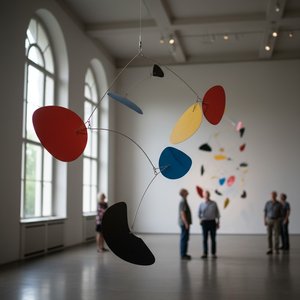
Alexander Calder: Kinetic Sculpture, Mobile Art & the Poetics of Chance
Explore the revolutionary world of Alexander Calder's kinetic sculptures & mobiles. Discover insights for collectors, acquisition advice, and the enduring legacy of this modern master. Expert analysis & art valuation.

Abstraction Géométrique : Les 10 Chefs-d'œuvre qui ont Marqué l'Histoire de l'Art
Plongez au cœur de l'abstraction géométrique avec OriginalUniqueArt.com ! Découvrez les 10 œuvres majeures de Mondrian, Malevitch et Kandinsky qui ont révolutionné l'art moderne. Inspirez votre décoration intérieure avec des reproductions de tableaux exceptionnelles. Explorez la collection en ligne !

Neo-Abstract Art: The High-Impact Evolution of Modern Visual Energy and Geometric Sophistication
Discover the power of Neo-Abstract art. Explore how bold geometric forms and high-impact visual energy are redefining modern design. Learn to curate sophisticated, high-energy spaces with the latest trends in contemporary abstraction and structural color.

Les 10 Chefs-d'œuvre Bronzes Qui Ont Révolutionné la Sculpture | OriginalUniqueArt
Plongez dans l'univers fascinant des 10 sculptures en bronze les plus emblématiques de l'histoire de l'art. Rodin, Degas et autres maîtres révélés ! Découvrez leur histoire, leurs techniques et trouvez l'œuvre parfaite pour sublimer votre intérieur sur OriginalUniqueArt.com.

Beyond Form & Color: Geometric Abstraction's Evolution in 20th/21st Century Art
Explore the evolution of geometric abstraction from Cubism to contemporary art. Discover key artists like Malevich & Mondrian, investment insights, and expert collecting advice at OriginalUniqueArt.


