

 Aperçu en situation
 Envoyer
 Partager
 Détails de l'œuvre
 Guide
Guide

 Télécharger l'image
 Articles similaires
 Radiographie
 Diaporama
 Statistiques
Arrangement
 Lithograph
- WallArt
- Socialist Realism
 1922
1922 20.0 x 20.0 cm
 Lire la suite
L’œuvre d'art présentée sur cette page est protégée par le droit d'auteur, ce qui signifie que nous ne pouvons légalement créer ou vendre de reproduction identique. Cette protection est appliquée en vertu d'accords internationaux tels que la Convention de Berne et par les lois nationales, notamment celles énoncées par le Loi américaine sur le droit d'auteur - Titre 17.
Cette méthode est pleinement conforme aux réglementations sur le droit d'auteur car elle ne repose pas sur la copie ou la duplication de l'œuvre protégée. Il s'agit plutôt d'une réinterprétation créative — une nouvelle peinture qui s'inspire de l'original sans pour autant lui être identique.
Giclées et impressions d'art
Impressions giclées ou sur toile de qualité musée, avec une production rapide et des finitions au choix. ( Commander la reproduction peinte à la main Passer au format numérique)




P118B €10

P118H €10

P118W €10

P438Z €10

P508JH €12

P508YH €12

P805H €10

P805Z €10

P919BZ €10

P919G €10

P919XJ €10

P959ZH €10

P968JZ €12

W106C €8

W218G €10

W218JH €8

W218Y €10

W307PJ €10

W316G €10

W316PJ €8

W316Y €10

W398PJ €8

W4111J €10

W500HY €15

W500JH €15

W692G €12

W849H €8

W940BG €15

W953PJ €8




Choisissez parmi nos formats prédéfinis qui respectent les proportions originales de l’œuvre.

Saisissez la largeur et la hauteur souhaitées pour qu'elles s'adaptent à votre cadre ou à votre mur. Une impression peut être recadrée, mais jamais agrandie au-delà de l'image originale ; ainsi, un format de forme différente entraînera la perte d'une partie de l'image. Nous vous envoyons une maquette numérique pour approbation avant toute impression. L'image présentée sur cette page ne montre pas le recadrage réel — seule la maquette le permet.
Livraison dans le monde entier () en 2 semaines au lieu des 4/5 semaines habituelles. (27 octobre)

Livraison express gratuite dans le monde entier

Toile de lin de qualité supérieure

Assurance transport complète

Garantie de remboursement des droits de douane

Garantie de fidélité des couleurs

Politique de retour de 100 jours (uniquement en cas de défaut)

Garantie de remboursement à 100%

Offre de tarifs dégressifs
 L'option verre n'est disponible que pour les dimensions inférieures à 110 cm.

Arrangement
Giclées et impressions d'art
Format de la reproduction
-


Prix total
€ 70
Aleksandr Deyneka's "Arrangement": A Snapshot of Soviet Modernity
Aleksandr Deyneka’s “Arrangement,” painted in 1922, isn't merely a depiction of figures within an interior space; it is a carefully constructed tableau reflecting the burgeoning spirit of post-revolutionary Russia. The lithograph pulsates with a dynamic energy, capturing a moment of seemingly casual interaction that belies a deeper commentary on social shifts and artistic experimentation. It’s a work steeped in the Constructivist movement's ideals – a celebration of industrial progress, urban life, and the new Soviet citizen. The monochromatic palette, dominated by shades of black, white, and grey, immediately draws the eye, forcing a focus on form and composition rather than coloristic nuance. This deliberate choice underscores the stark realities of the era, while simultaneously lending an air of dramatic intensity to the scene. The absence of color doesn't diminish the vibrancy; instead, it amplifies the textures created through bold lines, hatching, and cross-hatching – techniques that lend a raw, almost graphic quality to the image.Constructivism and Urban Life: A Visual Manifesto
The artwork’s style is firmly rooted in Constructivism, an avant-garde movement that sought to synthesize art with industrial production and social reform. Deyneka, like many of his contemporaries, aimed to create a visual language that reflected the new Soviet reality – one characterized by rapid modernization, technological advancement, and a collective spirit. The scene itself—a crowded interior space populated by figures engaged in various activities—is quintessential urban. A skateboard lies casually on the floor, an unexpected element hinting at youthful energy and perhaps even a touch of Western influence amidst the socialist fervor. The composition is deliberately asymmetrical, eschewing traditional notions of balance in favor of a more dynamic and unsettling arrangement. The diagonal lines created by limbs and objects contribute to this sense of movement, pulling the viewer’s eye across the canvas and creating a feeling of restless energy. This deliberate disruption of visual harmony mirrors the societal upheaval that defined the post-revolutionary period.Symbolism and Social Commentary
While seemingly straightforward in its depiction, "Arrangement" is rich with symbolic undertones. The reclining woman and standing man are central figures, their poses suggesting a complex interplay of power dynamics and social relationships. The other figures populating the background add to the sense of crowded urban life, hinting at the anonymity and interconnectedness of modern society. The skateboard itself can be interpreted as a symbol of youth culture and leisure, but also perhaps as a subtle critique of Western consumerism creeping into Soviet society. Deyneka’s use of stark contrasts between light and shadow further enhances the symbolic weight of the image. The deep shadows that engulf portions of the scene create an atmosphere of mystery and intrigue, suggesting hidden tensions beneath the surface of apparent social harmony. The rough, almost crude lines used to depict the figures contribute to a sense of immediacy and authenticity, as if we are witnessing a candid snapshot of everyday life rather than a carefully staged portrait.Technical Mastery: Lithography's Expressive Power
Deyneka’s choice of lithography as his medium is crucial to understanding the artwork’s impact. Lithography, a printmaking technique that involves drawing on a stone or metal plate with greasy materials and then using chemicals to fix the image before printing, allowed for a remarkable level of detail and tonal variation. The artist skillfully exploited the capabilities of this process, creating a range of textures and shades through meticulous hatching and cross-hatching. The resulting print possesses a unique tactile quality – one that invites close inspection and rewards careful observation. It’s not merely a reproduction; it's an original work of art in its own right, showcasing Deyneka’s technical prowess and his ability to harness the expressive potential of lithography to convey complex emotions and ideas. The slightly imperfect lines and textures further contribute to the artwork’s raw energy and authenticity, reinforcing its status as a powerful document of a pivotal moment in Russian history.Questions et réponses
Puis-je commander une reproduction à l'huile de « Arrangement » ?
«Arrangement» est disponible en tant que une reproduction à l'huile peinte à la main sur toile de lin. Vous pouvez passer commande sur sa page Reproduction peinte à la main, avec un choix de formats disponibles.
«Arrangement» de Alexandre Deïnekha est-il une composition en portrait, en paysage ou carrée ?
«Arrangement» de Alexandre Deïnekha est une composition en Square. Il convient de vérifier les proportions avant de choisir un format d'impression.
Comment la palette de «Arrangement» de Alexandre Deïnekha est-elle décrite ?
Les couleurs de "Arrangement" forment une palette Neutrals. Cette classification décrit les familles de couleurs dominantes.
Biographie de l'artiste
Premières années et formation
Alexandre Alexandrovitch Deïnekia, peintre soviétique russe renommé, artiste graphique et sculpteur, est né le 20 mai 1899 à Kursk, en Russie. Son parcours artistique a commencé par ses études au collège d'art de Kharkov sous la direction d'Alexandre Loubimov, suivi d'une inscription à VKhutemas.Contributions artistiques et style
Deïnekia est célébré pour ses contributions significatives à la peinture figurative moderniste russe. Son œuvre Le cultivateur collectif sur un vélo (1935) est l'exemple même du style réaliste socialiste, qui a dominé la scène artistique soviétique à cette époque. Caractéristiques clés de l’art de Deïnekia :- Scènes de genre représentant la vie quotidienne
- Thèmes liés au travail et aux sports, reflétant les idéaux socialistes de l'époque
- Œuvres antérieures souvent en monochrome en raison du manque de fournitures artistiques
- Transition vers des œuvres monumentales, telles que La défense de Petrograd (1928), La bataille de Sébastopol (1942) et Les abords de Moscou. Novembre 1941
- Mosaïques présentées dans la station de métro Mayakovski à Moscou, témoignant de sa polyvalence
Influences et développement artistique
Deïnekia a été influencé par les mouvements artistiques d'avant-garde du début du XXe siècle, notamment le constructivisme et le suprématisme. Il a également été inspiré par la poésie de Vladimir Mayakovski, avec lequel il a entretenu une relation étroite. Son travail reflète l’évolution de son style, passant des œuvres monochromes aux compositions colorées et dynamiques. Il s'est intéressé à la représentation du travail industriel, du sport et de la vie quotidienne soviétique, en mettant l'accent sur le réalisme et l'idéalisme socialiste.Réalisations majeures et importance historique
Deïnekia est reconnu pour ses œuvres monumentales qui célèbrent les réalisations de la société soviétique. La Défense de Petrograd (1928) est considérée comme son œuvre la plus emblématique, représentant le courage et l'héroïsme du peuple pendant la guerre civile russe. D’autres œuvres notables incluent Le cultivateur collectif sur un vélo (1935), qui incarne les idéaux socialistes de collectivisation agricole, et ses mosaïques à la station de métro Mayakovski, qui témoignent de sa maîtrise des techniques artistiques variées. Il a été classé comme "artiste mondialement célèbre" dans le classement des artistes unis.Héritage et reconnaissance
Deïnekia est décédé le 12 juin 1969 et est enterré au cimetière Novodievitchi à Moscou. Son travail continue d'être exposé et étudié, témoignant de son importance durable dans l’histoire de l’art russe et soviétique. Une exposition d'art réaliste socialiste a eu lieu en 2016 à la Galerie pour les arts russes et le design à Londres, inspirée par l'une de ses œuvres. Explorez davantage la vie et les œuvres d’Alexandre Deïnekia sur OriginalUniqueArt.com.
Alexandre Deïnekha
1899 - 1969 , Russie
L'essentiel de l'artiste
- Artistes Influents: ['Alexander Lubimov']
- Date De Décès: 12 juin 1969
- Date De Naissance: 20 mai 1899
- Lieu De Naissance: Kursk, Russie
- Mouvement Artistique: Réalisme socialiste
- Nationalité: Russe
- Nom Complet: Alexandre Deyneka
- Oeuvres Notables:
- Collective Farmer on a Bicycle
- The Defence of Petrograd
- The Battle of Sevastopol
- The Outskirts of Moscow. November 1941
Articles connexes
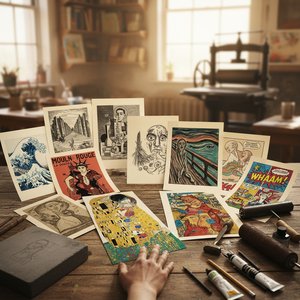
Les 10 Chefs-d'œuvre Lithographiques qui ont Révolutionné l'Art | OriginalUniqueArt
Plongez dans l'univers fascinant des 10 chefs-d'œuvre lithographiques qui ont marqué l'histoire de l'art. Découvrez Toulouse-Lautrec, Munch & Picasso sur OriginalUniqueArt.com ! Reproductions d'art de qualité muséale pour une décoration intérieure unique. Explorez la collection en ligne.
Échos de la Société : Explorer l'Héritage Durable du Réalisme Social dans l'Art
Explorez l'héritage durable du réalisme social dans l'art ! Découvrez Courbet, Manet, Sekoto et bien d'autres artistes engagés. Analyse approfondie et reproductions haute qualité sur OriginalUniqueArt.

Les 10 Chefs-d'œuvre Noirs : Peintures Célèbres et Décoration d'Intérieur
Plongez dans l'univers fascinant des 10 plus beaux tableaux noirs de l'histoire de l'art. Découvrez les secrets de Goya, Manet, Rothko et autres maîtres. Inspirez votre décoration intérieure avec !

10 chefs-d'œuvre du Réalisme Romantique qui capturent l'âme humaine
Plongez dans l'émotion du Réalisme Romantique. Explorez 10 chefs-d'œuvre iconiques, de Constable à Homer, mêlant vérité et passion. Trouvez l'inspiration pour votre décor avec nos reproductions de qualité musée sur OriginalUniqueArt.com. Découvrez toute la collection en ligne.
Le Réalisme Socialiste : Idéologie, Esthétique et Héritage Durable de l'Art Soviétique
Explorez l'histoire fascinante du Réalisme Socialiste soviétique : idéologie, esthétique et figures clés. Analyse approfondie des œuvres iconiques et de son héritage durable. Découvrez un mouvement artistique complexe et influent.


