

 Aperçu en situation
 Envoyer
 Partager
 Détails de l'œuvre

 Télécharger
 Articles similaires
 Radiographie
 Diaporama
René Vallery-Radot


 Lire la suite
Giclées et impressions d'art
Impressions giclées ou sur toile de qualité musée, avec une production rapide et des finitions au choix. ( Commander la reproduction peinte à la main Télécharger l'image haute résolution)




P118B $10

P118H $10

P118W $10

P438Z $10

P508JH $12

P508YH $12

P805H $10

P805Z $10

P919BZ $10

P919G $10

P919XJ $10

P959ZH $10

P968JZ $12

W106C $8

W218G $10

W218JH $8

W218Y $10

W307PJ $10

W316G $10

W316PJ $8

W316Y $10

W398PJ $8

W4111J $10

W500HY $15

W500JH $15

W692G $12

W849H $8

W940BG $15

W953PJ $8




Choisissez parmi nos formats prédéfinis qui respectent les proportions originales de l’œuvre.

Vous pouvez saisir vos propres dimensions pour vous adapter à un cadre ou à un espace spécifique. Si la taille sélectionnée ne correspond pas aux proportions de l'image originale, nous recadrerons l'œuvre ou étendrons l'image avec une bordure en miroir ou une couleur unie. Une maquette numérique vous sera envoyée pour approbation avant le début de la production.
Veuillez noter que l'aperçu à l'écran ne reflète pas le recadrage ou l'extension réelle. Seule la maquette montrera avec précision la composition finale.
Bien que des tailles personnalisées soient disponibles, nous vous recommandons de choisir une dimension dans la liste prédéfinie afin de préserver les proportions originales.
Livraison dans le monde entier () en 2 semaines au lieu des 4/5 semaines habituelles. (16 août)

Livraison express gratuite dans le monde entier

Toile de lin de qualité supérieure

Assurance transport complète

Garantie de remboursement des droits de douane

Garantie de fidélité des couleurs

Politique de retour de 60 jours (uniquement en cas de défaut)

Garantie de remboursement à 100%

Offre de tarifs dégressifs
 L'option verre n'est disponible que pour les dimensions inférieures à 110 cm.

René Vallery-Radot
Giclées et impressions d'art
Format de la reproduction
-


Prix total
$ 80
Description de la pièce
The Canvas as a Window: Albert Edelfelt’s Portrait of René Vallery-Radot
Albert Edelfelt's 1888 painting, “Portrait of René Vallery-Radot,” isn’t merely a likeness; it’s a carefully constructed tableau that speaks volumes about the man himself and the era in which he lived. Within the confines of a modestly sized canvas—measuring just over 45 by 31 centimeters—Edelfelt has captured not simply a face, but an entire life subtly interwoven with intellectual curiosity and familial devotion. The painting immediately draws the eye to René Vallery-Radot himself, seated at his desk, bathed in the soft glow of diffused light. His posture is relaxed yet attentive, suggesting a man deeply absorbed in thought – perhaps reviewing research notes or contemplating the implications of his scientific work alongside his role as husband and father.
Edelfelt’s masterful technique reveals a deliberate balance between realism and impressionistic sensitivity. He employs a meticulous attention to detail, evident in the rendering of René's features—the thoughtful furrow of his brow, the subtle lines around his eyes, and the precise brushstrokes defining his mustache. Yet, he avoids a photographic likeness, instead opting for a looser, more atmospheric approach to color and light. The background is deliberately muted, allowing the focus to remain firmly on the subject, while still hinting at the domestic setting—a testament to Edelfelt’s ability to capture not just what is seen but also the essence of a scene.
A Life in Science and Family: Contextualizing the Portrait
To fully appreciate “Portrait of René Vallery-Radot,” it's crucial to understand the context surrounding his life. René Vallery-Radot was a prominent figure in the scientific community, renowned for his work alongside Louis Pasteur in establishing pasteurization—a process that revolutionized food preservation and public health. He wasn’t simply an assistant; he played a vital role in developing and refining this groundbreaking technique. Simultaneously, he was a devoted husband to Marie-Louise Pasteur (Louis Pasteur's daughter) and a loving father to three children. Edelfelt skillfully portrays these dual roles—the scientist and the family man—without resorting to simplistic stereotypes.
The painting’s composition subtly reinforces this duality. The desk, laden with books, immediately establishes René’s intellectual pursuits. However, the inclusion of a small child's toy – a simple wooden horse – nestled amongst the scholarly volumes hints at his familial responsibilities and the joys of family life. This juxtaposition speaks to the harmonious balance he sought between his scientific endeavors and his personal relationships.
Symbolism and Emotional Resonance
Beyond its straightforward depiction, “Portrait of René Vallery-Radot” is rich in symbolic detail. The books on the desk represent knowledge, learning, and intellectual legacy—a direct reflection of René’s contributions to science. The muted colors and soft lighting evoke a sense of quiet contemplation and domestic tranquility. There's an underlying feeling of warmth and stability, suggesting a man grounded in his family and deeply committed to his work. The careful arrangement of the objects on the desk – from the inkwell to the writing implements—creates a visual rhythm that draws the eye inward, inviting the viewer to share in René’s focused attention.
Furthermore, the painting can be interpreted as a celebration of the Victorian ideal of domesticity. While acknowledging the scientific advancements of the era, Edelfelt subtly emphasizes the importance of family and intellectual pursuits within a stable home environment. It's a portrait that speaks to the values of hard work, dedication, and familial love—qualities highly esteemed in 19th-century society.
A Timeless Masterpiece: Reproductions and Artistic Legacy
Albert Edelfelt’s “Portrait of René Vallery-Radot” remains a captivating work of art, offering a glimpse into the life of a remarkable scientist and devoted family man. Reproductions of this painting are available in various sizes and formats, allowing art enthusiasts to bring this evocative image into their homes or offices. Whether displayed as a statement piece in a study or a thoughtful addition to a living room, this portrait continues to resonate with its quiet dignity, intellectual depth, and subtle emotional power—a testament to Edelfelt’s enduring artistic legacy.
Biographie de l'artiste
Premières années et formation
Albert Gustaf Aristides Edelfelt est né le 21 juillet 1854 à Porvoo, en Finlande. Ses parents, Carl Albert Edelfelt et Alexandra Brandt, étaient d'origine suédoise-finlandaise. Son père était architecte et sa mère issue d’une famille de marchands aisée. Très tôt, Edelfelt a montré une passion pour l'art qui l'a conduit à étudier à l'École de dessin de la Société finnoise des arts en 1869. Il a ensuite poursuivi ses études à l'Académie royale des beaux-arts d'Anvers (1873-74) et à l'École nationale supérieure des beaux-arts de Paris (1874-78), où il a été l’élève de Jean-Léon Gérôme. Il a également passé un certain temps à Saint-Pétersbourg (1881-82).Développement artistique et influences
Sous l'influence de son maître Gérôme, Edelfelt s'est d'abord orienté vers la peinture historique. Cependant, il s’est ensuite tourné vers le naturalisme à partir de 1880. Il a été influencé par Jules Bastien-Lepage et, dans une certaine mesure, par l'impressionnisme. Son style mêlant naturalisme et modernité lui a assuré un grand succès. Ses premières œuvres parisiennes, comme "Le Billet doux", lui ont valu des prix prestigieux. Il partagea un atelier avec Julian Alden Weir et se lia d’amitié avec John Singer Sargent.Œuvres majeures et reconnaissance
Edelfelt a connu une percée significative lors de l'Exposition universelle de Paris en 1889, où il a remporté une médaille d'or. Parmi ses œuvres les plus notables figurent : le "Portrait de Louis Pasteur", qui lui a valu la Légion d’honneur en 1886 ; "Une jeune femme dans son boudoir”, témoignant de sa maîtrise dans la capture de l'essence féminine ; et “Sous les bouleaux”, une représentation poignante des paysages finlandais. Il a également réalisé des portraits de personnalités importantes, notamment Aino Ackté et la famille impériale russe.Impact et héritage
Edelfelt est considéré comme l’un des premiers artistes finlandais à atteindre une renommée internationale. Son succès a ouvert la voie à d'autres peintres finlandais, tels qu'Akseli Gallen-Kallela et Gunnar Berndtson, qui ont également étudié à Paris. Il a contribué de manière significative au mouvement artistique réaliste en Finlande et son influence s’est étendue aux générations suivantes. Sa carrière a été marquée par un retour en Finlande en 1891 et par des œuvres patriotiques vers la fin de sa vie. Son héritage a été célébré par l'émission d'une pièce commémorative de 100 euros à l'occasion de son 150e anniversaire en 2004.
Albert Edelfelt
1854 - 1905 , Finlande
L'essentiel de l'artiste
- Artistes Influents:
- Jean-Léon Gérôme
- Jules Bastien-Lepage
- Date De Décès: 18 août 1905
- Date De Naissance: 21 juillet 1854
- Influence Sur D'Autres Artistes:
- Akseli Gallen-Kallela
- Gunnar Berndtson
- Lieu De Naissance: Porvoo, Finlande
- Mouvement Artistique: Réalisme
- Nationalité: Finlandaise
- Nom Complet: Albert Edelfelt
- Oeuvres Notables:
- Portrait de Louis Pasteur
- Une jeune femme dans son boudoir
- Sous les bouleaux
Articles connexes
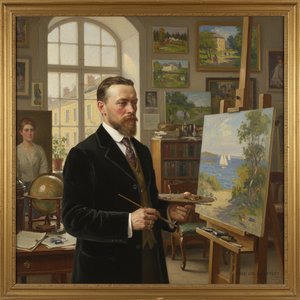
Albert Edelfelt: A Pioneer of Finnish Realism & International Impressionist Circles
Explore the life & work of Albert Edelfelt, a pioneering Finnish Realist painter who bridged Impressionism & national identity. Discover his masterpieces and lasting influence on art history.
Romantic Realism's Finest: 10 Masterpieces for Your Home | OriginalUniqueArt
Explore 10 defining masterpieces of Romantic Realism! Discover Courbet, Millet & Daumier's powerful paintings—capturing emotion and social realities. Find museum-quality reproductions for your home at OriginalUniqueArt.com.

Échos de la Société : Explorer l'Héritage Durable du Réalisme Social dans l'Art
Explorez l'héritage durable du réalisme social dans l'art ! Découvrez Courbet, Manet, Sekoto et bien d'autres artistes engagés. Analyse approfondie et reproductions haute qualité sur OriginalUniqueArt.
Realism in Art: A Professional Guide to Authentic Detail and Lifelike Masterpieces for Large-Scale Interior Projects
Master the use of Realism in professional interiors. This expert guide explores 19th-century masterpieces, offering procurement managers and designers technical insights into selecting authentic, hand-painted oil reproductions for high-end hotel and corporate projects.
The Evocative Embrace of Reality: Exploring Romantic Realism in 19th-Century Painting
Explore the captivating world of Romantic Realism! Discover key artists like Courbet & Millet, masterpieces, and the social context behind this influential art movement. Expert insights for collectors at OriginalUniqueArt.



