

 Aperçu en situation
 Partager
 Partager
 Détails

 Télécharger l'image
 Articles similaires
 Radiographie
 Voir le diaporama
Portrait of Louis Pasteur


 Afficher la suite
Giclées et impressions d'art
Impressions giclées ou sur toile de qualité musée, avec une production rapide et des finitions au choix. ( Acheter la peinture faite à la main Acheter l'image)




P118B $10

P118H $10

P118W $10

P438Z $10

P508JH $12

P508YH $12

P805H $10

P805Z $10

P919BZ $10

P919G $10

P919XJ $10

P959ZH $10

P968JZ $12

W106C $8

W218G $10

W218JH $8

W218Y $10

W307PJ $10

W316G $10

W316PJ $8

W316Y $10

W398PJ $8

W4111J $10

W500HY $15

W500JH $15

W692G $12

W849H $8

W940BG $15

W953PJ $8




Choisissez parmi nos formats prédéfinis qui respectent les proportions originales de l’œuvre.

Vous pouvez saisir vos propres dimensions pour vous adapter à un cadre ou à un espace spécifique. Si la taille sélectionnée ne correspond pas aux proportions de l'image originale, nous recadrerons l'œuvre ou étendrons l'image avec une bordure en miroir ou une couleur unie. Une maquette numérique vous sera envoyée pour approbation avant le début de la production.
Veuillez noter que l'aperçu à l'écran ne reflète pas le recadrage ou l'extension réelle. Seule la maquette montrera avec précision la composition finale.
Bien que des tailles personnalisées soient disponibles, nous vous recommandons de choisir une dimension dans la liste prédéfinie afin de préserver les proportions originales.
Livraison dans le monde entier () en 2 semaines au lieu des 4/5 semaines habituelles. (27 août)

Livraison express gratuite dans le monde entier

Toile de lin de haute qualité

Assurance transport complète

Garantie de remboursement des droits de douane

Garantie de fidélité des couleurs

Politique de retour de 60 jours (uniquement en cas de défaut)

Garantie de remboursement à 100%

Tarifs dégressifs sur quantité
 L'option verre n'est disponible que pour les dimensions inférieures à 110 cm.

Portrait of Louis Pasteur
Giclées et impressions d'art
Format de la reproduction
-


Prix total final
$ 80
Description de la pièce
A Vision of Scientific Eminence
In the quiet, focused atmosphere of a late nineteenth-century laboratory, Albert Edelfelt captures more than just a man; he captures the very essence of an intellectual revolution. His Portrait of Louis Pasteur is a profound meditation on the dawn of modern microbiology, presenting the legendary French chemist not as a distant icon, but as a figure deeply immersed in the tactile reality of his work. The painting serves as a window into a moment where scientific inquiry meets artistic mastery, inviting the viewer to witness the intense concentration and the heavy weight of discovery that defined Pasteur’s life. Through Edelfelt's lens, we see the pioneer surrounded by the tools of his trade—glassware, vials, and experimental apparatus—each element contributing to a narrative of relentless pursuit and the quiet dignity of scientific labor.
The emotional resonance of the piece lies in its ability to bridge the gap between the observer and the observed. There is an intimate, almost reverent quality to the way Edelfelt renders the laboratory setting, transforming a space of clinical study into a sanctuary of human intellect. For collectors and enthusiasts of historical portraiture, this work offers a rare opportunity to possess a piece that embodies the spirit of the Belle Époque—a period characterized by an unshakeable belief in progress and the power of human reason. The painting does not merely depict a subject; it evokes the atmosphere of an era where every drop of liquid in a test tube held the potential to change the course of medical history.
Mastery of Impressionistic Realism
Technically, Edelfelt achieves a breathtaking balance between Impressionistic vibrancy and Academic precision. Utilizing the rich, luminous qualities of oil on canvas, the artist employs a technique that allows for both meticulous anatomical accuracy and a soft, atmospheric light. One can observe the subtle gradations of color in Pasteur’s skin tones, which catch the ambient light of the lab, creating a lifelike warmth that breathes life into the portrait. The brushstrokes, while grounded in realism, possess a certain fluidity and texture—particularly in the rendering of the laboratory glassware and the fabric of Pasteur's attire—that lends the composition a sense of movement and vitality.
This sophisticated approach to light and shadow, often referred to as chiaroscuro, serves to direct the viewer's eye toward the subject's thoughtful expression. The interplay of light reflecting off the glass bottles on the table creates a rhythmic pattern of highlights that guides us through the depth of the room. For those looking to integrate such a masterpiece into a curated interior, the painting offers a versatile elegance. Its muted, earthy palette and sophisticated textures make it an ideal centerpiece for a study, a library, or a formal gallery space, providing a sense of historical gravity and intellectual sophistication to any environment.
A Legacy Captured in Pigment
Beyond its aesthetic brilliance, the portrait is steeped in profound symbolism. The laboratory environment acts as a metaphor for the human mind's capacity to unravel the mysteries of the natural world. Every bottle and vial serves as a visual testament to Pasteur’s tireless research into germ theory and vaccination. Edelfelt, a Finnish master who found his greatest acclaim in the heart of Paris, understood that to paint Pasteur was to paint the very foundation of modern hygiene and public health. The composition captures a moment of stillness within a life of constant motion, suggesting that true scientific breakthroughs are born from moments of profound, solitary reflection.
Owning a high-quality reproduction of this work is an invitation to celebrate the enduring legacy of human curiosity. It is a piece designed for those who appreciate art that tells a story—a story of courage, dedication, and the transformative power of knowledge. Whether displayed as a tribute to scientific history or as a cornerstone of classical decor, Edelfelt’s Portrait of Louis Pasteur remains an eternal emblem of achievement, reminding us that even in the smallest laboratory, the greatest revolutions begin.
Biographie de l'artiste
Premières années et formation
Albert Gustaf Aristides Edelfelt est né le 21 juillet 1854 à Porvoo, en Finlande. Ses parents, Carl Albert Edelfelt et Alexandra Brandt, étaient d'origine suédoise-finlandaise. Son père était architecte et sa mère issue d’une famille de marchands aisée. Très tôt, Edelfelt a montré une passion pour l'art qui l'a conduit à étudier à l'École de dessin de la Société finnoise des arts en 1869. Il a ensuite poursuivi ses études à l'Académie royale des beaux-arts d'Anvers (1873-74) et à l'École nationale supérieure des beaux-arts de Paris (1874-78), où il a été l’élève de Jean-Léon Gérôme. Il a également passé un certain temps à Saint-Pétersbourg (1881-82).Développement artistique et influences
Sous l'influence de son maître Gérôme, Edelfelt s'est d'abord orienté vers la peinture historique. Cependant, il s’est ensuite tourné vers le naturalisme à partir de 1880. Il a été influencé par Jules Bastien-Lepage et, dans une certaine mesure, par l'impressionnisme. Son style mêlant naturalisme et modernité lui a assuré un grand succès. Ses premières œuvres parisiennes, comme "Le Billet doux", lui ont valu des prix prestigieux. Il partagea un atelier avec Julian Alden Weir et se lia d’amitié avec John Singer Sargent.Œuvres majeures et reconnaissance
Edelfelt a connu une percée significative lors de l'Exposition universelle de Paris en 1889, où il a remporté une médaille d'or. Parmi ses œuvres les plus notables figurent : le "Portrait de Louis Pasteur", qui lui a valu la Légion d’honneur en 1886 ; "Une jeune femme dans son boudoir”, témoignant de sa maîtrise dans la capture de l'essence féminine ; et “Sous les bouleaux”, une représentation poignante des paysages finlandais. Il a également réalisé des portraits de personnalités importantes, notamment Aino Ackté et la famille impériale russe.Impact et héritage
Edelfelt est considéré comme l’un des premiers artistes finlandais à atteindre une renommée internationale. Son succès a ouvert la voie à d'autres peintres finlandais, tels qu'Akseli Gallen-Kallela et Gunnar Berndtson, qui ont également étudié à Paris. Il a contribué de manière significative au mouvement artistique réaliste en Finlande et son influence s’est étendue aux générations suivantes. Sa carrière a été marquée par un retour en Finlande en 1891 et par des œuvres patriotiques vers la fin de sa vie. Son héritage a été célébré par l'émission d'une pièce commémorative de 100 euros à l'occasion de son 150e anniversaire en 2004.
Albert Edelfelt
1854 - 1905 , Finlande
En bref
- Artistes Influents:
- Jean-Léon Gérôme
- Jules Bastien-Lepage
- Date De Décès: 18 août 1905
- Date De Naissance: 21 juillet 1854
- Influence Sur D'Autres Artistes:
- Akseli Gallen-Kallela
- Gunnar Berndtson
- Lieu De Naissance: Porvoo, Finlande
- Mouvement Artistique: Réalisme
- Nationalité: Finlandaise
- Nom Complet: Albert Edelfelt
- Oeuvres Notables:
- Portrait de Louis Pasteur
- Une jeune femme dans son boudoir
- Sous les bouleaux
Articles similaires
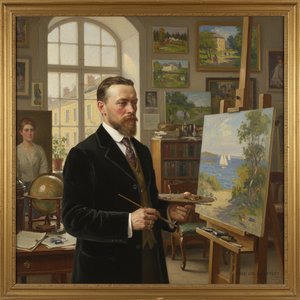
Albert Edelfelt: A Pioneer of Finnish Realism & International Impressionist Circles
Explore the life & work of Albert Edelfelt, a pioneering Finnish Realist painter who bridged Impressionism & national identity. Discover his masterpieces and lasting influence on art history.

La Précision du Regard : L'Illustration Scientifique entre Art et Épistémologie
Explorez l'histoire fascinante de l'illustration botanique : un art au service de la science. Découvrez les techniques, les artistes emblématiques et l'importance de la précision dans cette discipline unique.
The Art of Precision: Exploring the Beauty and Legacy of Scientific Illustration
Discover the exquisite intersection of science and fine art. Explore the history of scientific illustration, from botanical watercolor masters to nature's intricate geometry, through an expert lens of art history and technical precision.

L'Éveil du Détail Naturaliste : Histoire de l'Illustration Botanique et Scientifique
Explorez l'histoire fascinante de l'illustration botanique et scientifique, des herbiers anciens aux chefs-d'œuvre naturalistes. Découvrez les artistes clés et leur contribution à la science et à l'art.
The Flourishing Canvas: A Historical & Artistic Exploration of Botanical Illustration
Explore the rich history of botanical illustration! Discover key artists like Havell & Barraband, learn about scientific accuracy & aesthetic beauty. Shop museum-quality reproductions at OriginalUniqueArt.



