

 Aperçu en situation
 Partager
 Partager
 Détails
 Guide imprimable

 Télécharger
 Articles similaires
 Radiographie
 Voir le diaporama
 Statistiques
Louis Pasteur
 Acrylique sur toile
- Art mural
- Realist Painting
 1885
1885- XIXe siècle
 154.0 x 126.0 cm
 Musée d'Orsay
 Afficher la suite
Giclées et impressions d'art
Impressions giclées ou sur toile de qualité musée, avec une production rapide et des finitions au choix. ( Acheter la peinture faite à la main Passer au format image numérique)




P118B €10

P118H €10

P118W €10

P438Z €10

P508JH €12

P508YH €12

P805H €10

P805Z €10

P919BZ €10

P919G €10

P919XJ €10

P959ZH €10

P968JZ €12

W106C €8

W218G €10

W218JH €8

W218Y €10

W307PJ €10

W316G €10

W316PJ €8

W316Y €10

W398PJ €8

W4111J €10

W500HY €15

W500JH €15

W692G €12

W849H €8

W940BG €15

W953PJ €8




Choisissez parmi nos formats prédéfinis qui respectent les proportions originales de l’œuvre.

Saisissez la largeur et la hauteur souhaitées pour qu'elles s'adaptent à votre cadre ou à votre mur. Une impression ne peut être que découpée, elle ne peut jamais être agrandie au-delà de l'image originale ; ainsi, un format de forme différente entraînera la perte d'une partie de l'image. Nous vous envoyons une maquette numérique pour approbation avant toute impression. L'image présentée sur cette page ne montre pas le recadrage réel — seule la maquette le permet.
Livraison dans le monde entier () en 2 semaines au lieu des 4/5 semaines habituelles. (21 octobre)

Livraison express gratuite dans le monde entier

Toile de lin de haute qualité

Assurance transport complète

Garantie de remboursement des droits de douane

Garantie de fidélité des couleurs

Garantie de retour de 100 jours (uniquement en cas de défaut)

Garantie de remboursement à 100%

Tarifs dégressifs sur quantité
 L'option verre n'est disponible que pour les dimensions inférieures à 110 cm.

Louis Pasteur
Giclées et impressions d'art
Format de la reproduction
-


Prix total final
€ 70
The Genesis of a Masterpiece
Albert Edelfelt’s “Louis Pasteur,” painted in 1885, isn't merely a portrait; it’s a meticulously crafted distillation of an era – the burgeoning age of scientific discovery and the quiet revolution taking place within the laboratories of France. Commissioned during a period of intense intellectual ferment, this oil-on-canvas work transcends simple representation to embody Pasteur’s unwavering commitment to unraveling the mysteries of life and disease. Edelfelt, a Finnish artist deeply influenced by Northern European realism, chose to capture Pasteur not as a celebrated figure in public acclaim, but as a man profoundly engaged in his craft – a scientist immersed in the focused intensity of his laboratory.
The painting’s genesis lies within the context of Pasteur's groundbreaking work. His pioneering research into germ theory, vaccination against rabies and anthrax, and pasteurization were fundamentally reshaping medicine and public health. Edelfelt, keenly aware of this transformative impact, sought to immortalize not just Pasteur’s physical presence but also the spirit of relentless inquiry that defined his legacy. The choice of setting – a meticulously rendered laboratory filled with scientific instruments – immediately establishes this intellectual atmosphere, suggesting a space dedicated to observation, experimentation, and the pursuit of knowledge.
A Symphony of Detail: Technique and Style
Edelfelt’s masterful technique is evident in every brushstroke. He employs a rich, layered impasto—a thick application of paint—that lends texture and depth to the scene. The careful rendering of light and shadow creates a palpable sense of realism, drawing the viewer into Pasteur's world. Notice particularly the subtle gradations of color applied to the various glass bottles and scientific equipment; each element is rendered with painstaking detail, reflecting Edelfelt’s dedication to accuracy. The composition itself is carefully balanced, guiding the eye through the scene – from Pasteur himself, deeply absorbed in his work, to the surrounding apparatus that speaks volumes about his research.
- Color Palette: A muted palette of browns, greens, and blues dominates, reflecting the laboratory’s atmosphere.
- Brushwork: Edelfelt's brushstrokes are visible and deliberate, contributing to the painting's textured surface.
- Lighting: The use of chiaroscuro (strong contrasts between light and dark) emphasizes Pasteur’s figure and highlights the details of his workspace.
Symbolism and the Portrait of a Mind
Beyond its technical brilliance, “Louis Pasteur” is laden with symbolic meaning. The bottles scattered around the laboratory represent the countless experiments and observations that constitute Pasteur's scientific journey. The focused gaze of Pasteur himself embodies his intellectual rigor and unwavering dedication to his work. He’s not a triumphant hero; he’s a man consumed by curiosity, driven by an insatiable desire to understand the natural world. The inclusion of specific instruments—beakers, flasks, and retorts—are not merely decorative elements but rather visual cues that underscore Pasteur's scientific pursuits.
The painting subtly suggests the transformative power of science – a quiet revolution unfolding within the confines of the laboratory, with profound implications for humanity’s future.A Legacy Preserved: Emotional Resonance and Artistic Significance
“Louis Pasteur” is more than just a portrait; it's a testament to the enduring legacy of scientific innovation. It captures not only the likeness of a brilliant mind but also the spirit of inquiry that defines the modern era. The painting’s emotional resonance lies in its portrayal of focused concentration and unwavering dedication—qualities that continue to inspire scientists, artists, and thinkers today. It serves as a poignant reminder of the transformative power of knowledge and the profound impact one individual can have on the world. Reproductions of this iconic work offer a beautiful way to bring this powerful image into your home or office, celebrating both artistic mastery and scientific achievement.
Questions et réponses
De quel pays provient l'œuvre Realist Painting « Louis Pasteur » ?
«Louis Pasteur» relie le mouvement Realist Painting à Finlande par le biais du lieu de naissance de son créateur.
L'œuvre « Louis Pasteur » dispose-t-elle d'un aperçu en réalité augmentée ?
Vous pouvez prévisualiser «Louis Pasteur» de Albert Edelfelt sur votre propre mur grâce à la page Aperçu RA de l'œuvre, en utilisant la réalité augmentée sur un appareil compatible.
Qui est l'auteur de « Louis Pasteur », et dans quel mouvement ?
Derrière « Louis Pasteur » se trouvent Albert Edelfelt et le mouvement Realist Painting.
Biographie de l'artiste
Premières années et formation
Albert Gustaf Aristides Edelfelt est né le 21 juillet 1854 à Porvoo, en Finlande. Ses parents, Carl Albert Edelfelt et Alexandra Brandt, étaient d'origine suédoise-finlandaise. Son père était architecte et sa mère issue d’une famille de marchands aisée. Très tôt, Edelfelt a montré une passion pour l'art qui l'a conduit à étudier à l'École de dessin de la Société finnoise des arts en 1869. Il a ensuite poursuivi ses études à l'Académie royale des beaux-arts d'Anvers (1873-74) et à l'École nationale supérieure des beaux-arts de Paris (1874-78), où il a été l’élève de Jean-Léon Gérôme. Il a également passé un certain temps à Saint-Pétersbourg (1881-82).Développement artistique et influences
Sous l'influence de son maître Gérôme, Edelfelt s'est d'abord orienté vers la peinture historique. Cependant, il s’est ensuite tourné vers le naturalisme à partir de 1880. Il a été influencé par Jules Bastien-Lepage et, dans une certaine mesure, par l'impressionnisme. Son style mêlant naturalisme et modernité lui a assuré un grand succès. Ses premières œuvres parisiennes, comme "Le Billet doux", lui ont valu des prix prestigieux. Il partagea un atelier avec Julian Alden Weir et se lia d’amitié avec John Singer Sargent.Œuvres majeures et reconnaissance
Edelfelt a connu une percée significative lors de l'Exposition universelle de Paris en 1889, où il a remporté une médaille d'or. Parmi ses œuvres les plus notables figurent : le "Portrait de Louis Pasteur", qui lui a valu la Légion d’honneur en 1886 ; "Une jeune femme dans son boudoir”, témoignant de sa maîtrise dans la capture de l'essence féminine ; et “Sous les bouleaux”, une représentation poignante des paysages finlandais. Il a également réalisé des portraits de personnalités importantes, notamment Aino Ackté et la famille impériale russe.Impact et héritage
Edelfelt est considéré comme l’un des premiers artistes finlandais à atteindre une renommée internationale. Son succès a ouvert la voie à d'autres peintres finlandais, tels qu'Akseli Gallen-Kallela et Gunnar Berndtson, qui ont également étudié à Paris. Il a contribué de manière significative au mouvement artistique réaliste en Finlande et son influence s’est étendue aux générations suivantes. Sa carrière a été marquée par un retour en Finlande en 1891 et par des œuvres patriotiques vers la fin de sa vie. Son héritage a été célébré par l'émission d'une pièce commémorative de 100 euros à l'occasion de son 150e anniversaire en 2004.
Albert Edelfelt
1854 - 1905 , Finlande
En bref
- Artistes Influents:
- Jean-Léon Gérôme
- Jules Bastien-Lepage
- Date De Décès: 18 août 1905
- Date De Naissance: 21 juillet 1854
- Influence Sur D'Autres Artistes:
- Akseli Gallen-Kallela
- Gunnar Berndtson
- Lieu De Naissance: Porvoo, Finlande
- Mouvement Artistique: Réalisme
- Nationalité: Finlandaise
- Nom Complet: Albert Edelfelt
- Oeuvres Notables:
- Portrait de Louis Pasteur
- Une jeune femme dans son boudoir
- Sous les bouleaux
Articles connexes

Anne-Louis Girodet: Bridging Neoclassicism & Romanticism with Emotional Truth
Explore the captivating world of Anne-Louis Girodet, a pivotal figure bridging Neoclassicism & Romanticism. Discover his masterpieces and unique artistic vision with OriginalUniqueArt.

Morris Louis: Pioneering Color Field Painting & Abstract Expressionism's Legacy
Explore the groundbreaking abstract expressionism of Morris Louis, a pioneer of Color Field painting. Discover his innovative techniques, influential series & lasting legacy in post-war American art. Learn more at OriginalUniqueArt.

Albert Charles Lebourg : L'Impressionnisme Atmosphérique et la Campagne Française – Une Étude Raffinée
Découvrez Albert Charles Lebourg, un maître de l'impressionnisme atmosphérique et son exploration poétique du paysage français. Analyse approfondie, biographie et conseils pour collectionner ses œuvres.
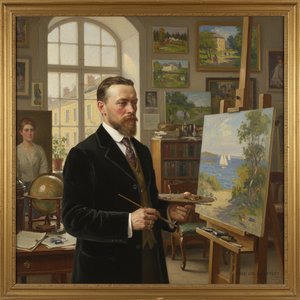
Albert Edelfelt: A Pioneer of Finnish Realism & International Impressionist Circles
Explore the life & work of Albert Edelfelt, a pioneering Finnish Realist painter who bridged Impressionism & national identity. Discover his masterpieces and lasting influence on art history.
Albert Goodwin: Capturing Victorian Light & Atmosphere – A Study in Landscape Painting
Explore the captivating landscapes of Albert Goodwin (1845-1932), a celebrated Victorian watercolourist influenced by Turner & Ruskin. Discover his techniques, prolific collection, and lasting legacy in British art history.


