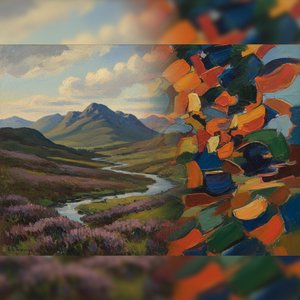
The Geometry of Light
Born in Edinburgh, William Crozier lived a life defined by a quiet, persistent struggle against ill health. His path was shaped by the rigorous training at the Edinburgh College of Art, where he moved within a circle of talented peers including William Gillies and Anne Redpath. These connections placed him at the heart of a significant movement in Scottish art. His early years were marked by a drive to understand the fundamental structures of the visual world, a pursuit that eventually led him away from the familiar landscapes of Scotland toward the intense clarity of the continent.
In 1923, a Carnegie travelling scholarship provided the means for Crozier to study in Paris. Under the guidance of the cubist André Lhote, his perception of form began to shift. He moved away from mere representation, seeking instead to understand the underlying architecture of his subjects. This period of study was not merely academic; it was a fundamental restructuring of how he saw the world, turning soft edges into deliberate, purposeful shapes.
The Italian Influence
The year 1924 brought a transformative shift as Crozier, alongside Geissler and Gillies, traveled through Italy. It was here that the harsh, uncompromising nature of Mediterranean light left its mark on his technique. He became preoccupied with the way intense sunlight could carve a landscape into sharp, geometric planes, creating deep, heavy shadows that defined the contours of the earth and the city alike. This fascination with the interplay of light and shadow became a hallmark of his mature style.
His work from this period demonstrates a clear synthesis of his Parisian training and his Italian observations:
- The use of simple geometric blocks to represent complex architecture.
- A high-contrast approach to light and shadow.
- A focus on the structural essence of landscapes and urban environments.
A Life Cut Short
By 1927, his ability to translate these observations into paint was evident in his depiction of Edinburgh from Salisbury Crags. In this work, the city is stripped of its romanticism and rebuilt through the lens of cubist influence, where buildings are rendered as stark, sunlit facades set against dark, shaded sides. His technical precision and unique vision earned him recognition, including the Guthrie Award in 1928 and an election as an Associate to the Royal Scottish Academy in 1930.
Tragedy arrived with suddenness. Suffering from haemophilia, Crozier’s physical resilience was constantly tested. His life ended prematurely at the age of 37 following a fall in his studio. Though his career was brief, his contribution to the Edinburgh School remains a significant chapter in the history of Scottish landscape painting, later recognized by exhibitions at the Scottish National Gallery of Modern Art.
Kysymykset ja vastaukset
Mihin tyylisuuntauksiin William Crozier kuului?
Kaikki taidesuuntaukset-sivulla William Crozier:n teokset on ryhmitelty taidesuuntauksen mukaan.
Mihin historialliseen aikakauteen William Crozier kuului?
William Crozier työskenteli Modern -aikakaudella. Aikakausi sijoittaa taiteilijan toiminnan historialliseen kontekstiin.
Mistä voin nähdä William Crozier'n teokset aikajärjestyksessä?
William Crozier'n teokset ovat nähtävissä aikajärjestyksessä artistin Teosten aikajana -sivulla.
Miten William Croziern taide kehittyi ajan myötä?
William Crozier:n tuotanto esitellään kronologisesti taiteilijan Ura kronikka -sivulla, jossa teokset etenevät luomisjärjestyksessä luku luvulta.