Bernardo Bellotto muotokuva

100 tunnetuinta Bernardo Bellotto -maalausta, gallerian valikoima

Päivitetty marraskuu 2026 · järjestetty suosituimmuuspisteiden mukaan (jokaisen teoksen haut, vierailut ja tilaukset) · 230 teosta taiteilijalta Bernardo Bellotto luettelossamme

Lyhyesti

Kaikista Bernardo Bellotto jättämistä alkuperäisteoksista kuuluisin on Kreuzkirche van Dresden raunioita (1765), joka kuuluu Gemäldegalerie Alte Meister -kokoelmaan, Dresden. Heti perässä tulevat Dresden, the Frauenkirche and the Rampische Gasse (1749) ja The Moat of the Zwinger in Dresden (1749). Katalogissamme on 230 teosta taiteilijalta Bernardo Bellotto; galleria on säilyttänyt 100 maailman ihailluimmista teoksista, ja jokaisesta on esitetty sen päivämäärä, museo sekä tarina.

1722 – 1780, Venetsia Rococo Eniten teoksia: Staatliche Kunstsammlungen Dresden

Bernardo Bellotto -taiteilijan 10 parasta maalausta: gallerian valinnat

1
Kreuzkirche van Dresden raunioita (1765) tekijä Bernardo Bellotto

Kreuzkirche van Dresden raunioita

1765 · Öljyväri kankaalle · Gemäldegalerie Alte Meister, Dresden

Bernardo Bellottin vuonna 1765 maalattu "Dresdenin rauniot" ei ole pelkästään kaupungin maisema, vaan syvällinen pohdinta menetyksen, toipumisen ja ihmisluonnon kestävyyden teemoista. Tämä veduta-tyylinen työ, joka on Bellottin mestariteos hänen isänsä Giovanni Antonio Canal Canalettin opastamana, tarjoaa katsojalle poikkeuksellisen kosketuksen Dresdenin elämään ennen ja jälkeen suurta taistelua. Bellotto ei esitä pelkästään tuhon maisemaa; hän vangitsee hetken, jossa kaupunki kamppailee palautumistaan, kun rauniot kertovat menneestä loistosta ja tulevaisuuden toivosta.

2
Dresden, the Frauenkirche and the Rampische Gasse (1749) tekijä Bernardo Bellotto

Dresden, the Frauenkirche and the Rampische Gasse

1749 · Oil On Canvas · Gemäldegalerie Alte Meister, Dresden

In the quiet, luminous depths of Bernardo Bellotto’s 1749 masterpiece, Dresden, the Frauenkirche and the Rampische Gasse, we are invited to step through a portal into the eighteenth century. This breathtaking oil on canvas is far more than a mere topographical record; it is a soulful meditation on a city at its zenith. As the eye wanders across the panoramic vista, one is immediately struck by the imposing presence of…

3
The Moat of the Zwinger in Dresden (1749) tekijä Bernardo Bellotto

The Moat of the Zwinger in Dresden

1749 · Oil On Canvas · Gemäldegalerie Alte Meister, Dresden

To look upon The Moat of the Zwinger in Dresden is to witness a moment of profound stillness from 1749. This canvas captures the Zwinger complex not as a mere fortification, but as a serene reflection of royal life during the reign of Augustus III. The water in the moat acts as a liquid mirror, its surface broken only by the gentle movement of small boats and the soft ripples…

4
The Moat of the Zwinger in Dresden (detail) (1749) tekijä Bernardo Bellotto

The Moat of the Zwinger in Dresden (detail)

1749 · Oil On Canvas · Gemäldegalerie Alte Meister, Dresden

In the heart of 18th-century Saxony, amidst the burgeoning prosperity of the Enlightenment, Bernardo Bellotto captured a moment of profound serenity and architectural splendor. His masterpiece, The Moat of the Zwinger in Dresden, is far more than a mere topographical record; it is a luminous window into a vanished world. Painted in 1749, this work invites the viewer to step onto the banks of the Zwinger Palace’s moat, where the…

5
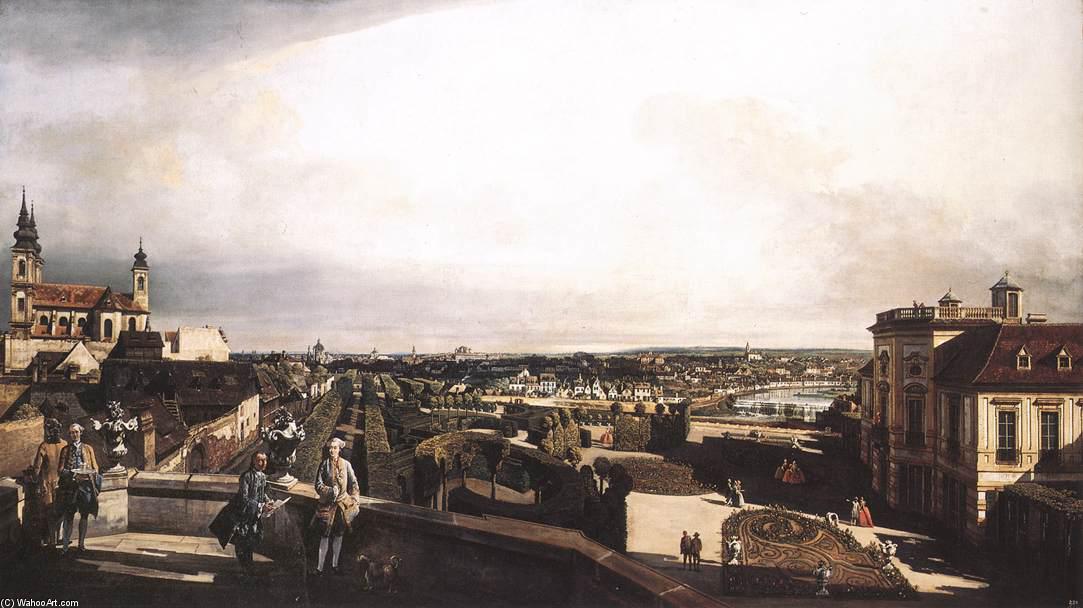
Wiener Panorama vom Palais Kaunitz (1759) tekijä Bernardo Bellotto

Wiener Panorama vom Palais Kaunitz

1759 · Öljyväri kankaalle · Szépművészeti Múzeum, Budapest

Bernardo Bellotto ja Viennan Panoraama Palais Kaunitzista Bernardo Bellotto oli italialainen maalaaja, joka syntyi Venetsiassa noin vuonna 1721/2 tai 30. tammikuuta 1721. Hän oli Giovanni Antonio Canaletto, eli Giovannin Antonio Kanalleton velipoika ja oppilas, joka oli merkittävä venetsialainen maalauskouluun kuuluva henkilö. Bellotto tunnettiin erityisesti suurten rakennusten ja luonnonmaisemien tarkkaan kuvaamiseen keskittyvällä tyylillään sekä jokaisen paikan oman valon vangitsemiseen taitavana mestarina. Hän sai kutsun työskentelyyn monien eurooppalaisten kuninkaiden palveluksessa, mikä mahdollisti…

6
Grand canal, view from north (1738) tekijä Bernardo Bellotto

Grand canal, view from north

1738 · Oil On Canvas · National Gallery of Victoria, Melbourne

In this work, titled Grand canal, view from north, the artist Bernardo Bellotto captures a specific moment within the Venetian cityscape. Painted about 1738, the scene focuses on the activity along the water, where several boats float upon the river. Some vessels occupy the foreground, while others drift toward the distance, creating a sense of depth across the waterway.

7
The Fortress of Konigstein (1758) tekijä Bernardo Bellotto

The Fortress of Konigstein

1758 · Oil On Canvas · National Gallery of Art, Washington

The painting titled The Fortress of Konigstein was executed by the Italian artist Bernardo Bellotto in 1758. Bellotto was an urban landscape painter and printmaker who specialized in the veduta style. He was the nephew and pupil of Giovanni Antonio Canal. This specific work was part of a series of views commissioned by the Elector of Saxony, Augustus III.

8
Allegory Inclinata Resurgit (1762) tekijä Bernardo Bellotto

Allegory Inclinata Resurgit

1762 · Oil On Canvas · Staatliche Kunstsammlungen Dresden, Dresden

The scene unfolds within the allegorical realm of Allegory Inclinata Resurgit, a painting that captures a moment of profound symbolic weight. Created by the hand of Bernardo Bellotto, this work invites the viewer into a staged, theatrical space where figures and architecture converge. The piece emerges from about 1762, a time when the artist was deeply engaged with the visual language of his era. Every element within the frame works…

10
Venetian Capriccio, View of Santa Maria dei Miracoli (1740) tekijä Bernardo Bellotto

Venetian Capriccio, View of Santa Maria dei Miracoli

1740 · Oil On Canvas · Niedersächsisches Landesmuseum, Hannover

In this work, titled Venetian Capriccio, View of Santa Maria dei Miracoli, the artist Bernardo Bellotto presents a detailed cityscape of Venice. Painted about 1740, the scene focuses on the architecture of the Santa Maria dei Miracoli church. It is a capriccio, a composition that uses a fanciful or imagined arrangement of real-world elements to create a specific atmosphere.

Bernardo Bellotto-valikoima jatkuu, 11–100

11Pirna Seen from the Right Bank of the Elbe (1750) tekijä Bernardo BellottoPirna Seen from the Right Bank of the Elbe1750 12A Capriccio River Landscape with a Church to the Left (1765) tekijä Bernardo BellottoA Capriccio River Landscape with a Church to the Left1765 13Allegory Ex Arduis Immortalitas (1762) tekijä Bernardo BellottoAllegory Ex Arduis Immortalitas1762 · Staatliche Kunstsammlungen Dresden 14Fantastic architecture with portrait of Franciszek Salezy Potocki and his son Stanisław Szczęsny (1763) tekijä Bernardo BellottoFantastic architecture with portrait of Franciszek Salezy Potocki and his son Stanisław Szczęsny1763 · El Paso Museum of Art 15The Fortress of Königstein: Courtyard with the Magdalenenburg (1758) tekijä Bernardo BellottoThe Fortress of Königstein: Courtyard with the Magdalenenburg1758 · National Gallery of Art 16The Fortress of Königstein (1756) tekijä Bernardo BellottoThe Fortress of Königstein1756 17The Election of the King Stanislaus Augustus (1764) tekijä Bernardo BellottoThe Election of the King Stanislaus Augustus1764 18View of Wilanów meadows (1775) tekijä Bernardo BellottoView of Wilanów meadows1775 · Varsovan kuninkaallinen linna 19Groom leading a horse (1773) tekijä Bernardo BellottoGroom leading a horse1773 · National Museum in Warsaw 20The Elbe between Pirna and Pillnitz (1766) tekijä Bernardo BellottoThe Elbe between Pirna and Pillnitz1766 · Staatliche Kunstsammlungen Dresden 21Dresden, the Ruins of the Pirnaische Vorstadt (1766) tekijä Bernardo BellottoDresden, the Ruins of the Pirnaische Vorstadt1766 22View of Ujazdów from the Royal Baths (1776) tekijä Bernardo BellottoView of Ujazdów from the Royal Baths1776 · National Museum in Warsaw 23Stable boy leading a horse (1773) tekijä Bernardo BellottoStable boy leading a horse1773 · National Museum in Warsaw 24Rio dei Mendicanti with the Scuola di San Marco (detail) (1738) tekijä Bernardo BellottoRio dei Mendicanti with the Scuola di San Marco (detail)1738 · Gallerie dell'Accademia di Venezia 25The Imperial Palace Schönbrunn, Garden Side (1758) tekijä Bernardo BellottoThe Imperial Palace Schönbrunn, Garden Side1758 · Kunsthistorisches Museum 26View of Pirna from the Sonnenstein Castle (1750) tekijä Bernardo BellottoView of Pirna from the Sonnenstein Castle1750 · Hermitage-museo 27View of Pirna from the Right Bank of the Elba above the Town (1753) tekijä Bernardo BellottoView of Pirna from the Right Bank of the Elba above the Town1753 · Hermitage-museo 28The Kreuzkirche in Dresden (1747) tekijä Bernardo BellottoThe Kreuzkirche in Dresden1747 · Gemäldegalerie Alte Meister 29Stairs Leading to the Colonnade of a Palace (1762) tekijä Bernardo BellottoStairs Leading to the Colonnade of a Palace1762 · Staatliche Kunstsammlungen Dresden 30Lagoon landscape (1741) tekijä Bernardo BellottoLagoon landscape1741 31Venice (Marriage of the Doge with the Sea) (1727) tekijä Bernardo BellottoVenice (Marriage of the Doge with the Sea)1727 32The Grand Canal from the Campo San Vio, Venice (1727) tekijä Bernardo BellottoThe Grand Canal from the Campo San Vio, Venice1727 · Scottish National Gallery 33The Pantheon (1742) tekijä Bernardo BellottoThe Pantheon1742 · Dayton Art Institute 34View of the Tiber in Rome with the Castel Sant'Angelo (1743) tekijä Bernardo BellottoView of the Tiber in Rome with the Castel Sant'Angelo1743 · Detroit Institute of Arts 35Piazza San Marco, Venice (1740) tekijä Bernardo BellottoPiazza San Marco, Venice1740 · Clevelandin taidemuseo 36The Piazzetta, Venice (1743) tekijä Bernardo BellottoThe Piazzetta, Venice1743 · National Gallery of Canada 37Piazza del Campidoglio with Santa Maria d'Aracoeli, Rome (1742) tekijä Bernardo BellottoPiazza del Campidoglio with Santa Maria d'Aracoeli, Rome1742 · Petworth House 38A View at the Entrance of the Grand Canal, Venice (1741) tekijä Bernardo BellottoA View at the Entrance of the Grand Canal, Venice1741 · Fitzwilliam Museum 39The Piazza San Martino, Lucca (1742) tekijä Bernardo BellottoThe Piazza San Martino, Lucca1742 · York Art Gallery 40Painting of the Church of Santa Maria Formosa, Venice (1742) tekijä Bernardo BellottoPainting of the Church of Santa Maria Formosa, Venice1742 41The Campo di SS. Giovanni e Paolo, Venice (1743) tekijä Bernardo BellottoThe Campo di SS. Giovanni e Paolo, Venice1743 · National Gallery of Art 42View of Via di Ripetta in Rome (1742) tekijä Bernardo BellottoView of Via di Ripetta in Rome1742 · Museum Kunstpalast 43View of the Grand Canal: Santa Maria della Salute and the Dogana from Campo Santa Maria Zobenigo (1743) tekijä Bernardo BellottoView of the Grand Canal: Santa Maria della Salute and the Dogana from Campo Santa Maria Zobenigo1743 · J. Paul Getty Museum 44View of Grand Canal with the Palazzi Foscari and Moro Lin (1734) tekijä Bernardo BellottoView of Grand Canal with the Palazzi Foscari and Moro Lin1734 · Nationalmuseum 45The harbor basin of San Marco on Ascension Day, Venice (1739) tekijä Bernardo BellottoThe harbor basin of San Marco on Ascension Day, Venice1739 46Colosseum and Arch of Constantine (Rome) (1742) tekijä Bernardo BellottoColosseum and Arch of Constantine (Rome)1742 47The Arch of Constantine (1742) tekijä Bernardo BellottoThe Arch of Constantine1742 · Royal Collection 48Signoria Square in Florence (1741) tekijä Bernardo BellottoSignoria Square in Florence1741 49View of the Grand Canal at San Stae (1738) tekijä Bernardo BellottoView of the Grand Canal at San Stae1738 50Arno in Florence (1742) tekijä Bernardo BellottoArno in Florence1742 51Capriccio Padovano (1740) tekijä Bernardo BellottoCapriccio Padovano1740 · Thyssen-Bornemisza Museum 52Pirna with the Dohna Gate (1754) tekijä Bernardo BellottoPirna with the Dohna Gate1754 · Staatliche Kunstsammlungen Dresden 53The Arno in Florence with the Ponte Vecchio (1745) tekijä Bernardo BellottoThe Arno in Florence with the Ponte Vecchio1745 · Fitzwilliam Museum 54The Arno in Florence with the Ponte Alla Carraia (1745) tekijä Bernardo BellottoThe Arno in Florence with the Ponte Alla Carraia1745 · Fitzwilliam Museum 55Capriccio with the Dolo lock (1748) tekijä Bernardo BellottoCapriccio with the Dolo lock1748 · Staatliche Kunstsammlungen Dresden 56The Lock at Dolo (1745) tekijä Bernardo BellottoThe Lock at Dolo1745 · Yale University Art Gallery 57The Grand Canal: Santa Lucia and the Church of the Scalzi, Venice (1750) tekijä Bernardo BellottoThe Grand Canal: Santa Lucia and the Church of the Scalzi, Venice1750 · Scottish National Gallery 58View of Pirna from the West, from the Corner of Wide Street (1755) tekijä Bernardo BellottoView of Pirna from the West, from the Corner of Wide Street1755 · Hermitage-museo 59View of Pirna, from Sonnestein Castle (1753) tekijä Bernardo BellottoView of Pirna, from Sonnestein Castle1753 · Pushkinin Valtion Taidemuseo 60View of Verona with the Castelvecchio and Ponte Scaligero (1745) tekijä Bernardo BellottoView of Verona with the Castelvecchio and Ponte Scaligero1745 · Philadelphia Museum of Art 61Dresden from the Right Bank of the Elbe, below the Augustus Bridge (1750) tekijä Bernardo BellottoDresden from the Right Bank of the Elbe, below the Augustus Bridge1750 · National Gallery of Ireland 62Dresden from the Right Bank of the Elbe above the Augustus Bridge (1750) tekijä Bernardo BellottoDresden from the Right Bank of the Elbe above the Augustus Bridge1750 · National Gallery of Ireland 63The Doge's Palace in Venice from the Sea (1750) tekijä Bernardo BellottoThe Doge's Palace in Venice from the Sea1750 · Musée municipal de Bourg-en-Bresse 64View of Pirna from the Right Bank of the Elba (1753) tekijä Bernardo BellottoView of Pirna from the Right Bank of the Elba1753 · Hermitage-museo 65The Moat of Zwinger in Dresden (1750) tekijä Bernardo BellottoThe Moat of Zwinger in Dresden1750 · Hermitage-museo 66Old Fortifications of Dresden (1749) tekijä Bernardo BellottoOld Fortifications of Dresden1749 · Hermitage-museo 67Market-Place of the Neustadt in Dresden (1751) tekijä Bernardo BellottoMarket-Place of the Neustadt in Dresden1751 · Hermitage-museo 68View of Pirna, from Sonnenstein Castle (1755) tekijä Bernardo BellottoView of Pirna, from Sonnenstein Castle1755 · Staatliche Kunstsammlungen Dresden 69Pirna from Kopitz (1753) tekijä Bernardo BellottoPirna from Kopitz1753 · Staatliche Kunstsammlungen Dresden 70The Zwinger in Dresden (1751) tekijä Bernardo BellottoThe Zwinger in Dresden1751 · Staatliche Kunstsammlungen Dresden 71The Old Ponte delle Navi in Verona (1746) tekijä Bernardo BellottoThe Old Ponte delle Navi in Verona1746 · Staatliche Kunstsammlungen Dresden 72The Old Market in Dresden from Schlossgasse (1750) tekijä Bernardo BellottoThe Old Market in Dresden from Schlossgasse1750 · Staatliche Kunstsammlungen Dresden 73The Old Fortifications in Dresden (1750) tekijä Bernardo BellottoThe Old Fortifications in Dresden1750 · Staatliche Kunstsammlungen Dresden 74Pirna from Posta (1753) tekijä Bernardo BellottoPirna from Posta1753 · Staatliche Kunstsammlungen Dresden 75Dresden from the left Bank of the Elbe above the Bridgehead of the Old Town (1748) tekijä Bernardo BellottoDresden from the left Bank of the Elbe above the Bridgehead of the Old Town1748 · Staatliche Kunstsammlungen Dresden 76View from the Bridge of Dresden on the Elbe (1749) tekijä Bernardo BellottoView from the Bridge of Dresden on the Elbe1749 · Fine Arts Museums of San Francisco 77Abbruch der Kreuzkirche, Dresden (1746) tekijä Bernardo BellottoAbbruch der Kreuzkirche, Dresden1746 78Piazza S. Marco, Venice (1746) tekijä Bernardo BellottoPiazza S. Marco, Venice1746 79The Old Market Square in Dresden (1750) tekijä Bernardo BellottoThe Old Market Square in Dresden1750 · Staatliche Kunstsammlungen Dresden 80The New Market Square in Dresden (1750) tekijä Bernardo BellottoThe New Market Square in Dresden1750 81Verona Veduta (1746) tekijä Bernardo BellottoVerona Veduta1746 · Powys Castle Museum 82View of Turin near the Royal Palace (1745) tekijä Bernardo BellottoView of Turin near the Royal Palace1745 · Galleria Sabauda 83New Market Square in Dresden (1750) tekijä Bernardo BellottoNew Market Square in Dresden1750 · Gemäldegalerie Alte Meister 84Dresden from the Left Bank of the Elbe, below the Fortifications (1748) tekijä Bernardo BellottoDresden from the Left Bank of the Elbe, below the Fortifications1748 · Gemäldegalerie Alte Meister 85Pirna Seen from the Harbour Town (1753) tekijä Bernardo BellottoPirna Seen from the Harbour Town1753 · Gemäldegalerie Alte Meister 86View of an Old Bridge Over the River Po, Turin (1745) tekijä Bernardo BellottoView of an Old Bridge Over the River Po, Turin1745 · Galleria Sabauda 87The Neuer Marktplatz in Dresden (1747) tekijä Bernardo BellottoThe Neuer Marktplatz in Dresden1747 · Hermitage-museo 88Venice (Rio di S. Fosca and S. Maria dei Servil) (1758) tekijä Bernardo BellottoVenice (Rio di S. Fosca and S. Maria dei Servil)1758 89View of München (1758) tekijä Bernardo BellottoView of München1758 90Venice: Riva degli Schiavoni towards the East (1760) tekijä Bernardo BellottoVenice: Riva degli Schiavoni towards the East1760 · John and Mable Ringlingin taidemuseo 91Venice: Piazza San Marco, Seen from the Campo San Basso (1760) tekijä Bernardo BellottoVenice: Piazza San Marco, Seen from the Campo San Basso1760 · John and Mable Ringlingin taidemuseo 92Saint Mark's Square, Venice (1756) tekijä Bernardo BellottoSaint Mark's Square, Venice1756 · National Gallery of Ireland 93Campo San Stin, Venice (1760) tekijä Bernardo BellottoCampo San Stin, Venice1760 94Old town of Dresden (1765) tekijä Bernardo BellottoOld town of Dresden1765 · Staatliche Kunsthalle Karlsruhe 95Pirna seen from the right bank of the Elbe (1756) tekijä Bernardo BellottoPirna seen from the right bank of the Elbe1756 · San Diegon taidemuseo 96Architectural Capriccio (1765) tekijä Bernardo BellottoArchitectural Capriccio1765 · San Diegon taidemuseo 97Nymphenburg Castle (1761) tekijä Bernardo BellottoNymphenburg Castle1761 98Architectural Caprice with a Palace (1765) tekijä Bernardo BellottoArchitectural Caprice with a Palace1765 · Bilbao Fine Arts Museum 99Venice: Canale Grande (1758) tekijä Bernardo BellottoVenice: Canale Grande1758 100View of Vienna with St. Charles's Church (1758) tekijä Bernardo BellottoView of Vienna with St. Charles's Church1758 · Museum Kunstpalast

Bernardo Bellotton kuuluisat maalaukset aikakausittain

Aiheet, jotka vangitsivat Bernardo Bellottoin katseen

Nämä neljä aihetta toistuvat näissä alkuperäisteoksissa useimmin, jokaisesta löytyy hienoin esimerkki.

Museot, joissa Bernardo Bellotto'n alkuperäisteokset sijaitsevat

Tämän sivun teoksista eniten sisältävät 8 museota.

Museo Kaupunki Bernardo Bellotto teokset Tämän listan maalaukset
Staatliche Kunstsammlungen Dresden, DresdenStaatliche Kunstsammlungen Dresden Dresden 19 Allegory Inclinata Resurgit, Allegory Ex Arduis Immortalitas, The Elbe between Pirna and Pillnitz
Gemäldegalerie Alte Meister, DresdenGemäldegalerie Alte Meister Dresden 12 Kreuzkirche van Dresden raunioita, Dresden, the Frauenkirche and the Rampische Gasse, The Moat of the Zwinger in Dresden
Hermitage-museo, PietariHermitage-museo Pietari 11 View of Pirna from the Sonnenstein Castle, View of Pirna from the Right Bank of the Elba above the Town, View of Pirna from the West, from the Corner of Wide Street
National Museum in Warsaw, VarsovaNational Museum in Warsaw Varsova 8 Groom leading a horse, View of Ujazdów from the Royal Baths, Stable boy leading a horse
National Gallery of Art, WashingtonNational Gallery of Art Washington 5 The Fortress of Konigstein, The Fortress of Königstein: Courtyard with the Magdalenenburg, The Campo di SS. Giovanni e Paolo, Venice
Fitzwilliam MuseumFitzwilliam Museum 3 A View at the Entrance of the Grand Canal, Venice, The Arno in Florence with the Ponte Vecchio, The Arno in Florence with the Ponte Alla Carraia
National Gallery of Ireland, DublinNational Gallery of Ireland Dublin 3 Dresden from the Right Bank of the Elbe, below the Augustus Bridge, Dresden from the Right Bank of the Elbe above the Augustus Bridge, Saint Mark's Square, Venice
Museum Kunstpalast, DüsseldorfMuseum Kunstpalast Düsseldorf 3 View of Via di Ripetta in Rome, View of Vienna with St. Charles's Church

Bernardo Bellotto vuosikymmenittäin: jokaisen aikakauden määrittänyt alkuperäisteos

Teokset vuosikymmenittäin

Valitse vuosikymmen nähdäksesi sen määrittäneen alkuperäisteoksen.

Keräilijöiden kysymyksiä Bernardo Bellotto -taiteilijan maalauksista

Mistä teoksesta Bernardo Bellotto on tunnetuin?Paljasta vastaus

Kreuzkirche van Dresden raunioita (1765), Gemäldegalerie Alte Meister, Dresden. Seuraavina ovat Dresden, the Frauenkirche and the Rampische Gasse (1749) ja The Moat of the Zwinger in Dresden (1749).

Kuinka vanha Bernardo Bellotto oli, kun Kreuzkirche van Dresden raunioita tehtiin?Paljasta vastaus

43 vuotta vanha: Kreuzkirche van Dresden raunioita on peräisin vuodelta 1765, ja Bernardo Bellotto on syntynyt vuonna 1722.

Mitkä ovat kymmenen kuuluisinta Bernardo Bellotto -taideteosta?Paljasta vastaus

Kreuzkirche van Dresden raunioita, Dresden, the Frauenkirche and the Rampische Gasse, The Moat of the Zwinger in Dresden, The Moat of the Zwinger in Dresden (detail), Wiener Panorama vom Palais Kaunitz, Grand canal, view from north, The Fortress of Konigstein, Allegory Inclinata Resurgit, The Arsenal, Venice ja Venetian Capriccio, View of Santa Maria dei Miracoli. Yllä oleva sijoitus kertoo kunkin teoksen vuosiluvun ja museon.

Kuinka monta maalausta Bernardo Bellotto jätti jälkeensä?Paljasta vastaus

Katalogissamme on 230 teosta taiteilijalta Bernardo Bellotto, aikaväliltä 1734–1776.

Missä museoissa Bernardo Bellotto's mestariteokset sijaitsevat?Paljasta vastaus

Pääasiassa Staatliche Kunstsammlungen Dresden (Dresden), Gemäldegalerie Alte Meister (Dresden) ja Hermitage-museo (Pietari). Yllä oleva museotaulukko listaa ne kaikki.

Minä vuosina Bernardo Bellotto maalasi kuuluisimmat teoksensa?Paljasta vastaus

Aikakaudella 1740s: 39 sivun 100 teoksista on tehty silloin, joista Dresden, the Frauenkirche and the Rampische Gasse.

Mitkä ovat Bernardo Bellotto ensimmäinen ja viimeinen tunnettua alkuperäisteosta?Paljasta vastaus

Tällä sivulla vanhin on View of Grand Canal with the Palazzi Foscari and Moro Lin (1734) ja uusin View of Ujazdów from the Royal Baths (1776).

Mitä aiheita Bernardo Bellotto käytti useimmiten?Paljasta vastaus

Sky (15), Architecture (12) ja People (10), yhteensä 100 teosta tällä sivulla.

Mitä tekniikkaa Bernardo Bellotto käytti eniten?Paljasta vastaus

Oil On Canvas, 23 teoksesta sivun 100 teoksesta.

Mihin taidesuuntaukseen Bernardo Bellotto kuuluu?Paljasta vastaus

Rococo, tämän sivun alkuperäisteosten perusteella.

Mitä Bernardo Bellotto -teoksia Staatliche Kunstsammlungen Dresden -museossa on esillä?Paljasta vastaus

Allegory Inclinata Resurgit, Allegory Ex Arduis Immortalitas ja The Elbe between Pirna and Pillnitz: Staatliche Kunstsammlungen Dresden, Dresden -ssä on 15 tämän sivun teoksista.

Bernardo Bellotto: elämä ja tuotanto

Varhaiset vuodet, perhe ja koulutus

Bernardo Bellotto saapui maailmaan Venetsiassa, Italiassa, noin vuosina 1721 tai 1722. Jotkut lähteet viittaavat tarkempaan päivämäärään 30. tammikuuta 1721. Hän syntyi perheeseen, jossa taide oli keskeisessä asemassa; hän oli Lorenzo Antonio Bellotton ja Fiorenza Canalin poika. Äitinsä kautta hänestä tuli osa merkittävää taiteellista sukua, sillä tämä oli kuuluisan Canaletto sisar. Tämä yhteys tarkoitti, että jo hänen varhaisista vuosistaan lähtien hänen kotinsa ilmapiiriä muovasivat venetsialaisen maalaustaiteen syvät perinteet.

Hänen virallinen koulutuksensa tapahtui hänen tätinsä, Giovanni Antonio Canalin, työpajassa. Toimiessaan oppilaana miehelle, joka tunnettiin nimellä Canaletto, Bernardo Bellotto oppi perspektiivin monimutkaiset vivahteet ja ne äärimmäisen tarkat yksityiskohdat, joita kaupungin olemuksen vangitseminen vaatii. Tämä oppisopimussuhde oli paljon enemmän kuin pelkkä koulutus; se oli uppoutumista tiettyyn tapaan nähdä maailma. Hän ei ainoastaan opiskellut tätinsä alaisuudessa, vaan hänestä tuli osa suvun perintöä, joka kantaisi lopulta hänen nimeään ympäri Eurooppaa. Tietyillä alueilla, kuten Saksassa ja Puolassa, häntä kutsuttiin usein nimellä Bernardo Canaletto, nimi, joka heijasti hänen syviä siteitään mentorinsa ja sukulaistensa luokse.

Venetsian varhaiset vuodet loivat pohjan uralle, joka kului monien eri kaupunkien arkkitehtuurin ja valon dokumentoimiseen. Vaikka hänen varhaiset teoksensa osoittivat hänen seuraavan tätinsä polkua, hän alkoi kehittää oman identiteettinsä valon ja varjon ainutlaatuisen käsittelyn kautta. Venetsialaisen koulukunnan kasvatus varmisti, että hänen tekniset taitonsa olivat juurtuneet syvään ymmärrykseen urbaaneista maisemista ja siitä, miten valo vuorovaikuttaa kiven ja veden kanssa.

Taiteellinen tyyli ja tekniikka

Bellotton tapa katsoa kaupunkia oli samanaikaisesti äärimmäisen tarkka ja syvän tunnelmallinen. Vaikka hän oppi perspektiivin ja sommittelun perusteet setkinsä työpajassa, hänen oma kätensä kääntyi kohti hillitympää tapaa havainnoida maailmaa. Hän siirtyi pois venetsialaisille kohtauksille tyypillisistä kirkkaista ja voimakkaista kontrasteista, valiten sen sijaan maltillisemman väripaletin. Hänen kangaskappaleensa rakentuivat usein maanläheisistä ruskeista, harmaista, okran sävyistä ja haalistuneista punaisista, jotka loivat syvyyttä hänen näkymilleen. Tämä valinta antoi hänelle mahdollisuuden keskittyä juuri siihen valon laatuun, joka määrittelee tietyn paikan, vangiten sen, kuinka aurinko ja varjo asettuvat kiven ja tiilen pinnalle.

Hänen taivaillaan on tiettyä painavuutta. Pilvien ja varjojen käsittelyssä on nähtävissä selkeä vaikutus hollantilaisesta maalaustaideesta; hän liikkui pois pelkästä koristeellisuudesta kohti jotain maanläheisempää ja luonnollisempaa. Bellotolla oli poikkeuksellinen kyky esittää arkkitehtoniset ja luonnonmukaiset näkymät niin yksityiskohtaisesti, että jokainen rakennus ja vesiväylä tuntui vakaalta ja todelliselta. Saavuttaakseen tämän tarkkuuden, hän käytti todennäköisesti apuvälineitä, kuten camera obscuraa tai camera lucidaa, jotka auttoivat häntä säilyttämään äärimmäisen tarkkuuden urbaaneissa maisemissaan.

Matkat ja eurooppalaiset tilaustyöt

Bernardo Bellotton ura vei hänet kauas syntymäpaikkansa tutuista kanavista. Vuonna 1742 hän muutti Roomaan, missä hän alkoi maalata kaupungin veduteja, eli kaupunkinäkymiä. Hänen matkansa jatkuivat Pohjois-Italian halki vuosina 1744–1745, jolloin hän työskenteli Savoyn Kaarle Emmanuel III:n palveluksessa. Nämä liikkuvuuden vuodet antoivat hänelle mahdollisuuden havainnoida eri alueiden ainutlaatuista valoa ja arkkitehtuuria, mikä laajensi hänen mainettaan kaupunkitilojen mestarillisena kuvaajana.

Hänen ammatillinen elämänsä kietoutui tiiviisti Euroopan hoveihin. Puolan kuningas August III:n kutsuesta Bellotto asui Dresdenissä vuosien 1747 ja 1758 välillä, ja tätä ajanjaksoa leimasi vakaa työskentely saksalaisessa hovissa. Tämän jälkeen hän sai vuonna 1758 keisarinna Maria Theresalta kutsun työskennellä Wienissä. Hänen kykynsä vangita kaupungin todellinen olemus teki hänestä erittäin halutun taiteilijan monarkoille, jotka halusivat dokumentoida pääkaupunkien loistoa.

Vuonna 1764 alkoi uusi luku, kun kuningas Stanisław August Poniatowski kutsui hänet Varsovan hovitaiteilijaksi. Hän viipyi Puolan pääkaupungissa monet vuodet dokumentoiden kaupunkia ja sen ympäristöä. Tämä viimeinen suuri merkittävä tilaustyö antoi hänelle mahdollisuuden asettua rooliin, joka kesti suuren osan hänen loppuelämästään.

Merkittävät teokset ja kaupunkimaisemat

Bernardo Bellotton sivellin vangitsi ainutlaatuisella tavalla niitä kaupunkeja, joissa hän asui, muuttaen kiven ja veden pysyviksi muistoiksi. Jo vuonna 1738 hän maalasi teoksen Rio dei Mendicanti with the Scuola di San Marco (detail), joka osoittaa hänen varhaisen kykynsä hallita venetsialaisen arkkitehtuurin monimutkaisia yksityiskohtia. Italian halki tehdyillä matkoilla hänen katseensa siirtyi kohti urbaanin elämän suurempaa mittakaavaa. Vuonna 1747 hän loi teoksen View of Verona and the River Adige from the Ponte Nuovo, vangiten taidokkaasti joen virran kulun kaupungin läpi. Kyky dokumentoida paikkoja äärimmäisellä tarkkuudella tuli hänen uransa tavaramerkiksi, oli hän sitten maalaamassa pääkaupungin vilkkaita katuja tai pikkukaupungin hiljaisia kulmia.

Hänen oleskelunsa Dresdenissä ja Wienissä antoi hänelle mahdollisuuden dokumentoida Euroopan arkkitehtuurista sydäntä. Vuonna 1748 hän loi teoksen View of Dresden from the Right Bank of the Elbe with the Augustus Bridge, näkymän, joka tallensi kaupungin rakenteen hämmästyttävällä selkeydellä. Myöhemmin hänen Wienissä tekemänsä työt sisälsivät muun muassa Dominican Church -kirkon (1758) ja teoksen Vienna, Panorama from Palais Kaunitz (1759). Nämä maalaukset olivat paljon enemmän kuin pelkkiä näkymiä; ne olivat tarkkoja havaintoja monumenteista ja palatseista, jotka määrittivät aikakauden keisarillista tunnelmaa.

Myöhemmällä elämänvaiheellaan Bellotto löysi kodin Puolasta, missä hänen työllään koottiin uusi, historiallisesti merkittävä ulottuvuus. Hän viimeisteli vuonna 1773 teoksen View of Warsaw from the Royal Palace (detail), tarjoten yksityiskohtaisen ikkunan Puolan pääkaupunkiin. Näistä Varsovan näkymistä tuli lopulta välttämättömiä viitepisteitä niille, joiden tehtävänä oli jälleenrakentaa kaupungin historiallinen keskusta pitkään sen jälkeen, kun itse rakennukset olivat tuhoutuneet.

Perintö ja kaupunkien jälleenrakentaminen

Bellotton maalaukset ovat usein toimineet hiljaisina, visuaalisina muistoina kaupungeille, jotka kohtasivat täydellisen tuhon. Dresdenissä hänen yksityiskohtaiset näkymänsä säilyttivät kaupungin sotien edeltäneen kauneuden vangiten arkkitehtoniset yksityiskohdat, jotka myöhemmin menetettiin konfliktien seurauksena. Hänen kykynsä dokumentoida katujen ja muistomerkkien tarkka asettelu tarkoitti, että hänen kankaistaan tuli muutakin kuin pelkkää taidetta; niistä tuli välttämättömiä piirustuksia niille, jotka saivat tehtäväkseen kaupunkien jälleenrakentamisen.

Tämä käytännön hyödyllisyys tuli kaikkein selkeimmin esiin Varsovassa. Kun kaupunki kärsi valtavia vaurioita toisen maailmansodan aikana, Bellotton kolmekymmentä näkymää Puolan pääkaupungista tarjosivat tarvittavan ohjaavan käden jälleenrakennukseen. Arkkitehdit hyödynsivät hänen teoksiaan palauttaakseen kaupungin ulkoasun, mikä auttoi tuomaan takaisin urbaanin maiseman sielun. Tämä huolellinen ennallistustyö oli niin menestyksekästä, että Varsovan historiallinen keskusta tunnustettiin UNESCOn maailmanperintökohteeksi vuonna 1980.

Missä hänen teoksiaan voi nähdä tänään

Bernardo Bellotton kädenjäljen jälkiä etsiessä on vaellettava läpi niiden kaupunkien, jotka hän kerran dokumentoi niin äärimmäisellä tarkkuudella. Dresdenissä Gemäldegalerie säilyttää merkittävän osan hänen tuotantoaan, mukaan lukien kaupunkinäkymät, jotka vangitsivat sen arkkitehtuurisen elämän ennen sodan tuhoja. Hänen läsnäolonsa saksalaisessa pääkaupungissa tuntuu näiden yksityiskohtaisten kaupunkielämän tallenteiden ja sen hiljaisen, melankolisen valon kautta, jota hän niin rakasti.

Hänen yhteytensä juuriinsa on edelleen nähtävissä Venetsiassa, missä Gallerie dell'Accademia di Venezia vaalii hänen varhaisia perspektiivejään. Nämä teokset heijastavat usein kimaltelevia vesiväyliä ja venetsialaisten laguunien ainutlaatuista tunnelmaa. Italian rajojen ulkopuolelle hänen vaikutuspiirinsä ulottuu Itä- ja Keski-Euroopan suuriin kokoelmiin. Pietarin Hermitage-museo ja Budapestin Szépművészeti Múzeum molemmat kätkevät sisäänsä hänen maalauksiaan, tarjoten kurkistusikkunoita maisemiin ja kaupunkinäkymiin, jotka hän maalasi matkallaan halki mantereen.

Wienissä Liechtenstein Museum ylläpitää teoksia, jotka osoittavat hänen kykynsä vangita keisarillisen arkkitehtuurin loisto. Hänen kykynsä kuvata kiven massiivisuutta ja pilvien liikettä tekee hänen läsnäolostaan näissä museoissa elintärkeän linkin 1700-luvulle. Keräilijät ja historioitsijat voivat löytää näistä kohteista konkreettisia esimerkkejä hänen taidostaan:

  • View of Verona and the River Adige from the Ponte Nuovo (1747)
  • The Ruins of the Old Kreuzkirche in Dresden (1765)
  • Vienna, Panorama from Palais Kaunitz (1759)
  • Rio dei Mendicanti with the Scuola di San Marco (detail) (1738)