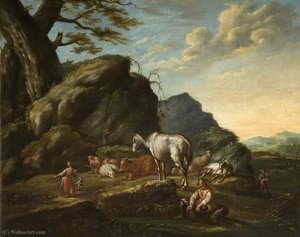
Goats and Flock of Sheep
Goats and Flock of Sheep is an oil painting by Philipp Peter Roos. The artist, who was also known by the moniker Rosa di Tivoli, produced this work about 1681. He was a German Baroque painter born in Sankt Goar, Germany.
Lyhyesti
Kaikista Philipp Peter Roos jättämistä alkuperäisteoksista kuuluisin on Goats and Flock of Sheep (1681), joka kuuluu Bavarian State Painting Collections -kokoelmaan, München. Heti perässä tulevat Piece of Livestock (1681) ja Landscape with Cattle and Shepherd (1681). Katalogissamme on 93 teosta taiteilijalta Philipp Peter Roos; galleria on säilyttänyt 92 maailman ihailluimmista teoksista, ja jokaisesta on esitetty sen päivämäärä, museo sekä tarina.
Goats and Flock of Sheep is an oil painting by Philipp Peter Roos. The artist, who was also known by the moniker Rosa di Tivoli, produced this work about 1681. He was a German Baroque painter born in Sankt Goar, Germany.
Piece of Livestock is an oil painting by Philipp Peter Roos, executed in 1681. The work originates from the Baroque period, a time when the artist was establishing his presence within the Italianate landscape tradition.
Landscape with Cattle and Shepherd is a work by the German Baroque painter Philipp Peter Roos. Created about 1681, the painting reflects the artist's specialized focus on pastoral scenes and animal subjects. Roos was a significant figure in the development of Italianate landscapes, often characterized by his intimate study of livestock and the natural environment.
In Piece of Livestock, Philipp Peter Roos organizes a pastoral scene through a close-up, ground-level perspective that establishes an immediate intimacy with the subjects. The composition is dominated by a large, seated cow positioned slightly to the right of the center. To the left, a smaller lamb or calf provides a sense of scale, while a woman interacts with a dog in the space behind the primary subject. This arrangement…
Resting Flock with Shepherds is an oil painting by the German Baroque artist Philipp Peter Roos. Created about 1681, this work captures a quiet moment within a rugged landscape. The composition focuses on a group of livestock and a shepherd, rendered with a sense of immediate presence that draws the viewer into the scene.
Resting Flock with Shepherds is an oil painting by Philipp Peter Roos. The canvas captures a heavy stillness among livestock and their guardian. This work was created about 1681. It presents a scene of animals and men gathered in a quiet, layered space under a turbulent sky.
In this Baroque-style oil painting, the mythological drama of the Liberation of Io unfolds with a sudden, heavy intensity. Created by Philipp Peter Roos about 1681, the scene captures a moment of profound tension between the divine and the mortal. A massive, powerful bull dominates the foreground, its muscular form rendered with a weight that feels almost tangible. This central figure looms over the landscape, its presence commanding the space…
This oil on canvas painting, dated 1681, presents a monochromatic scene rendered in various shades of gray. In the foreground, a young woman is positioned amidst a group of livestock, including sheep or goats. The composition is a medium shot, placing the human subject and the animals in the immediate front and middle ground. The terrain is undulating, forming rolling hills that recede into a background of hazy mountains and…
Returning Flock with Shepherds is an oil painting by Philipp Peter Roos. Created about 1681, the work captures a quiet moment of pastoral movement. The artist, a German Baroque painter, was born in Sankt Goar. He would later become known by the moniker Rosa di Tivoli.
The scene unfolds in Shepherd with Cow, Sheep and Goats in Italian Mountain Landscape, a work that captures a quiet moment of pastoral life. This painting, created about 1680, brings together a shepherd and his diverse herd amidst a rugged, mountainous setting. The figures and animals exist within a landscape that feels both immediate and deeply rooted in the natural world.
Nämä neljä aihetta toistuvat näissä alkuperäisteoksissa useimmin, jokaisesta löytyy hienoin esimerkki.
Tämän sivun teoksista eniten sisältävät 8 museota.
| Museo | Kaupunki | Philipp Peter Roos teokset | Tämän listan maalaukset |
|---|---|---|---|
| München | 15 | Goats and Flock of Sheep, Piece of Livestock, Landscape with Cattle and Shepherd | |
| Kööpenhamina | 5 | Cattle Piece, Landscape with a Bull, Sheep and Goats, A Shepherd with his Herd | |
| Buenos Aires | 4 | Landscape with shepherd and animals, Landscape with figures and animals, Shepherd and animals in a landscape | |
| Bratislava | 3 | Goat Herd with a Goatherd, Shepherd's Idyl in a Romantic Landscape with Ruins, Herd by an Ancient Well | |
| Praha | 3 | Ravine with a Stream, a Shepherd and His Herd, Horse and Goats Grazing, Shepherd with a Herd of Sheep and Goats | |
| Wien | 3 | Herd with Sleeping Shepherds, Rider Meeting, Landscape with Flock of Sheep | |
| Pietari | 3 | Landscape with a Grotto, Landscape with a Waterfall, Landscape with a Herd | |
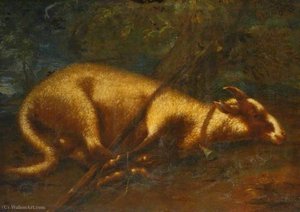
| Tukholma | 3 | Dead Hare, Landskap med hjord, A Goat Resting |
Valitse vuosikymmen nähdäksesi sen määrittäneen alkuperäisteoksen.
This large-scale oil painting, dated 1669, presents a crowded, maximalist composition of diverse animal species. The arrangement is packed, with various animals overlapping to create a sense of density and movement. The color palette relies on deep, earthy tones, including rich browns, blacks, and dark ochres. These dark shades are interrupted by specific highlights of white and cream, alongside splashes of red from a rooster and parrots. The lighting follows…
Goats and Flock of Sheep is an oil painting by Philipp Peter Roos. The artist, who was also known by the moniker Rosa di Tivoli, produced this work about 1681. He was a German Baroque painter born in Sankt Goar, Germany.
A heavy, dark-colored cow anchors the center of this scene, its presence felt in the weight of its silhouette. To the left, two goats rest upon the ground, one a pale contrast of white and light tan against the shadows. A man sits nearby, leaning back in a moment of stillness, his gaze directed toward the animals or perhaps the viewer. The air in the enclosure feels thick and dim,…
In this work, titled Shepherd's Idyl in a Romantic Landscape with Ruins, the artist Philipp Peter Roos presents a quiet moment of rural existence. Created about 1700, the painting captures a shepherd tending to his flock amidst a landscape of rolling hills and weathered stone structures. There is a sense of stillness in the way the figures and animals occupy the space, suggesting a life governed by the rhythms of…
Goats and Flock of Sheep (1681), Bavarian State Painting Collections, München. Seuraavina ovat Piece of Livestock (1681) ja Landscape with Cattle and Shepherd (1681).
24 vuotta vanha: Goats and Flock of Sheep on peräisin vuodelta 1681, ja Philipp Peter Roos on syntynyt vuonna 1657.
Goats and Flock of Sheep, Piece of Livestock, Landscape with Cattle and Shepherd, Piece of Livestock, Resting Flock with Shepherds, Resting Flock with Shepherds, Liberation of Io, Piece of Cattle, Returning Flock with Shepherds ja Shepherd with Cow, Sheep and Goats in Italian Mountain Landscape. Yllä oleva sijoitus kertoo kunkin teoksen vuosiluvun ja museon.
Katalogissamme on 93 teosta taiteilijalta Philipp Peter Roos, aikaväliltä 1669–1700.
Pääasiassa Bavarian State Painting Collections (München), Statens Museum for Kunst (Kööpenhamina) ja National Museum of Fine Arts (Buenos Aires). Yllä oleva museotaulukko listaa ne kaikki.
Aikakaudella 1680s: 21 sivun 92 teoksista on tehty silloin, joista Goats and Flock of Sheep.
Tällä sivulla vanhin on Various animals gathered before Noah's Ark (1669) ja uusin Shepherd's Idyl in a Romantic Landscape with Ruins (1700).
Landscape (33), Animals (29) ja Goats (19), yhteensä 92 teosta tällä sivulla.
Oil On Canvas, 18 teoksesta sivun 92 teoksesta.
Baroque, tämän sivun alkuperäisteosten perusteella.
Goats and Flock of Sheep, Piece of Livestock ja Landscape with Cattle and Shepherd: Bavarian State Painting Collections, München -ssä on 15 tämän sivun teoksista.
Italialaisen barokin kultaisessa valossa on harvalla nimellä yhtä vahvaa kaikuvaa voimaa maaseudun pastoraalista rauhaa kuin Philipp Peter Roos. Historiassa hänet tunnetaan puhuttelevalla nimellä Rosa di Tivoli, ja tämä saksalaissyntyinen mestari muutti maisemamaalauksen genren syvällä, lähes viskeraalisella yhteydellä luonnon maailmaan. Roos syntyi vuonna 1655 Reinin alueella, tarkemmin ottaen lähellä Sankt Goaria, ja hän oli kohtaloinen taiteilija jo varhaisista vuosistaan lähtien. Hän oli arvostetun maisemamaalari Johann Heinrich Roosin poika, joka antoi hänelle perustan sävyharmoniaan ja sommittelun tasapainoon, jotka myöhemmin määrittivät taiteilijan kypsyneen tyylin. Tämä varhainen oppisopimus ei koskenut vain tekniikkaa; se oli uppoutumista tapaan nähdä maailma valon, varjon ja maan hiljaisen arvokkuuden kautta.
Roos’n elämän suunta muuttui dramaattisesti vuonna 1677, hetken, jonka oli aiheuttanut Hessen-Kasselin lantisgrävi Charles I:n antelias tuki. Tunnistaen nuoren maalarin kasvavan lahjakkuuden, lantisgrävi antoi Roosille taloudelliset keinot aloittaa muuntava matka Roomaan. Tämä siirtymä germaanisista perinteistä italialaisen barokin sydämeen antoi Roosille mahdollisuuden imeä itseensä roomalaisen taiteen eloisa energia. Juuri täällä hän etsi mentorointia kuuluisan Giacinto Brandin alaisuudessa, jonka vaikutus auttoi hienoviltaistamaan Roos’n kykyä yhdistää klassinen rakenne spontaanimpaan, ilmakehälliseen realismiin. Tämä Rooman ajanjakso oli myös syvästi henkilökohtainen; näiden vuosien aikana Roos rakastui mentorinsa tyttäreen Isabella Brandiin. Heidän liittonsa johti lopulta hänen asettumiseensa Tivoliin, siirtoon, joka liitti hänen identiteettinsä ikuisesti siihen maisemaan, jota hän niin rakasti.
Mikä todella erottaa Rosa di Tivolin teokset toisistaan, on hänen eläinaiheidensa vertaansaismainen aitous. Toisin kuin monet hänen aikalaistensa, jotka käyttivät eläimiä maisemassa vain koristeellisina lisähuomautuksina, Roos kohtasi jokaisen olennon – raskaasta härästä ketterään vuoreen – kuin muotokuvaaja. Hänen residenssinsä Tivolissa oli kuuluisasti suunniteltu ikään kuin eläväksi studioksi; hän ylläpiti laajaa eksoottisten ja kotieläinten kokoelmaa, muuttaen ympäristönsä jatkuvaksi liikkeen, anatomian ja temperamentin tutkimukseksi. Tämä intiimi läheisyys antoi hänelle mahdollisuuden vangita korvan hienovaraisen värähdyksen tai pedon lihasjännityksen, mikä antoi hänen kangasilleen henkeäsalpaavan eloisuuden.
Hänen tekninen mestaruutensa näkyy tavassa, jolla hän navigoi barokin estetiikan monimutkaisuuksissa. Vaikka hänen sommitelmansa ammentavat usein Alankomaiden kultakauden seesteisistä ja ilmakehällisistä laadusta, niihin on kudottu italialaiselle koulukunnalle tyypillistä dramaattista intensiteettiä. Hänen teoksissaan korostuvat usein:
Philipp Peter Roos’n historiallinen merkitys piilee hänen kykenevyydessään siltojen rakentamiseen Pohjois-Euroopan rakenteellisten maisemaperinteiden ja Italian emotionaalisen, valon täyttämän draaman välille. Hän nousi esiin aikana, jolloin aikakauden tieteellinen tutkimus alkoi vaatia tarkempia havaintoja luonnon maailmasta, vaikka uskonnolliset ja mytologiset teemat hallitsivatkin vielä taiteellista tietoisuutta. Hänen maalauksistaan löytyy sekä luonnontieteilijän tarkka yksityiskohtaisuus että romantiikan ajan poeettinen sielu. Dokumentoimalla Rooman maaseudun kasvistoa ja eläimistöä näin omistautuneesti, hän loi visuaalisen tallenteen, joka kertoo yhtä paljon aikakauden hengestä kuin itse aiheista.
Vaikka hän kuoli vuonna 1706 jättäen jälkeensä perinnön, joka on kaiverrettu Tivolin maaperään, hänen vaikutuksensa kesti. Hän pysyy keskeisenä hahmona kaikille, jotka tutkivat eläinaiheisen maalaustaiteen kehitystä ja italialaistuneen maisemamaalauksen syntyä. Hänen silmiensä kautta emme näe vain karjan kokoelmaa; todistamme elämän syvää juhlistamista sen kaikkein perustavimmassa, koristelemattomassa muodossa. Hänen työnsä jatkaa resonointiaan todistuksena havainnoinnin voimasta ja pastoraalisen ihanteen kestävästä kauneudesta.