Naddo Ceccarelli muotokuva

16 tunnetuinta Naddo Ceccarelli -maalausta, gallerian valikoima

Päivitetty marraskuu 2026 · järjestetty suosituimmuuspisteiden mukaan (jokaisen teoksen haut, vierailut ja tilaukset) · 16 teosta taiteilijalta Naddo Ceccarelli luettelossamme

Lyhyesti

Kaikista Naddo Ceccarelli jättämistä alkuperäisteoksista kuuluisin on Madonna and Child (1347), joka kuuluu Ashmolean Museum -kokoelmaan, Oxford. Heti perässä tulevat Madonna and Child (1347) ja Madonna and Child Flanked by Four Saints (1347). Katalogissamme on 16 teosta taiteilijalta Naddo Ceccarelli; galleria on säilyttänyt 16 maailman ihailluimmista teoksista, ja jokaisesta on esitetty sen päivämäärä, museo sekä tarina.

1320 – 1347, Siena Eniten teoksia: Ashmolean Museum

Naddo Ceccarelli -taiteilijan 10 parasta maalausta: gallerian valinnat

1
Madonna and Child (1347) tekijä: Vincent van Gogh Naddo Ceccarelli

Madonna and Child

1347 · Tempera On Panel · Ashmolean Museum, Oxford

Madonna and Child is a religious panel painting by Naddo Ceccarelli, executed in 1347. The artist, born in Siena, Italy, in 1320, was a prominent figure in the Sienese school during the mid-14th century. This work is a representative example of the International Gothic style, characterized by its lyrical lines and decorative emphasis.

2
Madonna and Child (1347) tekijä: Vincent van Gogh Naddo Ceccarelli

Madonna and Child

1347 · Tempera On Panel

The painting presents a vertical, centered composition of the Virgin Mary holding the Christ Child. The figures are positioned against a background of gold leaf, which creates a flat, non-directional light that emanates from the surface rather than a natural source. The Madonna is draped in a dark blue or black mantle, which contrasts with the pale pink tunic worn by the Child. Their faces are rendered in oval shapes…

3
Madonna and Child Flanked by Four Saints (1347) tekijä: Vincent van Gogh Naddo Ceccarelli

Madonna and Child Flanked by Four Saints

1347 · Tempera On Panel · Chrysler Museum of Art, Norfolk

In the quiet intimacy of a private chapel or a refined domestic space, certain works of art possess the power to transcend time, acting as windows into a more spiritual era. Madonna and Child Flanked by Four Saints is precisely such a masterpiece. Created in 1347 by the Sienese master Naddo Ceccarelli, this delicate three-part altarpiece functions like a gilded Gothic dollhouse, inviting the viewer into a sacred, enclosed world.…

4
The Crucifixion tekijä: Vincent van Gogh Naddo Ceccarelli

The Crucifixion

Tempera On Panel · Fitzwilliam Museum

Naddo Ceccarelli, a gifted pupil of the leading Sienese painter Simone Martini, executed The Crucifixion as a significant religious panel painting. This work belongs to the Sienese School and reflects the stylistic developments of the Late Gothic period. Ceccarelli’s training under Martini is evident in the execution of this piece, which emerged from a workshop tradition defined by both spiritual intensity and technical precision.

5
Saints Blaise, Catherine of Alexandria, and Lawrence tekijä: Vincent van Gogh Naddo Ceccarelli

Saints Blaise, Catherine of Alexandria, and Lawrence

Tempera On Panel · Harvard Art Museums, Cambridge

In this religious panel, Naddo Ceccarelli presents Saints Blaise, Catherine of Alexandria, and Lawrence. The three figures emerge from a gold ground, standing in a silent row. They occupy a shallow space, their upright postures creating a rhythmic verticality. This Sienese work reflects the devotional focus of the mid-fourteenth century, a period when the artist was active between about 1330 and 1360.

6
Pietà with Saints tekijä: Vincent van Gogh Naddo Ceccarelli

Pietà with Saints

Tempera On Panel

Pietà with Saints is a religious composition by Naddo Ceccarelli. The artist, born in Siena, Italy, in 1320, was a 14th-century Italian painter. This work likely served as an altarpiece, a sacred object intended for a place of worship. It captures a moment of profound stillness through its specific arrangement of figures.

Naddo Ceccarelli-valikoima jatkuu, 11–16

Aiheet, jotka vangitsivat Naddo Ceccarelliin katseen

Nämä neljä aihetta toistuvat näissä alkuperäisteoksissa useimmin, jokaisesta löytyy hienoin esimerkki.

Museot, joissa Naddo Ceccarelli'n alkuperäisteokset sijaitsevat

Tämän sivun teoksista eniten sisältävät 5 museota.

Museo Kaupunki Naddo Ceccarelli teokset Tämän listan maalaukset
Ashmolean Museum, OxfordAshmolean Museum Oxford 1 Madonna and Child
Chrysler Museum of Art, NorfolkChrysler Museum of Art Norfolk 1 Madonna and Child Flanked by Four Saints
Fitzwilliam MuseumFitzwilliam Museum 1 The Crucifixion
Harvard Art Museums, CambridgeHarvard Art Museums Cambridge 1 Saints Blaise, Catherine of Alexandria, and Lawrence
Museum of Fine Arts, BostonMuseum of Fine Arts Boston 1 Crucified Christ with the Virgin and Saint John the Evangelist

Naddo Ceccarelli vuosi vuodelta: jokaisen vuoden määrittävät alkuperäisteokset

1347 on jokaisen tässä valikoimassa olevan päivätyn Naddo Ceccarelli teoksen vuosi: tässä ne ovat, järjestettynä suosion mukaan.

Teokset vuosittain

Valitse vuosi nähdäksesi alkuperäisteokset.

Keräilijöiden kysymyksiä Naddo Ceccarelli -taiteilijan maalauksista

Mistä teoksesta Naddo Ceccarelli on tunnetuin?Paljasta vastaus

Madonna and Child (1347), Ashmolean Museum, Oxford. Seuraavina ovat Madonna and Child (1347) ja Madonna and Child Flanked by Four Saints (1347).

Kuinka vanha Naddo Ceccarelli oli, kun Madonna and Child tehtiin?Paljasta vastaus

27 vuotta vanha: Madonna and Child on peräisin vuodelta 1347, ja Naddo Ceccarelli on syntynyt vuonna 1320.

Mitkä ovat kymmenen kuuluisinta Naddo Ceccarelli -taideteosta?Paljasta vastaus

Madonna and Child, Madonna and Child, Madonna and Child Flanked by Four Saints, The Crucifixion, Saints Blaise, Catherine of Alexandria, and Lawrence, Pietà with Saints, The Virgin Annunciate, Virgin And Child, The Virgin and Child ja The Virgin Annunciate -. Yllä oleva sijoitus kertoo kunkin teoksen vuosiluvun ja museon.

Kuinka monta maalausta Naddo Ceccarelli jätti jälkeensä?Paljasta vastaus

Katalogissamme on 16 teosta taiteilijalta Naddo Ceccarelli.

Missä museoissa Naddo Ceccarelli's mestariteokset sijaitsevat?Paljasta vastaus

Pääasiassa Ashmolean Museum (Oxford), Chrysler Museum of Art (Norfolk) ja Fitzwilliam Museum. Yllä oleva museotaulukko listaa ne kaikki.

Minä vuosina Naddo Ceccarelli maalasi kuuluisimmat teoksensa?Paljasta vastaus

Aikakaudella 1347: 3 sivun 16 teoksista on tehty silloin, joista Madonna and Child.

Mitä aiheita Naddo Ceccarelli käytti useimmiten?Paljasta vastaus

Gold background (5), Virgin (4) ja Child (3), yhteensä 16 teosta tällä sivulla.

Mitä tekniikkaa Naddo Ceccarelli käytti eniten?Paljasta vastaus

Tempera On Panel, 8 teoksesta sivun 16 teoksesta.

Naddo Ceccarelli: elämä ja tuotanto

Early Life and Artistic Training

Naddo Ceccarelli emerged onto the artistic landscape of Siena in the mid-14th century, a period marked by fervent religious devotion and burgeoning urban sophistication. Precise biographical details remain elusive, shrouded in the mists of medieval documentation—information about his birth year is uncertain, estimated to be around 1320. However, what we know with relative confidence is that he received his formative artistic education under the tutelage of Simone Martini (ca. 1284–1344), arguably Siena’s most celebrated painter of the era. Martini's workshop was a crucible for innovation and stylistic refinement, attracting ambitious young artists eager to absorb his mastery. Ceccarelli’s association with Martini extended beyond mere instruction; he traveled alongside Martini to Avignon in 1330, immersing himself in the papal court’s artistic milieu—a pivotal experience that undoubtedly broadened his horizons and influenced his subsequent oeuvre.Simone Martini's influence is palpable in Ceccarelli's stylistic choices, particularly evident in his predilection for delicate color palettes and meticulous attention to detail.

Style and Technique

Ceccarelli’s artistic style can be characterized as a harmonious blend of Martini’s expressive grandeur and the more restrained elegance of the master of Palazzo Venezia and Memmi. He excelled in capturing the luminous quality of tempera paint, skillfully layering translucent glazes over gold leaf to achieve breathtaking effects of shimmering brilliance—a technique that mirrored the advancements occurring in goldsmithing at the time. This masterful manipulation of light was particularly evident in depictions of chain mail and other metallic embellishments, demonstrating a keen understanding of how to convey texture and materiality through pigment alone.His compositions are often characterized by serene stillness, reflecting the spiritual ethos of his era. Ceccarelli’s paintings frequently portray Madonna and Child figures—a motif deeply rooted in Marian devotion—often accompanied by saints. These small-scale panels stand apart from Martini's monumental works, suggesting a stylistic divergence driven by individual artistic sensibilities.
    Notable features include:
  • Precise delineation of drapery folds
  • Subtle gradations of color
  • Delicate rendering of facial expressions
  • Major Works and Patronage

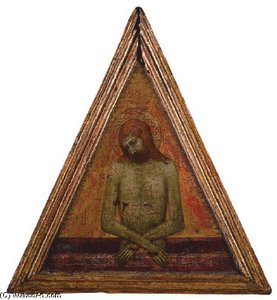
    Two signed paintings by Ceccarelli’s hand—the Madonna and Child (formerly in the Cook Collection in Richmond, Surrey) dated to 1347 and Christ The Man Of Sorrows (Liechtenstein Collection, Vaduz)—provide invaluable insight into his artistic output. These masterpieces exemplify Ceccarelli's stylistic prowess and underscore his position as one of Martini’s workshop’s most accomplished pupils.
      The Madonna and Child,
  • displays a masterful use of color and texture, capturing the ethereal beauty of Mary and Jesus with remarkable sensitivity.
  • Christ The Man Of Sorrows
  • is distinguished by its solemn expression and evocative depiction of sorrow—a testament to Ceccarelli’s ability to convey profound emotion through visual imagery.
      Ceccarelli's work was commissioned primarily by ecclesiastical patrons,
    reflecting the pervasive influence of religious faith on artistic production during the fourteenth century. The Madonna and Child with Saints (Pinacoteca Nazionale Siena) represents a larger-scale altarpiece, showcasing Ceccarelli’s ambition to undertake ambitious projects that would elevate his reputation.
  • Historical Significance

    Naddo Ceccarelli's contribution to Sienese art is significant not only for its stylistic refinement but also for its embodiment of a broader cultural trend—the fusion of painting and goldsmithing. Like Martini and Memmi, Ceccarelli pioneered the innovative practice of incorporating gold leaf into panel paintings, transforming them into objects of devotional splendor.This approach reflects a shift away from traditional sculptural representations of saints, prioritizing visual narratives that conveyed spiritual meaning through luminous color and intricate ornamentation. Ceccarelli’s legacy endures as an exemplar of medieval artistic excellence—a painter who skillfully navigated the stylistic currents of his time while forging a distinctive artistic voice.His work serves as a reminder of Siena's role as a center for artistic innovation during the High Gothic period, securing its place in art history.