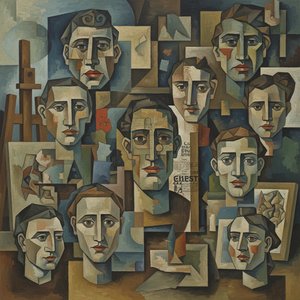
Marie Laurencin’s formative years were steeped in the cultural vibrancy of early 20th-century Paris. Raised primarily by her mother, Pauline-Mélanie Laurencin (1861–1913), a woman who defied societal expectations through her independence as a domestic servant, Marie received an education that prioritized artistic pursuits—a testament to her mother’s unwavering belief in the transformative power of creativity. Her father, Alfred-Stanislas Toulet (1839–1905), played a crucial role in providing financial support for her studies, fostering her ambition to excel in the realm of art. From a young age, Laurencin demonstrated an innate talent for drawing and sculpting, honing her skills at Sèvres porcelain manufactory—a locale renowned for its exquisite craftsmanship and artistic heritage—before embarking on formal training at Académie Humbert, nestled in Montmartre’s bohemian heart.
Embracing Cubism and the Section d'Or
Laurencin swiftly immersed herself in the revolutionary currents swirling within Paris’s avant-garde circles. Drawn to the visionary ideas championed by Pablo Picasso and Guillaume Apollinaire, she became an integral participant in the *Section d'Or*, a collective of artists united by their dedication to exploring the principles of Cubism—a movement that irrevocably altered the course of artistic history. Exhibiting her groundbreaking canvases at the Salon des Indépendents and the Salon d’Automne between 1910 and 1912, Laurencin solidified her position as a pioneer of modern art. Her early works showcased a profound engagement with Cubist techniques—fragmentation, geometric abstraction, and multiple perspectives—reflecting the intellectual fervor of the era.
A Feminine Vision: Style and Themes
Laurencin distinguished herself from her contemporaries by cultivating a style uniquely attuned to feminine sensibilities. Rejecting the harsh angularity and stark monochrome palettes favored by Picasso and Braque, she opted instead for curvilinear forms and delicate pastel hues—a deliberate departure from prevailing artistic conventions. Her canvases pulsed with life—populated primarily by women—capturing moments of intimacy and grace with remarkable sensitivity. Laurencin’s artistic vision transcended mere representation; it served as a powerful assertion of the female gaze within a predominantly male-dominated artistic landscape.
Later Years and Legacy
The tumultuous backdrop of World War I profoundly impacted Laurencin’s life and career, prompting her to seek refuge in Spain alongside Baron Otto von Waetjen—a circumstance that underscored the societal constraints imposed upon women during this period. Following their divorce in 1920, Laurencin returned to Paris, where she enjoyed considerable success throughout the 1920s and 30s—continuing her artistic endeavors while teaching art and nurturing her passion for creative expression. Despite facing economic hardships, Laurencin persevered, refining her signature style and exploring new avenues of artistic exploration. Today, Marie Laurencin is recognized as a pivotal figure in early 20th-century art—one of the few female Cubist painters who challenged gender norms and expanded the boundaries of modernism. Her enduring legacy resides not only in her captivating artworks but also in her courageous embrace of independence and artistic freedom.
OriginalUniqueArt.com:n toimitus
Tietovisa
Jokaisessa kysymyksessä on vain yksi oikea vastaus.
Kysymys 1:
Mikä taiteilija tunnetaan erityisesti hänen varhaisista kubistisista töistään ja yhteistyöstään Pablo Picasso ja Guillaume Apollinaire kanssa?
Kysymys 2:
Missä Marie Laurencinin koulutus alkoi hänelle ensimmäisenä taideopiskelijana?
Kysymys 3:
Marie Laurencinin tyyliin tunnusomaisia ovat erityisesti:
Kysymys 4:
Marie Laurencinin työ keskittyy pääosin:
Kysymys 5:
Mikä oli Marie Laurencinin merkittävä yhteistyökumppani kirjallisuuden saralla?
Tutustu kubismin 10 mestariteokseen – Picasso, Braque ja muut taiteen uudistajat. Taidehistoriaa kotiisi OriginalUniqueArt.fi:stä! Löydä upeita muotokuva-tauluja ja inspiroi sisustusta. Tutki kokoelma verkossa.
Explore the captivating world of Marie Laurencin, a key figure in Parisian Cubism & Modern art. Discover her unique feminine aesthetic, intimate portraits, and lasting influence on early 20th-century painting.