Leonaert Bramer muotokuva

Leonaert Bramer -maalaukset: Gallerian silmin 65 kuuluisinta teosta

Päivitetty marraskuu 2026 · järjestetty suosituimmuuspisteiden mukaan (jokaisen teoksen haut, vierailut ja tilaukset) · 68 teosta taiteilijalta Leonaert Bramer luettelossamme

Lyhyesti

Gallerian silmissä Leonaert Bramer's tunnetuin maalaus on Soldiers with Horses before a House (1655), jonka alkuperäinen teos on esillä Museum Kunstpalast -museossa, kaupungissa Düsseldorf. Adoration of the Magi (1639) ja The Sacrifice of Iphigenia (1623) täydentävät kolmikon, jonka jokainen silmä tunnistaa. Galleria esittelee Leonaert Bramer teoksista 68 tunnetuimmat 65 teosta alla; jokainen on alkuperäisteos, josta kerrotaan vuosi, museo sekä teoksen erityispiirteet.

1596 – 1674, Delft Baroque Eniten teoksia: Nationalmuseum

Gallerian 10 parasta Leonaert Bramer -maalausta

1
Soldiers with Horses before a House (1655) tekijä Leonaert Bramer

Soldiers with Horses before a House

1655 · Oil On Canvas · Museum Kunstpalast, Düsseldorf

In the masterful oil painting "Soldiers with Horses before a House," Leonaert Bramer invites viewers into a meticulously crafted moment from the Dutch Golden Age. The scene, captured with profound anatomical accuracy, centers on two mounted soldiers who command the viewer's attention through their expressive poses and the palpable energy of their movement. Bramer employs a sophisticated technique of hatching and cross-hashing, particularly evident in the metallic sheen of the…

2
Adoration of the Magi (1639) tekijä Leonaert Bramer

Adoration of the Magi

1639 · Oil On Panel · Hermitage-museo, Pietari

The darkness of a vast, desolate landscape presses in from every side, swallowing the horizon in a heavy, nocturnal shroud. In this quiet, shadowy realm, a sudden, intense glow emanates from the center of the scene, cutting through the gloom like a physical presence. This light does not merely illuminate; it transforms. It spills across the figures in the lower left, catching the textures of ornate, heavy garments and the…

3
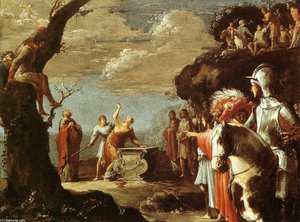
The Sacrifice of Iphigenia (1623) tekijä Leonaert Bramer

The Sacrifice of Iphigenia

1623 · Oil On Copper · Het Prinsenhof, Delft

Leonaert Bramer produced The Sacrifice of Iphigenia during his time in Italy. This work is one of the few paintings known to have been executed by the artist in Rome. It represents a significant period of his development, occurring after his departure from Delft and his involvement with the Bentvueghels.

4
The Adoration of the Magi (1642) tekijä Leonaert Bramer

The Adoration of the Magi

1642 · Oil On Copper · Statens Museum for Kunst, Kööpenhamina

The Adoration of the Magi emerges from the shadows of 1639, a moment frozen in oil where the sacred meets the earthly. Leonaert Bramer captures the Holy Family and the Magi in a quiet, intense encounter. The scene centers on the Wise Men as they approach to present their precious gifts to the Christ-child. Every figure exists within a heavy, atmospheric stillness, caught in the act of reverence.

5
Four Latin Fathers of the Church and Saints (verso) (1650) tekijä Leonaert Bramer

Four Latin Fathers of the Church and Saints (verso)

1650 · Oil On Canvas · British Museum, Lontoo

Leonaert Bramer's "Four Latin Fathers of the Church and Saints (verso)" isn’t merely a painting; it’s an intimate portrait of artistic process, a whispered secret revealed through layers of paint, time, and deliberate obscurity. This remarkable work, currently housed in the British Museum, offers a captivating journey into the mind of a pivotal 17th-century Dutch artist – a man often dubbed “Leonardo della Notte” for his mastery of nocturnal scenes…

6
Allegory of Vanity (Vanitas) (1650) tekijä Leonaert Bramer

Allegory of Vanity (Vanitas)

1650 · Oil On Canvas · Kunsthistorisches Museum, Wien

In this somber Dutch Golden Age composition, we find ourselves in a space defined by shadow and light. The scene is arranged in a triangular formation, drawing the eye toward a cluttered table where the objects of earthly pleasure lie scattered. A strong light source from the upper left cuts through the darkness, illuminating the polished wood of a lute and the metallic sheen of silver vessels. These textures—the soft…

7
Dying Vision of Mary Magdalene (1633) tekijä Leonaert Bramer

Dying Vision of Mary Magdalene

1633 · Oil On Panel · Hermitage-museo, Pietari

The oil on panel titled Dying Vision of Mary Magdalene was created by Leonaert Bramer in 1633. This religious work captures a moment of spiritual revelation through the heavy application of pigment. The canvas holds the gaze of a woman kneeling in the shadows, her eyes turned toward a celestial light.

9
Crucifixion (1650) tekijä Leonaert Bramer

Crucifixion

1650 · Oil On Panel · Hermitage-museo, Pietari

The air feels heavy, thick with the silence of a world gone dark. In this somber Baroque scene, the central figure of Christ hangs upon the cross, his body illuminated by a sudden, sharp light that cuts through the surrounding gloom. This light catches the pale tones of his flesh and the tension in his musculature, pulling him forward from a near-black background. Below him, the weight of grief takes…

10
Journey of the Three Magi to Bethlehem (1638) tekijä Leonaert Bramer

Journey of the Three Magi to Bethlehem

1638 · Oil On Canvas · New York Historical Society, New York

In the quiet, shadowed corridors of the Dutch Golden Age, few artists possessed the ability to conjure atmosphere as masterfully as Leonaert Bramer. His 1638 masterpiece, Journey of the Three Magi to Bethlehem, is not merely a depiction of a biblical pilgrimage; it is a profound immersion into a world of divine mystery and dramatic tension. As the viewer approaches this canvas, they are immediately swept into the urgent movement…

Leonaert Bramer -taideteokset, sijoitukset 11–65

11St Peter"s Denial, Leonaert Bramer, 1642 (1642) tekijä Leonaert BramerSt Peter"s Denial, Leonaert Bramer, 16421642 · Rijksmuseum 12Christ before Pilate (1635) tekijä Leonaert BramerChrist before Pilate1635 · Bavarian State Painting Collections 13The Finding of Pyramus and Thisbe (1624) tekijä Leonaert BramerThe Finding of Pyramus and Thisbe1624 · Gemäldegalerie 14Five men playing music in an interior (1633) tekijä Leonaert BramerFive men playing music in an interior1633 · Staatliche Kunsthalle Karlsruhe 15The Adoration of the Shepherds (1635) tekijä Leonaert BramerThe Adoration of the Shepherds1635 · Nationalmuseum 16The Martyrdom of the Prophet Isaiah (1625) tekijä Leonaert BramerThe Martyrdom of the Prophet Isaiah1625 17Abraham and the Three Angels (1640) tekijä Leonaert BramerAbraham and the Three Angels1640 · Museo del Prado 18The circumcision of the Christ-child by the priest in the temple (1640) tekijä Leonaert BramerThe circumcision of the Christ-child by the priest in the temple1640 · Groninger Museum 19Solomon's idolatry (1 Kings 11:7-8) (1642) tekijä Leonaert BramerSolomon's idolatry (1 Kings 11:7-8)1642 · Wallraf-Richartz-Museum 20Saphan reads the book of Law aloud to Josiah (2 Kings 8-10) (1642) tekijä Leonaert BramerSaphan reads the book of Law aloud to Josiah (2 Kings 8-10)1642 21The presentation in the temple (1642) tekijä Leonaert BramerThe presentation in the temple1642 · New York Historical Society 22The Betrayal of Christ (1637) tekijä Leonaert BramerThe Betrayal of Christ1637 23Marcus Curtius Leaping into the Abyss on His Horse (1657) tekijä Leonaert BramerMarcus Curtius Leaping into the Abyss on His Horse1657 24Quevedo Sees Chicotus in the Battle (1659) tekijä Leonaert BramerQuevedo Sees Chicotus in the Battle1659 · Staatliche Graphische Sammlung 25Figures in a Loggia (1660) tekijä Leonaert BramerFigures in a Loggia1660 · Victoria and Albert Museum 26Jacob's Dream (1657) tekijä Leonaert BramerJacob's Dream1657 · Koninklijke Tichelaar 27The Judgment of Solomon (detail) (1640) tekijä Leonaert BramerThe Judgment of Solomon (detail)1640 · Metropolitan Museum of Art 28Money Combats the World, the Flesh, and the Devil (1659) tekijä Leonaert BramerMoney Combats the World, the Flesh, and the Devil1659 · Staatliche Graphische Sammlung 29Salomonin tuomio (1640) tekijä Leonaert BramerSalomonin tuomio1640 · Metropolitan Museum of Art 30The Fall of Simon Magus (1623) tekijä Leonaert BramerThe Fall of Simon Magus1623 31The Quarrel between Ajax and Odysseus (1623) tekijä Leonaert BramerThe Quarrel between Ajax and Odysseus1623 · Het Prinsenhof 32Quevedo and the Skeletons of Juan de la Encina and King Perico (1659) tekijä Leonaert BramerQuevedo and the Skeletons of Juan de la Encina and King Perico1659 · Staatliche Graphische Sammlung 33Scene from the Metamorphoses (1660) tekijä Leonaert BramerScene from the Metamorphoses1660 34Scene from the Metamorphoses (1660) tekijä Leonaert BramerScene from the Metamorphoses1660 35Scenes from the Life of Christ (1660) tekijä Leonaert BramerScenes from the Life of Christ1660 36Allegory of Transitoriness (1640) tekijä Leonaert BramerAllegory of Transitoriness1640 · Kunsthistorisches Museum 37Kristuksen Temptatio (1645) tekijä Leonaert BramerKristuksen Temptatio1645 · Hessisches Landesmuseum 38Design for a wall decoration (1645) tekijä Leonaert BramerDesign for a wall decoration1645 · Nasjonalgalleriet 39Pashur Smiting Jeremiah in the Temple, Leonaert Bramer, c. 1648 (1648) tekijä Leonaert BramerPashur Smiting Jeremiah in the Temple, Leonaert Bramer, c. 16481648 · Rijksmuseum 40Musicians in an Interior (1660) tekijä Leonaert BramerMusicians in an Interior1660 · Rijksmuseum 41The Trials of Job (1630) tekijä Leonaert BramerThe Trials of Job1630 · Courtauld Gallery 42Joseph and Potiphar's Wife (1630) tekijä Leonaert BramerJoseph and Potiphar's Wife1630 · Courtauld Gallery 43A Peasant and Two Soldiers Playing Dice tekijä Leonaert BramerA Peasant and Two Soldiers Playing DiceNationalmuseum 44Soldiers Arguing tekijä Leonaert BramerSoldiers ArguingNationalmuseum 45Musical Company tekijä Leonaert BramerMusical CompanyNationalmuseum 46Company around a Table tekijä Leonaert BramerCompany around a TableNationalmuseum 47Anchias Fleeing Troy with His Father and Son tekijä Leonaert BramerAnchias Fleeing Troy with His Father and Son 48the curious ones tekijä Leonaert Bramerthe curious ones 49Résurrection de Jésus tekijä Leonaert BramerRésurrection de Jésus 50SCENE DE SORCELLERIE tekijä Leonaert BramerSCENE DE SORCELLERIE 51L'Arrestation de Jésus Jésus au Jardin des Oliviers tekijä Leonaert BramerL'Arrestation de Jésus Jésus au Jardin des Oliviers 52Christ among the Doctors tekijä Leonaert BramerChrist among the Doctors 53Salome Presented with the Head of St John the Baptist tekijä Leonaert BramerSalome Presented with the Head of St John the BaptistMusée des Beaux-Arts 54Christ before Caiaphas tekijä Leonaert BramerChrist before CaiaphasBirmingham Museum and Art Gallery 55LE DRAGON DE CADMUS tekijä Leonaert BramerLE DRAGON DE CADMUS 56LA DECOUVERTE DES CORPS DE PYRAME ET DE THISBE tekijä Leonaert BramerLA DECOUVERTE DES CORPS DE PYRAME ET DE THISBELouvre 57portrait of a man tekijä Leonaert Bramerportrait of a man 58Peasants by a Fire tekijä Leonaert BramerPeasants by a Fire 59Scenes from the Life of Christ tekijä Leonaert BramerScenes from the Life of Christ 60The Adoration of the Magi tekijä Leonaert BramerThe Adoration of the MagiDetroit Institute of Arts 61Concert of Angels (recto) tekijä Leonaert BramerConcert of Angels (recto) 62Musicians on a Terrace tekijä Leonaert BramerMusicians on a Terrace 63The Liberation of Saint Peter tekijä Leonaert BramerThe Liberation of Saint PeterLos Angelesin maakunnallinen taidemuseo 64Christ among the Doctors tekijä Leonaert BramerChrist among the Doctors 65Circumcision of Christ (1640) tekijä Leonaert BramerCircumcision of Christ1640 · National Museum in Warsaw

Leonaert Bramern kuuluisat maalaukset aikakausittain

Aiheet, jotka vangitsivat Leonaert Bramerin katseen

Nämä neljä aihetta toistuvat näissä alkuperäisteoksissa useimmin, jokaisesta löytyy hienoin esimerkki.

Museot, joissa Leonaert Bramer'n alkuperäisteokset sijaitsevat

Tämän sivun teoksista eniten sisältävät 8 museota.

Museo Kaupunki Leonaert Bramer teokset Tämän listan maalaukset
Nationalmuseum, TukholmaNationalmuseum Tukholma 5 The Adoration of the Shepherds, A Peasant and Two Soldiers Playing Dice, Soldiers Arguing
Hermitage-museo, PietariHermitage-museo Pietari 3 Adoration of the Magi, Dying Vision of Mary Magdalene, Crucifixion
Rijksmuseum, AmsterdamRijksmuseum Amsterdam 3 St Peter"s Denial, Leonaert Bramer, 1642, Pashur Smiting Jeremiah in the Temple, Leonaert Bramer, c. 1648, Musicians in an Interior
Staatliche Graphische Sammlung, MünchenStaatliche Graphische Sammlung München 3 Quevedo Sees Chicotus in the Battle, Money Combats the World, the Flesh, and the Devil, Quevedo and the Skeletons of Juan de la Encina and King Perico
Het Prinsenhof, DelftHet Prinsenhof Delft 2 The Sacrifice of Iphigenia, The Quarrel between Ajax and Odysseus
Kunsthistorisches Museum, WienKunsthistorisches Museum Wien 2 Allegory of Vanity (Vanitas), Allegory of Transitoriness
New York Historical Society, New YorkNew York Historical Society New York 2 Journey of the Three Magi to Bethlehem, The presentation in the temple
Metropolitan Museum of Art, New YorkMetropolitan Museum of Art New York 2 The Judgment of Solomon (detail), Salomonin tuomio

Leonaert Bramer, yksi tunnusomainen maalaus vuosikymmeneltä

Teokset vuosikymmenittäin

Valitse vuosikymmen nähdäksesi sen määrittäneen alkuperäisteoksen.

Leonaert Bramern maalaukset: gallerian vastaukset

Mikä Leonaert Bramer -taideteos on kaikkien kuuluisin?Paljasta vastaus

Soldiers with Horses before a House (1655), Museum Kunstpalast, Düsseldorf. Seuraavina ovat Adoration of the Magi (1639) ja The Sacrifice of Iphigenia (1623).

Kuinka vanha Leonaert Bramer oli valmistuessaan teos Soldiers with Horses before a House?Paljasta vastaus

59 vuotta vanha: Soldiers with Horses before a House on peräisin vuodelta 1655, ja Leonaert Bramer on syntynyt vuonna 1596.

Mitkä ovat Leonaert Bramer'n 10 parasta maalausta?Paljasta vastaus

Soldiers with Horses before a House, Adoration of the Magi, The Sacrifice of Iphigenia, The Adoration of the Magi, Four Latin Fathers of the Church and Saints (verso), Allegory of Vanity (Vanitas), Dying Vision of Mary Magdalene, The Raising of Lazarus (John 11: 43-44), Crucifixion ja Journey of the Three Magi to Bethlehem. Yllä oleva sijoitus kertoo kunkin teoksen vuosiluvun ja museon.

Kuinka monta teosta Leonaert Bramer loi?Paljasta vastaus

Katalogissamme on 68 teosta taiteilijalta Leonaert Bramer, aikaväliltä 1623–1660.

Missä Leonaert Bramer'n kuuluisimmat alkuperäisteokset sijaitsevat?Paljasta vastaus

Pääasiassa Nationalmuseum (Tukholma), Hermitage-museo (Pietari) ja Rijksmuseum (Amsterdam). Yllä oleva museotaulukko listaa ne kaikki.

Milloin Leonaert Bramer maalasi kuuluisimmat teoksensa?Paljasta vastaus

Aikakaudella 1640s: 15 sivun 65 teoksista on tehty silloin, joista The Adoration of the Magi.

Mitkä ovat Leonaert Bramer'n varhaisimmat ja viimeisimmät kuuluisat teokset?Paljasta vastaus

Tällä sivulla vanhin on The Sacrifice of Iphigenia (1623) ja uusin Figures in a Loggia (1660).

Mihin aiheisiin Leonaert Bramer palasi useimmin?Paljasta vastaus

People (12), Figures (11) ja Shadows (10), yhteensä 65 teosta tällä sivulla.

Mitä tekniikkaa Leonaert Bramer käytti eniten?Paljasta vastaus

Oil On Canvas, 10 teoksesta sivun 65 teoksesta.

Mihin taidesuuntaukseen Leonaert Bramer kuuluu?Paljasta vastaus

Baroque ja Dutch golden age, tämän sivun alkuperäisteosten perusteella.

Mitä Leonaert Bramer -taiteilijan alkuperäisteoksia Nationalmuseum -museossa on?Paljasta vastaus

The Adoration of the Shepherds, A Peasant and Two Soldiers Playing Dice ja Soldiers Arguing: Nationalmuseum, Tukholma -ssä on 5 tämän sivun teoksista.

Leonaert Bramer: taiteilija

Valoa ja varjoa: Leonaert Bramerin maailma

Leonaert Bramer, nimi joka kantaa mukanaan 1600-luvun Delftin kaiun, oli paljon enemmän kuin pelkkä taidemaalari; hän oli seikkailija, uudistaja ja keskeinen hahmo hollantilaisen kultakauden loistossa. Syntyneenään vuonna 1596 hänen elämänsä avautui kiehtovana kertomuksena, johon kietoutuivat laajat matkat, taiteelliset kokeilut ja syvä osallistuminan aikansa eloisaan kulttuuriseen kudokseen. Bramerin perintöä ei määrittele ainoastaan hänen maalaamansa kankaat, vaan se ainutlaatuinen näkökulma, jonka hän niihin toi – taipumus dramaattisiin yöllisiin kohtauksiin, joita täplittivät eksoottiset yksityiskohdat, erottaen hänet monista aikalaisekseen. Hän ei ainoastaan kuvannut todellisuutta, vaan loi maailmoja, jotka olivat täynnä tunnelmaa ja mysteereitä, mikä toi hänelle puhuttelevan lisänimen ”Leonardo della Notte” eli ”Yön Leonardo” hänen Italiassa viettämällään ajalla.

Delftistä Roomaan: Taiteellisen muotoutumisen matka

Bramerin taiteellinen matka alkoi rohkealla lähdöllä kotikaupungista Delftistä jo nuorena, vain kahdeksastotenatoisia vuosia vanhana, aloittaen suuren kiertomatkan, joka muovasi hänen esteettistä silmäänsä. Kyseessä ei ollut rento tutkimusmatka, vaan syventävä oppipoikakausi Euroopan taiteen sydämessä. Kulkiessaan kaupunkien, kuten Atrechtin, Amiensin ja Pariisin kautta, hän saapui lopulta Roomaan vuonna 1616, joka toimi taiteellisen kunnianhimon sulatusuunina. Siellä hän liittyi Bentvueghels-ryhmään, pohjoisten taiteilijoiden yhteisöön, joka käytti satiirisia lempinimiä ja osallistui vilkkaaseen älylliseen keskusteluun. Bramer tunnettiin nimellä ”Nestelghat” (Hätäinen), mikä viittasi levottomaan energiaan, joka läpäisi sekä hänen elämäänsä että taidettaan. Hänen aikansa Italiassa ei ollut vailla konflikteja; kertomukset yksityiskohtaisesti kuvaavat fyysistä yhteenottoa kuuluisan Claude Lorrainen kanssa, mikä osoittaa intohimoista henkeä, joka ei pelännyt konfrontaatiota. Juuri tässä dynaamisessa ympäristössä Bramer kuitenkin hioi taitojaan ja hallitsi freskotekniikan – menetelmän, joka oli suhteellisen harvinainen Pohjois-Euroopassa – samalla kun hän imi vaikutteita mestareilta kuten Adam Elsheimer ja Agostino Tassi. Hän matkusti laajasti ympäri Italiaa vieraillen Mantovassa ja Venetsiassa, ja jokainen kohde lisäsi uuden kerroksen hänen kehittyvään tyyliinsä.

Paluu Delftiin: Suojelus, innovaatio ja taiteellinen monipuolisuus

Palattuaan Delftiin vuonna 1628 Bramer integroitui saumattomasti paikalliseen taidemaailmaan liittyen Pyhän Luukkaan kiltaan vuonna 1629. Hän sai nopeasti suojelusta merkittäviltä henkilöiltä, mukaan lukien Oranjen suvun jäseniltä ja vaikutusvaltaisilta paikallisilta virkamiehiltä, mikä varmisti vakaan pohjan hänen taiteellisille pyrkimyksilleen. Mutta Bramer ei ollut yksivivahteinen taiteilija; hän omaksui monipuolisia luovia toimintoja myös maalaamisen ulkopuolella. Hän suunnitteli monimutkaisia kuvioita tapetitehtäille, luoden teoksia, jotka koristivat koteja ympäri Alankomaiden. Lisäksi hän otti vastaan kunnianhimoisia seinämaalausprojekteja hyödyntäen illusionistisia tekniikoita muuttaakseen sisätilat upottaviksi ympäristöiksi. Valitettavasti monet näistä freskoista menetettiin ajan myötä Alankomaiden ankarassa ilmastossa, mutta niiden olemassaolo todistaa Bramerin huomattavasta monipuolisuudesta ja halusta rikkoa taiteellisia rajoja. Hänen ainutlaatuinen tyylinsä, jolle oli ominaista hermokas energia ja mestarillinen valon heijastumisen kuvaus, suosi johdonmukaisesti italialaistyylisiä teemoja perinteisempien hollantilaisten maisemien tai asetelmien sijaan, tehden hänestä yksilöllisen taiteilijan omassa piirissään.

Mentorina: Bramerin vaikutus ja pysyvä perintö

Bramerin vaikutus ulottui kauemmas kuin hänen omaan taiteelliseen tuotantoonsa. Uskotaan, että hänellä oli ratkaiseva rooli Johannes Vermeerin uran alkuvaiheessa puolustamalla nuorta taiteilijaa silloin, kun tämän tuleva anoppi yritti estää häntä menosta naimisiin. Tämä teko viittaa läheiseen suhteeseen, mikä on saanut monet tutkijat spekuloimaan, että Bramer on saattanut toimia Vermeerin opettajana – vaikka konkreettiset todisteet ovatkin vaikeasti tavoitettavissa. Hänen älyllinen uteliaisuutensa osoitettiin myös ”Album Bramer” (1642–1654) luomisessa, piirroskokoelmassa, joka tarjoaa arvokasta tietoa Delftin taidekeräilystä ja taiteellisista käytännöistä hänen aikanaan. Leonaert Bramer kuoli Delftissä ennen 10. helmikuuta 1674 jättäen jälkeensä teoskokonaisuuden, joka jatkaa lumoamistaan ja kiehtomistaan. Vaikka hänen maineensa hiipui hetkeksi hänen kuolemansa jälkeen, uusi tutkimus on herättänyt uudelleen kiinnostuksen hänen elämäänsä ja taiteeseensa, vahvistaen hänen asemansa tärkeänä – ja usein aliarvioituna – hahmona hollantilaisessa taidehistoriassa. Hän säilyy todistuksena yksilöllisen vision voimasta ja taiteellisen erinomaisuuden tavoittelun peräänantamattomasta viehätyksestä.