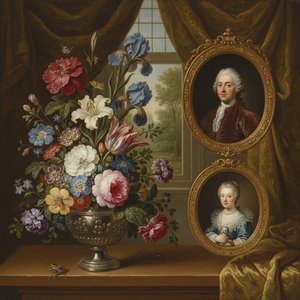
Early Life, Family and Training
Hieronymus Van Der Mij was born in 1687 in Leiden, Netherlands, into a family defined by technical craftsmanship. He was the eldest son of Philip van der Mij, a caster of sculptures and vases who lived from 1654 to 1721. This lineage of material precision provided a grounded starting point for an artist who would eventually move from the casting of metal to the application of oil on canvas. The influence of a father skilled in the physical properties of sculpture is a concrete reality that shaped his early environment in the Dutch Republic.
His formal entry into the professional art world was marked by his enrollment in the Leiden Album Studiosorum in February 1710. This was not a mere academic formality; it was a necessary step for an artist establishing his presence in a competitive urban center. His training was further solidified under the guidance of Willem van Mieris. Studying under a figure of such established standing provided Hieronymus Van Der Mij with the technical foundation required to navigate the high standards of the Leiden school. This apprenticeship was the essential mechanism through which he transitioned from a student of form to a practitioner of the Dutch tradition.
Patrons, Workshop and Commissions
Van der Mij’s professional standing was solidified by his entry into the Guild of St. Luke in 1724. This membership facilitated a career built on high-level portraiture and significant religious commissions. His ability to navigate the social hierarchies of the Dutch Republic is evident in the subjects he captured. He secured the likenesses of influential figures, including David van Royen and the composer Anton Wilhelm Solnitz. These were not merely likenesses; they were exercises in documenting status through precise oil painting.
His reach extended beyond the local elite of Leiden. One of his most substantial undertakings was a monumental cycle of the Stations of the Cross, commissioned for St. Pancras Church in London. This project required a scale and emotional weight that moved him beyond the confines of small-scale genre scenes. In his home city, he maintained a steady connection to academic and institutional life. He produced a series of portraits of professors for Leiden University, a task that required both technical precision and an understanding of the formal requirements of institutional portraiture.
- Portrait of David van Royen
- Allegorical Portrait of the Composer Anton Wilhelm Solnitz
- Stations of the Cross cycle for St. Pancras Church
Key Works and Output
Van der Mij’s output reflects a career spent navigating the demands of both private portraiture and genre scenes. His early work, such as Fish Sellers in The Hague (about 1712), demonstrates an early interest in the daily mechanics of Dutch life. This focus on the mundane continued into his middle period with Four Children in a Park like Landscape (about 1723), where he moved away from the street and into more structured, natural settings. These works show a painter capable of handling both the grit of commerce and the softer requirements of landscape composition.
The artist’s technical precision is most evident in his portraiture, where he captured the specific social standing of his subjects. His 1735 Portrait of David van Royen is a clear example of this ability to render status through detail. He applied similar rigor to more complex, symbolic assignments, such as the Allegorical Portrait of the Composer Anton Wilhelm Solnitz (1743). This work moves beyond simple likeness to incorporate the specific iconography required by the sitter's profession. Even in his later years, his commitment to the genre remained steady, as seen in Young Girl Selling Oranges (about 1750), which returns to the observational realism of his youth.
Technique and Style
Van der Mij’s technical versatility allowed him to move between the large-scale demands of portraiture and the precision required for miniature painting. He was a multi-disciplinary practitioner, working as an etcher, draftsperson, and painter. This breadth of skill is evident in his ability to handle diverse subjects, ranging from intimate genre scenes to formal historical compositions. His work often focused on the psychological nuance of his subjects, a quality that prevented his portraits from becoming mere likenesses. He achieved this through a controlled application of paint that prioritized the character of the sitter over decorative flourish.
His output included a specific interest in "antique and modern cabinet pictures," a genre that required a high degree of detail and a sophisticated handling of composition. This penchant for smaller, highly finished works demonstrates a technical discipline that translates well to his larger commissions. In his genre paintings, he applied the same meticulous attention to detail to everyday life as he did to his more formal subjects. His ability to navigate between the grandiosity of historical scenes and the specificity of portraiture marks him as a highly adaptable technician of the Dutch Republic.
- Fish Sellers in The Hague
- Four Children in a Park like Landscape
- Portrait of David van Royen
- Allegorical Portrait of the Composer Anton Wilhelm Solnitz
- Young Girl Selling Oranges
Circle, Rivals and Pupils
Van der Mij’s influence extended far beyond his own canvases through his institutional authority in Leiden. He did not merely practice art; he managed its formal education. His tenure at the Leidse Tekenacademie saw him rise from a teacher to a supervisor, eventually securing the position of director alongside Frans van Mieris de jonge. This leadership role ensured his technical standards and approach to portraiture and genre scenes were transmitted directly to the next generation of Dutch painters.
The lineage of his instruction is clearly defined by the specific talents he cultivated. His studio produced several notable figures who would carry the Leiden tradition forward, including Pieter Catel, Johannes le Francq van Berkheyde, Nicolaas Reyers, Nicolaas Rijnenburg, and Hendrik van Velthoven. These pupils were not mere imitators; they were the practitioners who solidified the academic rigor he helped establish. His ability to shape the curriculum of the academy speaks to a professional standing that was both administrative and pedagogical.
Later Years and Death
Van der Mij’s persistence in the art market was notable. While many of his contemporaries chose retirement, he remained active in the professional sphere for decades. In 1728, he established a permanent base by purchasing a house in the Breestraat. This residence served as his home for the remainder of his life, anchoring his presence in the Leiden art community until his death in 1761.
The end of his career was marked by the liquidation of his personal holdings. Six months after he died, his collection of prints and plaster sculptures was auctioned off in 1763. This sale represented the final dispersal of the material he had gathered throughout his long tenure as a painter and art dealer.
Kysymykset ja vastaukset
Miten voin seurata Hieronymus Van Der Mij's teoksia vuosi vuodelta?
Hieronymus Van Der Mij'n teokset ovat nähtävissä aikajärjestyksessä artistin Teosten aikajana -sivulla.
Missä kaupungissa ja maassa Hieronymus Van Der Mij on syntynyt?
Hieronymus Van Der Mij on syntynyt Leiden, Alankomaat.
Mistä voin selata Hieronymus Van Der Mij's teoksia tunnelman mukaan järjestettynä?
Taiteilijan Tunnelmallinen huone -sivulla Hieronymus Van Der Mij:n teokset on järjestetty niiden tunnelman mukaan.