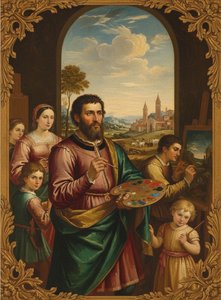
The Shadow of the Workshop
To understand Girolamo da Ponte, one must look at the mechanics of the Bassano workshop. He was the youngest son of Jacopo da Bassano, a position that dictated his entire professional existence. He did not operate in a vacuum; he functioned as a vital component of a family-run production engine. His career was defined by the necessity of maintaining a specific stylistic standard established by his father. This was not a matter of mere imitation, but a requirement of the high-volume output required by the Venetian market.
His work often blurs the lines of individual authorship. Like his brother Giambattista, Girolamo contributed to the massive collection of canvases attributed to Jacopo. This familial collaboration meant that his hand was frequently part of a larger, collective effort to meet the demands of patrons. He was a practitioner of the Renaissance period, working within the established visual language of his lineage.
Technical Contributions and Collaborations
Girolamo’s output was characterized by a specific division of labor. While the workshop functioned as a unit, individual members handled different aspects of a commission. His technical focus included:
- The execution of specific religious subjects, such as the Apparition of the Virgin to St. Barbara.
- Collaborative portraiture, specifically working alongside his brother Leandro Bassano on works like the Portraits of Sagredo.
- The replication and expansion of his father's compositions to satisfy market demand.
This method of production ensured that the Bassano brand remained consistent. He was not an outlier; he was a specialist within a system. His ability to replicate his father's style allowed the workshop to maintain its momentum, even as the individual identities of the painters became difficult for historians to untangle.
The Venetian Legacy
His life ended in Venice, the center of the artistic commerce he had served since his birth in Bassano del Grappa. The distinction between Girolamo da Ponte and Gerolamo Bassano is often a matter of nomenclature rather than a change in artistic direction. He remained tethered to the family name and the family method until his death in 1621. His significance lies in this very continuity. He represents the practical reality of Renaissance art production, where the workshop was often more important than the individual ego.
Kysymykset ja vastaukset
Onko Girolamo da Ponte teoksista saatavilla aikajana?
Taiteilijan Teosten aikajana -sivu esittelee Girolamo da Ponte:n teokset aikajärjestyksessä, vuosi vuodelta.
Missä ja minä vuonna Girolamo da Ponte on syntynyt?
Girolamo da Ponte syntyi Bassano del Grappassä vuonna 1566.
Voinko tutkia Girolamo da Ponte teoksia aiheen mukaan?
Girolamo da Ponte-taiteilijan Aiheatlas on sivu, joka ryhmittelee taiteilijan teokset niiden aiheiden mukaan.
Onko Girolamo da Ponte esitelty aikajärjestyksessä?
Girolamo da Ponte-taiteilijan Ura kronikka on vieritettävä aikajana, joka esittää taiteilijan teokset kronologisessa järjestyksessä jaettuna uravaiheita vastaaviin lukuihin.