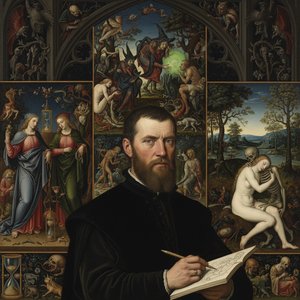
The Life and Academic Career of Clemens von Zimmermann
Clemens von Zimmermann was a German historical painter associated with the Düsseldorf school of painting. Born in Düsseldorf, he began his artistic journey by studying under Johann Peter von Langer. In 1808, he accompanied his master to Munich to enter the Academy. His professional trajectory saw him appointed as a professor and director of the school of art in Augsburg in 1815, and ten years later, he achieved the position of professor at the Munich Academy.
Throughout his career, Zimmermann contributed to significant decorative works, including frescoes at the Glyptothek where he assisted Peter von Cornelius. His decorative engagements extended to the colonnades of the Hofgarten, the corridor of the Alte Pinakothek, and the dining-hall of the Residenz.
Artistic Works and Legacy
The repertoire of Zimmermann includes a large number of portraits, notably those of Queen Hortense and King Max I of Bavaria. Beyond portraiture, he was active in etching and lithographing many views of Rome. His artistic legacy is preserved in collections such as the Neue Pinakothek, which contains two of his paintings:
- Cimabue finding Giotto sketching a Lamb
- Pilgrims to Loretto from the Roman Campagna
He passed away in Munich.
Kysymykset ja vastaukset
Onko Clemens von Zimmermann esitelty aikajärjestyksessä?
Clemens von Zimmermann'n ura avautuu vaihe vaiheelta artistin Ura kronikka -sivulla: vaakasuuntainen aikajana teoksista, ryhmiteltynä uravaiheiden mukaisiin lukuihin.
Mistä voin nähdä kaikki Clemens von Zimmermann teokset?
Voit selata kaikkia tämä sivusto-sivuston Clemens von Zimmermann teoksia artistin Kaikki teokset -sivulta.
Mihin historialliseen aikakauteen Clemens von Zimmermann kuului?
Clemens von Zimmermann työskenteli 19th Century -aikakaudella. Aikakausi sijoittaa taiteilijan toiminnan historialliseen kontekstiin.