 Jaa teos
 Jaa
Jaa
 Tiedot
 Opas
Opas

 Lataa kuva
 Samanlaisia kohteita
 Diaesitys
 Kysymykset ja vastaukset
 Tilastot
Duduzile Zozo


 Lue lisää
Tällä sivulla esitettyä taideteosta suojaa tekijänoikeuslaki, mikä tarkoittaa, ettemme voi laillisesti luoda tai myydä täsmälleen samanlaista jäljennöstä. Tämä suoja toteutetaan kansainvälisten sopimusten, kuten esimerkiksi Berne-konventio ja kansallisilla laeilla, mukaan lukien niillä määritellyt Yhdysvaltain tekijänoikeuslaki – Luku 17. Kaikki oikeudet pidätetään. Luvaton kopiointi tai jäljittely on kielletty.
Tämä menetelmä noudattaa täysin tekijänoikeussäännöksiä, sillä se ei sisällä suojatun taideteoksen kopioimista tai jäljentämistä. Sen sijaan kyseessä on luova uudelleentulkinta – uusi maalaus, joka ammentaa vaikutteita alkuperäisestä, mutta ei ole sen identtinen kopio.
Giclée- ja taideprintit
Museolaatuisia giclée- tai kankaitaulun tulosteita nopealla tuotannolla ja joustavilla viimeistelyvaihtoehdoilla. ( Osta käsinmaalattu taideteos Siirry digitaaliseen kuvaan)




































Valitse valmiista mitoistamme sellaiset, jotka vastaavat teoksen alkuperäisiä mittasuhteita.

Syötä tarvitsemasi leveys ja korkeus, jotta tuloste sopii kehyksiisi tai seinällesi. Tulostetta voidaan vain leikata, sitä ei voida koskaan suurentaa alkuperäistä kuvaa suuremmaksi, joten eri muotoinen koko aiheuttaa osan kuvasta katoamisen. Lähetämme sinulle digitaalisen mallikuvan hyväksyttäväksi ennen kuin aloitamme tulostuksen. Tällä sivulla näkyvä kuva ei näytä lopullista rajausta — vain mallikuva näyttää sen.
Maailmanlaajuinen toimitus () 2 viikossa tavallisen 4–5 viikon sijaan. (4 marraskuu)

Ilmainen pikatoimitus ympäri maailman

Korkealaatuinen pellavakangas

Kattava kuljetusvakuutus

Tulliveron palautustakuu

Takuu täydellisestä värien vastaavuudesta

100 päivän palautusoikeus (vain valmistusvirheet)

100% rahat takaisin -takuu

Määräalennus tarjolla
 Lasivaihtoehto on saatavilla vain alle 110 cm kokoisille teoksille

Duduzile Zozo
Giclée- ja taideprintit
Replikaatin koko
-


Kokonaishinta
€ 72
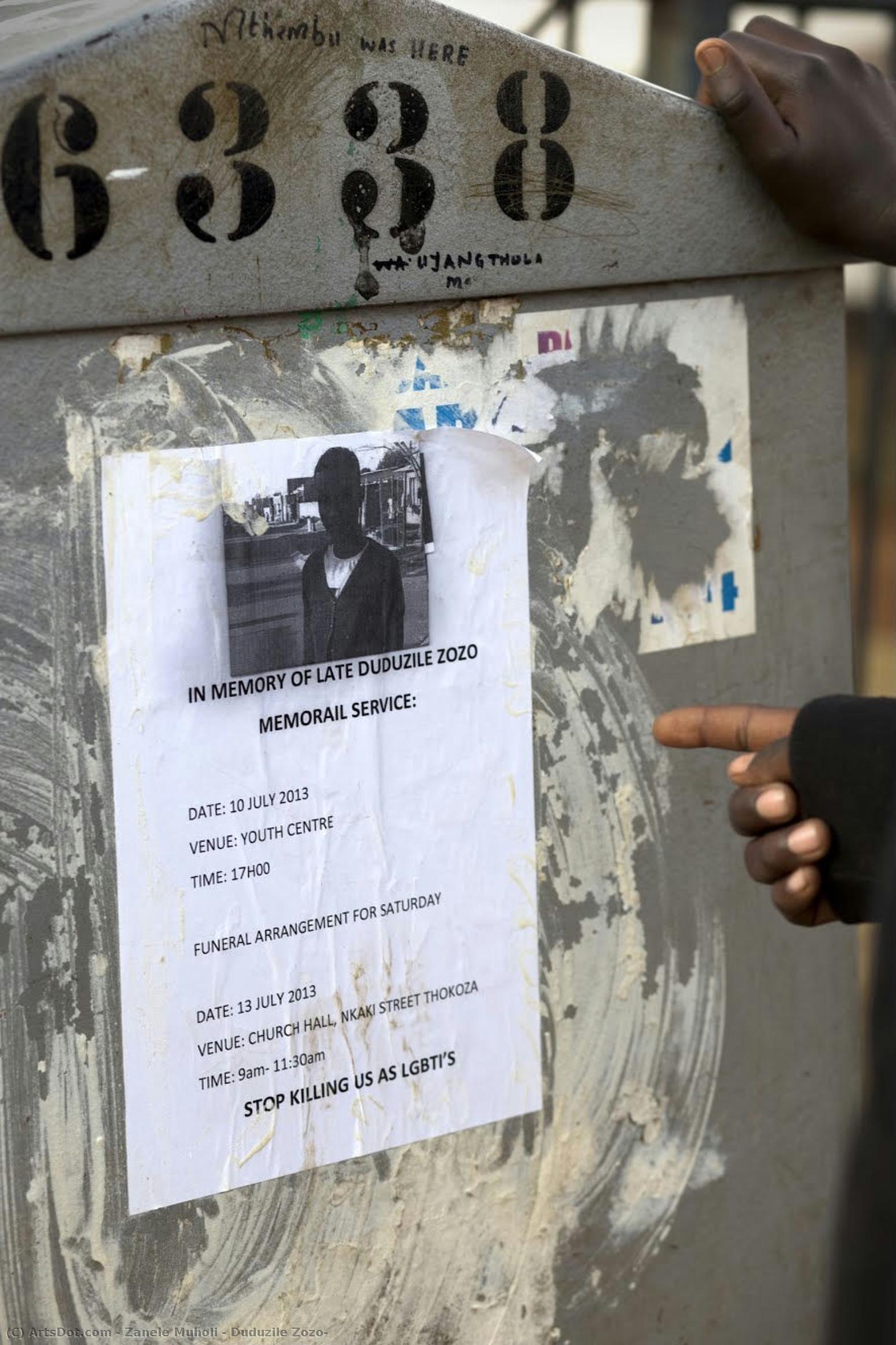
A Silent Testimony: Duduzile Zozo by Zanele Muholi
Zanele Muholi’s “Duduzile Zozo” isn't merely a photograph; it’s a poignant and deeply resonant memorial, a visual testament to the lives lost within South Africa’s LGBTQ+ community. The image, rendered on a weathered stone slab amidst an urban landscape – a stark juxtaposition of fragility and permanence – immediately commands attention with its raw honesty and understated power. It's a piece born from grief, activism, and a profound commitment to visibility, offering a glimpse into the realities faced by Black lesbian, gay, transgender, and intersex individuals in a nation still grappling with the legacies of apartheid.
The photograph itself is a masterclass in documentary realism. Muholi’s technique eschews idealized representation, instead embracing the textures and imperfections of the world – the cracked stone, the faded poster, the hand gently holding it all. Grainy detail speaks to its origins as a captured moment, lending an immediate sense of authenticity. The lighting, seemingly natural daylight, casts dramatic shadows that accentuate the surfaces, highlighting the weight of history and the enduring presence of loss. The composition is deliberately chaotic – layers of elements vying for attention – mirroring the complex emotional landscape it attempts to convey. It’s a deliberate departure from polished portraiture, opting instead for an image that feels both immediate and deeply considered.
Unveiling the Context: Zanele Muholi and South African Activism
To fully appreciate “Duduzile Zozo,” one must understand the artist's broader context. Zanele Muholi is not simply a photographer; they are a vital visual activist, a chronicler of marginalized voices in South Africa. Born in 1972 and identifying as non-binary, Muholi’s work has consistently challenged societal norms and demanded recognition for those historically rendered invisible. Their early life, marked by the absence of their father and the struggles faced by their mother as a domestic worker under apartheid, instilled within them a deep empathy for the vulnerable and a fierce determination to amplify their stories.
Muholi’s practice extends far beyond individual portraits. They have dedicated themselves to documenting the violence and discrimination experienced by Black LGBTQ+ individuals, particularly Black lesbians, who face disproportionately high rates of hate crimes and systemic marginalization. This work is inextricably linked to a broader movement for social justice, fueled by the legacy of apartheid and the ongoing fight for equality. Muholi’s commitment extends beyond documentation; they actively engage with their subjects, inviting them to participate in the creation of the images themselves, fostering a sense of collaboration and empowerment.
Symbolism Woven into Stone: The Layers of Meaning
The image is rich with symbolic layers. The weathered stone slab itself represents permanence, memory, and the enduring nature of grief. The faded memorial poster – bearing the name “Duduzile Zozo” – serves as a direct marker of loss, a tangible reminder of a life cut short. The etched names on the stone—6338—could be interpreted as representing remembrance, perhaps specific individuals within the community or a collective honoring those lost. The hand holding the poster speaks to the act of bearing witness, of carrying the burden of grief and demanding recognition.
Furthermore, the urban setting – a seemingly ordinary street corner transformed into a site of mourning – highlights the pervasive nature of violence and discrimination within South African society. It’s a stark reminder that these tragedies don't occur in isolation but are embedded within the fabric of everyday life. The juxtaposition of the memorial with the surrounding cityscape underscores the urgent need for systemic change.
Emotional Resonance: A Call to Remember, a Plea for Justice
"Duduzile Zozo" is not simply a photograph; it’s an emotional plea. It evokes a profound sense of grief, but also resilience and determination. The image compels us to confront uncomfortable truths about inequality and violence, while simultaneously celebrating the strength and dignity of those who continue to fight for their right to exist. Muholi's work serves as a powerful reminder that visibility is not merely aesthetic; it’s an act of resistance, a declaration of humanity, and a vital step towards justice.
This evocative piece would be particularly impactful in settings where social awareness and support are valued – galleries, community centers, or even thoughtfully curated private collections. A high-quality reproduction captures the texture and depth of the original, allowing viewers to connect with its powerful message on a deeper level.
Kysymykset ja vastaukset
Mikä sijoittelu sopii teoksen Zanele Muholi:n "Duduzile Zozo" formaattiin?
Zanele Muholi:n "Duduzile Zozo"-teoksen Portrait-muoto on suositeltava Living Room-tilaan. Muoto ja tila ohjaavat yhdessä reproduktion sijoittelua.
Miten teoksen Zanele Muholi:n "Duduzile Zozo" värit liittyvät sen välittämään tunteeseen?
Zanele Muholi:n "Duduzile Zozo" yhdistää Neutrals väripaletin ja Melancholic tunnelman.
Mitä Zanele Muholi:n "Duduzile Zozo" esittää ja millainen on sen tunnelma?
Zanele Muholi:n "Duduzile Zozo" esittää aiheita lgbtq activism, memorial service, south africa art, social justice, urban memorial, photographic portrait, black lgbtq+ lives Calm tunnelmassa. Aihe ja ilmapiiri kuvaavat teosta yhdessä.
Taiteilijan elämäkerta
Zanele Muholi - Artist as Activist
Zanele Muholi, born July 19, 1972, Umlazi, KwaZulu-Natal, South Africa, is more than just an artist; they are a vital chronicler and courageous advocate for the Black LGBTQI+ community. Their work transcends traditional artistic boundaries, functioning as a powerful form of visual activism that challenges societal norms and demands recognition for lives historically marginalized and rendered invisible. Muholi identifies as nonbinary, embracing they/them pronouns—a fundamental aspect of their identity that profoundly informs their practice—rooted in self-discovery and an unwavering commitment to representing the fullness of human experience. Growing up during the waning years of apartheid and its lingering aftermath, Muholi witnessed firsthand the pervasive discrimination and violence faced by Black South Africans, particularly those who dared to live outside prescribed societal expectations. This early exposure ignited a fire within them—a determination to transform art into resistance, healing, and ultimately, liberation. Initially self-taught, Muholi’s journey began with documenting everyday life within their community, quickly realizing the transformative potential of photography to reshape narratives and reclaim agency.Documenting Existence: Themes and Artistic Development
Muholi's artistic practice is remarkably diverse, encompassing photography, video, and installation art—yet a consistent thread unites these varied mediums: an intimate and direct engagement with their subjects. Their portraits are not merely representations; they are collaborations—a shared act of defiance against erasure. Central to Muholi’s work are explorations of identity, race, gender, sexuality, social justice, and the enduring power of memory. The early focus on documenting Black lesbians in South Africa – a community disproportionately affected by violence and hate crimes – evolved into broader investigations of gender nonconformity and sexual diversity. This evolution wasn't simply an expansion of scope but a deepening of their commitment to portraying the complexities of lived experience, refusing simplistic categorization or easy answers. Faces and Phases—a long-term photographic project documenting the lives of Black LGBTI individuals in South Africa—stands as a testament to this dedication—a growing archive that celebrates resilience, beauty, and dignity while challenging viewers to confront their own biases. The series isn’t just about visibility; it's about creating a counter-narrative to dominant histories—one that honors the experiences of those who have been silenced or ignored. Muholi acknowledges inspiration from artists who have used their work as a tool for social change, notably W.E.B. Du Bois’ photographic studies of African Americans—a recognition of the importance of visual storytelling in advancing justice and equality. Their artistic style is characterized by its unflinching gaze and deliberate use of visual language; Somnyama Ngonyama (“Hail the Dark Lioness”), a series of self-portraits exploring themes of beauty, race, and representation, marks a pivotal moment—a bold reimagining of colonial aesthetics and a reclamation of Blackness on Muholi’s own terms. The images are often confrontational, challenging conventional notions of beauty and forcing viewers to grapple with the historical weight of representation.Somnyama Ngonyama & Beyond: Style and Influences
Muholi's artistic style is characterized by its unflinching gaze and deliberate use of visual language; Somnyama Ngonyama (“Hail the Dark Lioness”), a series of self-portraits exploring themes of beauty, race, and representation, marks a pivotal moment—a bold reimagining of colonial aesthetics and a reclamation of Blackness on Muholi’s own terms. The images are often confrontational, challenging conventional notions of beauty and forcing viewers to grapple with the historical weight of representation. They utilize dramatic lighting, found objects—everything from plastic combs to oven scrubbers—and symbolic gestures to convey profound messages about resistance and self-expression. This stylistic choice reflects Muholi’s belief that art can serve as a catalyst for social transformation—a conviction rooted in their understanding of how visual imagery shapes perceptions and influences behavior. The series isn't merely an aesthetic statement; it’s a deliberate provocation—an invitation to reconsider assumptions about identity and representation. Muholi draws inspiration from documentary photography traditions, recognizing the power of photographic documentation to illuminate marginalized experiences and challenge dominant narratives. Their commitment to creating an archive that counters these narratives is evident in *Brave Beauties*, which celebrates the resilience and strength of Black women in South Africa—a project that underscores the importance of portraying diverse voices and perspectives.Recognition and Enduring Legacy
Zanele Muholi’s groundbreaking work has garnered widespread recognition, including The Infinity Award from the International Center of Photography (2016), Chevalier de l'Ordre des Arts et des Lettres (France, 2016), and an Honorary Fellowship of the Royal Photographic Society (2018). Recent exhibitions—such as the retrospective at Maison Européenne de la Photographie in Paris (2023) and showings at mudec-museo delle culture in Milan that same year—demonstrate the growing international acclaim for their work. However, accolades are not Muholi’s primary motivation. Their true reward lies in the impact their art has on individuals and communities—in fostering dialogue, challenging prejudice, and creating a more just and equitable world. Muholi's historical significance is undeniable. They have created a vital archive of lives that were previously marginalized or ignored—a testament to courage, compassion, and an unwavering commitment to social justice. Their work continues to inspire artists and activists alike—serving as a beacon of hope for those striving to dismantle barriers to equality and liberation.
Zanele Muholi
1972 - , Etelä-Afrikka
Pähkinänkuoressa
- Artistic Movement Or Style: Visual Aktivismi, Fotografia
- Artists Or Movements Influenced By This Artist: ['W.E.B. Du Bois']
- Artists Who Influenced This Artist:
- Dokumenttifotograafi
- Aktivisti taiteet
- Date Of Birth: 1972
- Full Name: Zanele Muholi
- Nationality: Eteläafrikkalainen
- Notable Artworks:
- Kasvot ja Faasit
- Somnyama Ngonyama
- Rohkeat Kauneudet
- Place Of Birth: Umlazi, Etelä-Afrikka
Aiheeseen liittyvät artikkelit

The Lens of Truth: A Comprehensive History and Legacy of Documentary Photography
Explore the profound history of documentary photography. From early daguerreotypes to social reform movements, discover how the lens captures truth, preserves vanishing cultures, and shapes our global visual narrative through an expert art-historical lens.

Pictorialism: A Search for Artistic Photography's Soul – Aesthetics, Techniques & Legacy
Explore the captivating world of Pictorialism – a pivotal movement that transformed photography into fine art. Discover key artists like Stieglitz & Käsebier, techniques, and collecting tips from experts.

Witnessing History Through Lens & Light: Documentary Photography's Enduring Legacy
Explore the powerful history of documentary photography – from its origins to contemporary masters like Gordon Parks & W. Eugene Smith. Discover how this art form shapes our understanding of society and witness pivotal moments in time.

Beyond the Lens: Photography's Enduring Influence on Modern & Contemporary Art
Explore photography's pivotal role in shaping modern & contemporary art. Discover key movements, influential artists like Stieglitz, and expert collecting advice from OriginalUniqueArt.

Monochrome Visions: Exploring the Aesthetic & Historical Significance of Black & White Photography
Explore the rich history & artistic power of black and white photography. From early techniques to iconic masters like Ansel Adams, discover why monochrome continues to captivate art lovers today. Expert insights for collectors.