Öljyvärimaalaus-versio
 Kaikki teoksesta Hamilton Sutton Smith







































 Teoksille tai reproduktioille, joiden mikä tahansa sivu on suurempi kuin 105 cm (noin 41 tuumaa), kehys toimitetaan osina purettuna sarjana. Tämä menetelmä varmistaa turvallisen toimituksen ja ehkäisee vaurioita kuljetuksen aikana.


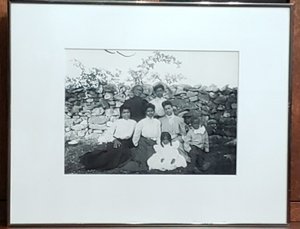
A Portrait of Hamilton Sutton Smith
This photographic print captures Hamilton Sutton Smith, a man who turned his gaze toward the lens to document the passing of time. Created by the artist Hamilton Sutton Smith, the image presents a formal study of the subject in a three-quarter pose. He is positioned with a quiet, upright confidence, his body angled away while his head turns back to meet the viewer's eye. The likeness is a steady one, fixed in a moment likely captured around 1915.
The subject wears a dark suit jacket that anchors his figure against a soft, indistinct background. There is a stillness in his posture, a sense of a man settled within his own skin. The photographic medium preserves the fine textures of his hair and the heavy weave of his clothing. He exists here not as a fleeting shadow, but as a documented presence, held within the silver and light of the print.
A sense of order defines this depiction of Hamilton Sutton Smith. The lines of his collar and shoulders provide a structural frame for the face. It is a quiet encounter with a man of his own making. The gaze is direct and unwavering.
Composition and Visual Elements
The figure of Smith occupies the center of the frame, though he is weighted slightly to the left. He faces toward the right, a directionality countered by his head, which turns back to meet the viewer's gaze. This torsion creates a quiet tension within the stillness of the pose. Behind him, the world dissolves into a blurred and indistinct void, stripping away the environment to leave only the man.
Structure emerges through a series of geometric intersections. Strong vertical lines define the upright posture of his body and the sharp edges of his suit jacket. These are met by the horizontal suggestions of his collar and shoulders. Within this framework, the composition relies on a vocabulary of fundamental shapes: the rectangle of the jacket, the oval of the face, and the cylindrical forms of the arms. The arrangement is orderly and disciplined.
The subject's presence is anchored by these intersecting planes. A sense of depth is achieved through selective focus, where the sharpness of the subject's features recedes into the soft obscurity of the background. The silhouette remains clear against the haze. It is a study of form and stillness.
Lighting and Tonal Qualities
The portrait exists within a strictly monochromatic realm. There is no color to distract the eye, only a measured scale of gray that spans from the deepest blacks of the shadows to the lightest whites of the highlights. This absence of hue focuses the gaze entirely on the interplay of light and shade across the subject's features. The lighting is soft and diffused, wrapping around the form without the harshness of direct sun. It settles gently, creating a quiet gradation of tone that defines the structure of the face and the weight of the clothing.
Subtle highlights catch the light on the forehead, the bridge of the nose, and the crisp edge of the collar. These small points of brightness provide the necessary relief against the darker tones of the suit. Depth is achieved through a selective focus, where the subject remains sharp while the background recedes into a soft, indistinct blur. This technique pulls the figure forward, isolating the man from the obscurity behind him. The light does not shout; it merely reveals.
Technique and Materials Used
The image exists as a photographic print, a physical manifestation of light captured through a camera. It relies on the traditional methods of black and white photography to translate a three-quarter pose into a permanent record. Every shade of gray is a result of the careful interplay between the subject and the light source, which descends from above to touch the forehead and the collar.
The creation of this portrait required a disciplined command of composition and lighting. To achieve the sharp focus on the face against the blurred, indistinct background, the artist utilized selective focus. This technical choice directs the eye toward the subject's gaze. The process moved from the initial exposure on photographic film to the controlled environment of the darkroom. There, the interaction of darkroom chemicals and printing paper transformed a fleeting moment into a structured, monochromatic form.
The textures of the suit fabric and the subtle lines of the hair are held within the silver grains of the print. It is a quiet alchemy of chemistry and light. The stillness remains.
Related Works by the Artist
The artist’s lens often turned toward the faces and figures that anchored his personal history. In a work titled John J. Smith, dating from about 1900, the subject emerges through the same careful attention to character seen in this portrait. This piece is held within the Museum of African American History, Boston. Another depiction of John J. Smith exists in the collection, capturing a different facet of the same lineage.
Beyond the intimate study of individuals, Smith’s vision extended to the public stone of the Prince Hall Monument. Created in 1915, this work is also part of the Museum of African American History, Boston. It remains a fixed point in the archive of his photographic and commemorative output. The shadows of the past find a permanent home in these documented subjects.
Kysymykset ja vastaukset
Onko teos Hamilton Sutton Smith käsinmaalattu vai painettu?
Käsinmaalattu: ammattitaitoinen taiteilija kopioi teoksen Hamilton Sutton Smith öljyväreillä pellavalle.
Mikä koko Hamilton Sutton Smith -teokselle kannattaa valita?
Koot vaihtelevat välillä 37.8 x 26.5 cm (€178) – 241.0 x 168.8 cm (€1354); tämän sivun taulukossa on lueteltu tärkeimmät vaiheet ja niiden hinnat.
Kuinka kauan toimitus kestää?
Toimitusaika on 4–5 viikkoa, ja tarjoamme ilmaisen pikatoimituksen ympäri maailmaa; tällä sivulla on saatavilla myös kiireellinen tuotantovaihtoehto. Voit palauttaa tuotteen 100 päivän kuluessa täyden hyvityksen saamiseksi ilman mitään ehtoja.
Missä teoksen Hamilton Sutton Smith alkuperäinen sijaitsee?
Alkuperäinen teos kuuluu Museum of African American History -museon kokoelmaan, Boston.
Mitä tekniikkaa Hamilton Sutton Smith käytti teoksessa Hamilton Sutton Smith?
Black and White Photography
 Jaa teos
 Jaa
 Tiedot
 Tiedot-arkki


 Lataa kuva
 Samanlaisia kohteita
 Diaesitys
 Kysymykset ja vastaukset

 Tilastot