Vaihda tulosteeseen
 Lue lisää







































 Teoksille tai reproduktioille, joiden mikä tahansa sivu on suurempi kuin 105 cm (noin 41 tuumaa), kehys toimitetaan osina purettuna sarjana. Tämä menetelmä varmistaa turvallisen toimituksen ja ehkäisee vaurioita kuljetuksen aikana.


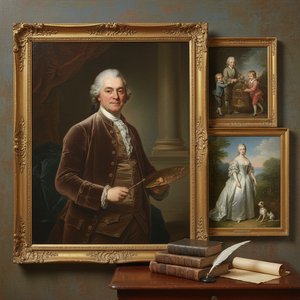
Richard Potter - A Portrait of Quiet Dignity
Samuel William Reynolds’s depiction of Richard Potter stands as a testament to the meticulous artistry of mezzotint engraving in the early 19th century. Executed around 1830 or 1840, this portrait captures Potter—a prominent businessman and founding member of the Great Western Railway company—with remarkable detail and understated elegance.
Reynolds’s skill is immediately evident in the subtle tonal gradations achieved through the printing process. The mezzotint technique, pioneered by Rembrandt and perfected by artists like John Raphael Smith, allowed for incredibly nuanced shading – a crucial element in conveying Potter's character and conveying an aura of calm confidence. Observe how Reynolds skillfully renders the folds of Potter’s suit and waistcoat, highlighting the texture of fabric with astonishing precision.
The painting’s composition is deliberately restrained, placing Potter centrally within a dark background that serves to emphasize his form and features. This stylistic choice reflects the prevailing taste for formal portraiture during the Victorian era—a period characterized by an obsession with documenting individuals of distinction. The artist's careful attention to detail extends beyond mere representation; it aims to capture not just what Potter looked like, but also something of his inner state.
The Artist’s Legacy: Reynolds and Mezzotint Mastery
Samuel William Reynolds Jr., son of the celebrated landscape painter Samuel William Reynolds Sr., inherited his father's exceptional talent for engraving. Like his father, Reynolds Jr. was a prolific artist who embraced multiple mediums—oil painting and watercolor—demonstrating versatility and an understanding of artistic expression.
Reynolds’s reputation as a mezzotint engraver soared throughout Britain and France during his lifetime. Over 400 examples of his work reside in the National Portrait Gallery, London, cementing his place among the foremost artists of his time. His dedication to mastering the technique—a laborious process involving etching plates with acid rollers—is evident in every plate he produced.
Considered a pioneer of the art form, Reynolds Jr.’s work exemplifies the meticulous craftsmanship demanded by mezzotint engraving. He skillfully combined etching and stipple engraving techniques to achieve breathtaking levels of tonal subtlety, mirroring his father’s approach to landscape painting—a commitment to capturing atmospheric conditions with unparalleled accuracy.
Historical Context: Victorian Portraiture and Social Status
The portrait was created during the reign of Queen Victoria (1837-1901), a period marked by significant social and economic transformations. Victorian society placed immense importance on lineage, status, and outward appearances—factors meticulously documented in portraits commissioned by wealthy families and prominent figures.
Richard Potter’s image embodies the ideals of Victorian gentlemanly culture: intellect, responsibility, and adherence to moral principles. The pose—seated upright with a dignified gaze—communicates composure and self-assurance—qualities highly valued during this era. Furthermore, the dark background serves as a symbolic device, emphasizing Potter's presence against an implied backdrop of societal influence.
Symbolism: Quiet Strength and Reflection
Beyond its technical brilliance, the portrait possesses subtle symbolic resonance. The muted palette—primarily browns and blacks—suggests introspection and seriousness—characteristics associated with intellectual pursuits and moral contemplation. Potter’s gaze directs towards the viewer, fostering a connection between sitter and observer—a gesture that speaks to the Victorian fascination with conveying inner character.
The meticulous rendering of Potter's attire—the suit and waistcoat—represents social status and professionalism—affirming his position within the upper echelons of Victorian society. Reynolds’s masterful execution elevates this simple depiction into a profound statement about human dignity and artistic achievement.
Kysymykset ja vastaukset
Kuinka voimakkaita värit teoksessa Samuel William Reynolds:n "Richard Potter" ovat?
Teoksen "Richard Potter" väri-intensiteetti on Monochromatic. Intensiteetti kuvaa värien voimakkuutta.
Mikä on alkuperäisen Samuel William Reynolds:n "Richard Potter" tekniikka ja koko?
Teoksen Samuel William Reynolds:n "Richard Potter" tekniikka on Acrylic On Canvas, ja sen mitat ovat 90 x 69 cm.
Kuinka vaalea "Richard Potter" on kokonaisuudessaan?
Koetun kirkkauden osalta teos Samuel William Reynolds:n "Richard Potter" on deep_shadow.
 Esikatselu
 Jaa teos
 Jaa
Jaa
 Tiedot
 Opas
Opas

 Lataa kuva
 Samanlaisia kohteita
 Röntgenkuvaus
 Diaesitys
 Q&A
Q&A Tilastot