Esikatselu
 Jaa teos
 Jaa
Jaa
 Tiedot
 Opas
Opas

 Lataa kuva
 Samanlaisia kohteita
 Röntgenkuvaus
 Diaesitys
 Q&A
Q&A Tilastot
Showing at Tattersall's
 Oil On Panel
- WallArt
- British Modernism
 1919
1919- Modern
 58.0 x 71.0 cm
 Ashmolean-museo
 Lue lisää
Giclée- ja taideprintit
Museolaatuisia giclée- tai kankaitaulun tulosteita nopealla tuotannolla ja joustavilla viimeistelyvaihtoehdoilla. ( Osta käsinmaalattu taideteos Siirry digitaaliseen kuvaan)




P118B €10

P118H €10

P118W €10

P438Z €10

P508JH €12

P508YH €12

P805H €10

P805Z €10

P919BZ €10

P919G €10

P919XJ €10

P959ZH €10

P968JZ €12

W106C €8

W218G €10

W218JH €8

W218Y €10

W307PJ €10

W316G €10

W316PJ €8

W316Y €10

W398PJ €8

W4111J €10

W500HY €15

W500JH €15

W692G €12

W849H €8

W940BG €15

W953PJ €8




Valitse valmiista mitoistamme sellaiset, jotka vastaavat teoksen alkuperäisiä mittasuhteita.

Syötä tarvitsemasi leveys ja korkeus, jotta tuloste sopii kehyksiisi tai seinällesi. Tulostetta voidaan vain leikata, sitä ei voida koskaan suurentaa alkuperäistä kuvaa suuremmaksi, joten eri muotoinen koko aiheuttaa osan kuvasta katoamisen. Lähetämme sinulle digitaalisen mallikuvan hyväksyttäväksi ennen kuin aloitamme tulostuksen. Tällä sivulla näkyvä kuva ei näytä lopullista rajausta — vain mallikuva näyttää sen.
Maailmanlaajuinen toimitus () 2 viikossa tavallisen 4–5 viikon sijaan. (28 lokakuu)

Ilmainen pikatoimitus ympäri maailman

Korkealaatuinen pellavakangas

Kattava kuljetusvakuutus

Tulliveron palautustakuu

Takuu täydellisestä värien vastaavuudesta

100 päivän palautusoikeus (vain valmistusvirheet)

100% rahat takaisin -takuu

Määräalennus tarjolla
 Lasivaihtoehto on saatavilla vain alle 110 cm kokoisille teoksille

Showing at Tattersall's
Giclée- ja taideprintit
Replikaatin koko
-


Kokonaishinta
€ 71
A Vibrant Snapshot of Racing Tradition
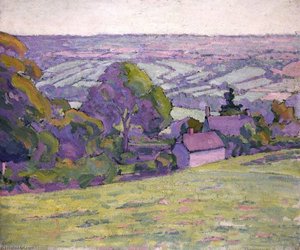
Robert Bevan's “Showing at Tattersall’s,” completed in 1919, stands as a remarkable testament to British Modernism and a captivating portrayal of the social fabric surrounding horse racing during its golden age. This oil on panel painting transcends mere depiction; it captures an atmosphere brimming with energy and ambition—a feeling palpable even through high-quality reproductions. The scene unfolds as a bustling tableau, presenting a horse race unfolding against the backdrop of London’s streets. Bevan skillfully employs diagonal lines to guide the viewer's eye across the canvas, emphasizing the movement of the horses as they surge forward. At the heart of this composition lies a striking blue horse, appearing to gallop with a sense of unbridled power, serving as a focal point that anchors the surrounding chaos.
The painting is far more than a simple record of an event; it is a meticulously crafted tableau vivant, a frozen moment brimming with the energy and social significance of an era. Tattersalls, renowned for its history of selling thoroughbred racehorses, serves here as a microcosm of society, a place where wealth, status, and tradition converged. Through his brush, Bevan captures the excitement of the competition, utilizing warmer tones of reds and yellows emanating from the spectators to highlight the palpable tension and joy of the crowd. For the collector or interior designer, this piece offers a window into a vanished world, bringing a sense of historical prestige and dynamic movement into any contemporary space.
Mastery of Color and Fauvist Influence
Bevan’s artistic approach aligns closely with the burgeoning Fauvist movement, spearheaded by legends like Matisse and Derain. Like his contemporaries, Bevan prioritized expressive color over strict realism, choosing to prioritize emotion and sensation above meticulous detail. This stylistic choice is evident in the textured brushstrokes that imbue the canvas with a palpable sense of immediacy. The dominant hue of striking blue is chosen not just for its visual impact but also to represent prestige and nobility—associations fitting for the legendary auction house. These bold colors are balanced by a sophisticated use of light, where diffused daylight creates an atmospheric depth that anchors the scene.
The technique showcases Bevan's distinctive style, characterized by smooth planes of color, sharp outlines, and a deliberate flattening of perspective. While his approach is reminiscent of Impressionism, he pushes beyond mere representation to achieve a modern abstraction. The figures within the painting are rendered with a remarkable degree of realism, yet they are imbued with a subtle sense of ambiguity; faces are often obscured by hats or coats, suggesting a detachment that emphasizes the spectacle itself rather than individual personalities. This deliberate choice invites the viewer to become an observer within the scene, making the artwork an immersive experience.
A Timeless Addition to the Modern Interior
As a founding member of the Camden Town Group, Robert Bevan sought to capture the gritty yet vibrant realities of London life. “Showing at Tattersall’s” exemplifies this mission, offering a sophisticated blend of movement and stillness. The painting's ability to balance energetic composition with a harmonious color palette makes it an exceptional choice for art lovers seeking pieces that provoke conversation and evoke emotion. Whether placed in a grand gallery or as a focal point in a curated residential collection, the work radiates a sense of vitality.
For those looking to invest in a high-quality reproduction, this piece provides more than just decoration; it offers an infusion of British heritage and modernist innovation. The interplay of the cool blues against the warm, sunlit tones creates a visual rhythm that complements various interior aesthetics, from classic traditionalism to sleek modern minimalism. Owning a piece of this caliber allows one to possess a fragment of the golden age of racing, preserved through the lens of a master who redefined the boundaries of British art.
Kysymykset ja vastaukset
Ovatko teoksen "Showing at Tattersall's" värit voimakkaita vai hillittyjä?
Teoksessa Robert Polhill Bevan:n "Showing at Tattersall's" on Clear Color Presence kylläisyys ja Vivid voimakkuus.
Mikä on alkuperäisen Robert Polhill Bevan:n "Showing at Tattersall's" tekniikka ja koko?
Teoksen Robert Polhill Bevan:n "Showing at Tattersall's" tekniikka on Oil On Panel, ja sen mitat ovat 58 x 71 cm.
Miltä aikakaudelta Robert Polhill Bevan:n "Showing at Tattersall's" on peräisin?
Robert Polhill Bevan:n "Showing at Tattersall's" on peräisin Modern-kaudelta. Kyseinen aikakausi antaa teokselle historiallisen kontekstin.
Taiteilijan elämäkerta
A Pioneer of British Modernism: The Life and Art of Robert Polhill Bevan
Robert Polhill Bevan, born in Hove in 1865, occupies a pivotal yet often understated position within the narrative of early 20th-century British art. Emerging from a Quaker background steeped in banking connections – his parents were Richard Alexander Bevan and Laura Maria Polhill – he defied conventional expectations to become a daring innovator, a key figure in the transition from Impressionism towards more radical explorations of color and form. His journey was one of constant experimentation, absorbing influences from across Europe while forging a distinctly personal artistic vision that would profoundly impact the development of modern art in Britain. Bevan’s early education at Westminster School of Art under Fred Brown provided a solid foundation, but it was his subsequent studies at the Académie Julian in Paris that truly ignited his creative spark. There, he encountered a constellation of rising stars – Paul Sérusier, Pierre Bonnard, Édouard Vuillard, and Maurice Denis – artists who were challenging academic conventions and embracing new approaches to painting. These encounters proved formative, exposing Bevan to the principles of synthetism and laying the groundwork for his future explorations.Brittany, Fauvism, and the Search for Pure Color
The impact of Brittany on Bevan’s artistic development cannot be overstated. Two significant journeys in 1890 and 1891 immersed him in the atmosphere of Pont-Aven, a small coastal town that had become a magnet for artists seeking an alternative to Parisian salon culture. The bold colors and simplified forms championed by artists like Gauguin resonated deeply with Bevan, influencing his early drawings and prints. He was particularly captivated by the luminous landscapes of Breton coastlines, where the interplay of light and color offered unparalleled opportunities for artistic expression. This fascination fueled his experimentation with pure color – a decisive step away from Impressionistic realism – anticipating the emergence of Fauvism on the continent. His painting “Courtyard” stands as a remarkable example of this proto-Fauvist approach, demonstrating a willingness to abandon naturalistic representation in favor of expressive chromatic intensity – a boldness that set him apart from many of his British contemporaries. This exploration didn’t remain static; Bevan subsequently adopted a divisionist or pointillist technique, evident in works like “Ploughing on the Downs” and “The Turn-Rice Plough,” showcasing his commitment to exploring different methods of applying color and capturing light. The influence of masters such as Velázquez and Goya remained palpable, alongside more immediate guidance from Renoir regarding the depiction of horses – a testament to Bevan’s broad artistic curiosity and willingness to learn from diverse sources.Collective Visions: The Camden Town Group and Beyond
Bevan was not an artist who worked in isolation. He actively sought connection with like-minded individuals, playing a crucial role in the formation of several influential art groups. As a founding member of the Camden Town Group, he joined forces with artists determined to depict modern urban life and challenge established artistic norms. This collective spirit extended to his involvement with the London Group and the Cumberland Market Group, further demonstrating his commitment to progressive artistic movements. The group’s ambition was to capture the dynamism of London's industrial landscape and its inhabitants—a task Bevan tackled with unwavering conviction. He collaborated closely with fellow Camden Town artists like Walter Sickert and Frank Auerbach, fostering a stimulating dialogue that propelled their artistic endeavors forward. These affiliations were not merely social; they fostered a dynamic exchange of ideas that shaped Bevan’s artistic trajectory and contributed to the broader evolution of British art.Landscapes, Urban Scenes, and Lasting Legacy
Bevan's oeuvre is characterized by a profound engagement with both rural and urban environments. His landscapes—particularly those depicting Sussex and Brittany—are imbued with an extraordinary sensitivity to light and color, reflecting his unwavering dedication to capturing the essence of nature’s beauty. Paintings such as “In the Downs near Lewes,” “The Chestnut Tree,” and “Landscape in the Blackdown Hills, Devon” exemplify this mastery, showcasing his ability to convey both the physical grandeur and emotional resonance of the natural world. Simultaneously, Bevan documented the realities of modern life through urban scenes—most notably "The Cab Horse"—capturing the textures and moods of industrial Britain with meticulous detail. His artistic vision transcended stylistic trends; he remained steadfast in his pursuit of authentic expression, establishing himself as a cornerstone of British Modernism. Robert Polhill Bevan’s legacy extends far beyond his individual paintings. He is rightfully recognized as a pioneer of modern British art, particularly for his early adoption of Fauvist principles and his fearless experimentation with color. His influence on subsequent generations of painters is undeniable, and his contribution to the Camden Town Group was instrumental in shaping the development of modern art in Britain. A retrospective exhibition at Colnaghi’s in 1961 served as a crucial moment of recognition, solidifying his place in art history and ensuring that his innovative spirit continues to inspire artists today. He remains a vital figure for understanding the complex evolution of British painting in the early twentieth century.
Robert Polhill Bevan
1865 - 1925 , Yhdistynyt kuningaskunta
Pähkinänkuoressa
- Artistic Movement Or Style: Fauvism/Divisionismi
- Artists Or Movements Influenced By This Artist: ['Camden Town Group']
- Artists Who Influenced This Artist:
- Paul Gauguin
- Velázquez
- Goya
- Renoir
- Date Of Birth: 1865
- Full Name: Robert Polhill Bevan
- Nationality: Britanni
- Notable Artworks:
- The Farmhouse
- Ploughing on the Downs
- Queen’s Grove
- The Cab Horse
- Place Of Birth: Hove, United Kingdom
Aiheeseen liittyvät artikkelit

The Equine Muse: A Historical & Artistic Exploration of Horses in Painting
Explore the captivating history of horses in painting! Discover Renaissance masterpieces, Baroque grandeur & expert insights for collecting equestrian art. Learn about symbolism, techniques & lasting value with OriginalUniqueArt.
The Noble Steed: A Historical and Artistic Exploration of Horses in Fine Art
Explore the rich history of horses in fine art! From ancient depictions to Renaissance masterpieces & beyond, discover iconic artworks and artists. Learn about symbolism, techniques, and find museum-quality reproductions at OriginalUniqueArt.
The Noble Steed on Canvas: A Historical & Artistic Exploration of Horse Painting Across Cultures
Explore the rich history of horse painting! Discover masterpieces from Stubbs to Munnings & learn about symbolism, techniques & artists. Find museum-quality reproductions at OriginalUniqueArt.
Robert Bevan: Pioneering British Post-Impressionism & the Camden Town Group's Intimate Vision
Explore the life & work of Robert Bevan, a pioneer of British Post-Impressionism and founding member of the Camden Town Group. Discover his vibrant landscapes and lasting impact on early 20th-century art.

Hubert Robert: Picturing Ruins, Preserving Memory – A Study of Romantic Antiquarianism & Artistic Innovation
Explore the captivating world of Hubert Robert, master of Romantic landscape painting & 'capriccio' ruins. Discover his historical context, artistic innovations, and collecting insights with OriginalUniqueArt.