

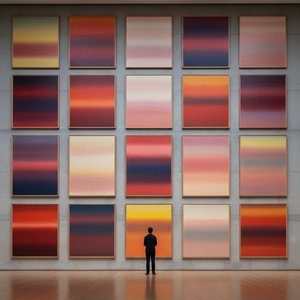
 Katso seinällä
 Lähetä
 Jaa
Jaa
 Tarkemmat tiedot
 Opas
Opas

 Lataa kuva
 Samanlaisia kohteita
 Röntgenkuvaus
 Diaesitys
 Tilastot
Untitled #767


 Lue lisää
Tällä sivulla esitettyä taideteosta suojaa tekijänoikeuslaki, mikä tarkoittaa, ettemme voi laillisesti luoda tai myydä täsmälleen samanlaista jäljennöstä. Tämä suoja toteutetaan kansainvälisten sopimusten, kuten esimerkiksi Berne-konventio ja kansallisilla laeilla, mukaan lukien niillä määritellyt Yhdysvaltain tekijänoikeuslaki – Luku 17. Kaikki oikeudet pidätetään. Luvaton kopiointi tai jäljittely on kielletty.
Tämä menetelmä noudattaa täysin tekijänoikeussäännöksiä, sillä se ei sisällä suojatun taideteoksen kopioimista tai jäljentämistä. Sen sijaan kyseessä on luova uudelleentulkinta – uusi maalaus, joka ammentaa vaikutteita alkuperäisestä, mutta ei ole sen identtinen kopio.
Giclée- ja taideprintit
Museolaatuisia giclée- tai kankaitaulun tulosteita nopealla tuotannolla ja joustavilla viimeistelyvaihtoehdoilla. ( Tilaa käsinmaalattu jäljennös Siirry digitaaliseen kuvaan)




































Valitse valmiista mitoistamme sellaiset, jotka vastaavat teoksen alkuperäisiä mittasuhteita.

Kirjoita tarvitsemasi leveys ja korkeus, jotta tuloste sopii kehyskokoon tai seinällesi. Tulostetta voidaan vain leikata, sitä ei voi koskaan tehdä suuremmaksi kuin alkuperäinen kuva, joten eri muotoinen koko aiheuttaa osan kuvasta katoamisen. Lähetämme sinulle digitaalisen mallikuvan hyväksyttäväksi ennen kuin aloitamme tulostuksen. Tällä sivulla näkyvä kuva ei näytä lopullista leikkausta — vain mallikuva näyttää sen.
Maailmanlaajuinen toimitus () 2 viikossa tavallisen 4–5 viikon sijaan. (23 lokakuu)

Ilmainen pikatoimitus ympäri maailman

Korkealaatuinen pellavakangas

Kattava kuljetusvakuutus

Tulliveron palautustakuu

Takuu täydellisestä värien vastaavuudesta

100 päivän palautusoikeus valmistusvirhetapauksissa

100% rahat takaisin -takuu

Määräalennus saatavilla
 Lasivaihtoehto on saatavilla vain alle 110 cm kokoisille teoksille

Untitled #767
Giclée- ja taideprintit
Replikaatin koko
-


Kokonaishinta
€ 70
A Symphony of Crimson: The Abstract Depth of Untitled #767
In the evocative realm of contemporary abstraction, few works command the immediate attention of the viewer quite like Prudencio Irazábal’s Untitled #767. Created in 1996, this masterpiece serves as a profound meditation on color, texture, and the very essence of the painted surface. At first glance, the eye is ensnously drawn into a sea of reds—a spectrum that ranges from deep, bruised crimsons to vibrant, pulsating scarlets. This is not merely a painting of color, but an exploration of it. The composition is built upon a complex architecture of layers, where each section reveals a new nuance of hue, creating a rhythmic movement that guides the viewer through a labyrinth of light and shadow.
The technique employed by Irazábal in this piece demonstrates a masterful command over the physical properties of paint. Through a meticulous process of layering, the artist achieves a sculptural quality that transcends the two-dimensional plane. The presence of subtle black accents acts as a structural skeleton, providing necessary contrast and depth to the overwhelming warmth of the red palette. These dark elements serve as anchors, preventing the vibrant reds from becoming overwhelming and instead directing the gaze toward the intricate textures that define the work. It is this interplay between the bold, saturated tones and the delicate, shadowy outlines that creates a sense of breathing life within the canvas.
The Legacy of Abstraction and Emotional Resonance
To understand the soul of Untitled #767, one must look toward the artistic lineage of its creator. Irazábal, a Spanish virtuoso shaped by the academic rigor of Seville and Barcelona and the expansive creative energy of New York City, carries within his brushstrokes the echoes of giants like Picasso and Miró. While he moves away from their figurative roots, he retains their relentless pursuit of abstraction's origins. In this work, we see a modern evolution of that quest—a move toward pure form and emotional resonance where the subject is not an object, but the sensation of color itself.
For the discerning collector or interior designer, this painting offers more than just aesthetic beauty; it offers a transformative atmosphere. The piece possesses a powerful emotional gravity, capable of anchoring a room with its warmth and intensity. Whether placed in a minimalist contemporary gallery or as a sophisticated focal point in a luxury residential setting, Untitled #767 invites contemplation. It is a work that rewards the patient observer, revealing new details of craftsmanship and complexity upon every encounter, making it an enduring investment for those who appreciate the profound dialogue between light, pigment, and emotion.
Kysymykset ja vastaukset
Voinko nähdä röntgenkuvan teoksesta Prudencio Irazábal:n "Untitled #767"?
Teoksen Prudencio Irazábal:n "Untitled #767" X-säteily -sivu on interaktiivinen katseluohjelma, jonka avulla voit selata teoksen kuvan ydintä läpi yhdennellätoista optisella kerroksella, mukaan lukien röntgenkuvamainen näkymä.
Milloin ja millä materiaaleilla "Untitled #767" on tehty?
"Untitled #767" on tehty vuonna 1996 käyttäen tekniikkaa Painting.
Mihin käyttöön Prudencio Irazábal:n "Untitled #767" on suositeltu?
Prudencio Irazábal:n "Untitled #767"-teoksen reproduktio on suositeltava Focal. Tämä suositus perustuu teoksen aiheeseen, tunnelmaan ja väreihin.
Taiteilijan elämäkerta
The Luminous Architecture of Color: The Art of Prudencio Irazábal
In the vast landscape of contemporary abstraction, few artists command the canvas with such a profound investigation into the very soul of medium as Prudencio Irazábal. Born in 1954 in Puentelarreia, Spain, Irazábal’s journey is one of transatlantic dialogue, bridging the academic rigor of his Spanish roots with the expansive, experimental energy of New York City. His early encounters with the monumental legacies of Pablo Picasso and Joan Miró acted as a creative catalyst, instilling in him a lifelong fascination with the origins of abstraction. This pursuit was not merely about simplifying form, but about deconstructing the fundamental elements of painting to discover what remains when all narration and symbolism are stripped away.
Irazábal’s academic foundation was laid at the Universidad de Sevilla and Barcelona, providing him with a deep respect for classical technique. However, it was his move to New York in 1986 to study at Columbia University that fundamentally reshaped his artistic trajectory. For over two decades, living and working in the heart of the global art capital, he immersed himself in a period of intense research. This era marked a pivotal shift toward what he calls "irreducible facts"—a focus on the raw, unmediated relationship between light, color, and material truth. His work began to move away from the figurative, seeking instead a way to capture intangible sensations through the physical properties of paint.
The Alchemy of Surface and Light
To encounter an Irazábal painting is to enter a meditative space where the boundary between the two-dimensional plane and sculptural depth begins to dissolve. His technique is a masterful alchemy, characterized by a complex layering process that invites the viewer into a labyrinth of hue and texture. He often employs porous fabrics as a base, allowing bold, sometimes monochromatic colors to interact with the grain of the substrate. This creates a surface that feels alive, breathing with a rhythmic movement that guides the eye through layers of light and shadow.
A defining moment in his technical evolution occurred in the early 1990s when Irazábal began photographing microscopic cross-sections of his older works. These investigations revealed a hidden world of structural beauty, showing the correlation between raw materials and the transcendent nature of the painted image. This discovery led to the development of groundbreaking methods where he would build massive colors from chromatic ideas, creating surfaces that could be unweaved and reassembled as an illusionistic experience. In masterpieces such as “Untitled #767,” one can witness this "symphony of crimson," where deep, bruised crimsons and vibrant scarlets are anchored by subtle black accents, creating a structural skeleton that prevents the warmth from becoming overwhelming.
A Legacy of Perceptual Exploration
The significance of Irazábal’s oeuvre lies in his ability to unite the certainty of materiality with the unreliable nature of human perception. His work does not merely represent color; it facilitates a unique perceptual event where light, mediated through thin, translucent layers, becomes the primary protagonist. This creates an ongoing challenge for the viewer: to synthesize image, matter, and meaning in an attempt to paint that which is otherwise unpaintable.
Throughout his career, Irazábal has achieved remarkable recognition on the international stage, with his works finding homes in prestigious institutions such as the Diseño Museo Barcelona. His exhibitions, ranging from the evocative “Tide Marks” to the conceptually dense “Grammar of Extension” at Galería Pelaires in Mallorca, demonstrate a consistent commitment to exploring the "extensive intimacy" of the painted surface. As he continues to live and work between Madrid and New York, Irazábal remains a vital figure in Spanish painting, standing as a bridge between the historical weight of Cubism and Abstract Expressionism and the limitless possibilities of contemporary chromatic thought.

Prudencio Irazábal
1954 - , Spain
Tietoa taiteilijasta
- Artistic Movement Or Style: Geometric abstraction
- Artists Or Movements Influenced By This Artist: ['Francisco de Goya']
- Artists Who Influenced This Artist:
- Pablo Picasso
- Joan Miró
- Date Of Birth: 1954
- Full Name: Prudencio Irazábal
- Nationality: Spanish
- Notable Artworks: ['Untitled #767']
- Place Of Birth: Puentelarreia, Spain
Aiheeseen liittyvät artikkelit

Crimson Threads of Narrative: Exploring Symbolism & Representation in Artworks Featuring the Red Dress
Explore the rich symbolism of the red dress in art history! From ancient power displays to iconic portraits like Cézanne’s 'Madame Cezanne', discover the cultural and artistic significance behind this captivating color. Expert analysis & insights.
Mark Rothkon 25 mestariteosta: Värien syvyydessä – Taidetta kotiisi OriginalUniqueArtilta
Tutustu Mark Rothkon 25 mestariteokseen ja syvälliseen maailmaan abstraktin ekspressionismin parissa. Löydä tunteelliset väritaulut, taidehistorian helmet ja inspiraatiota kotiisi OriginalUniqueArtilta. Tutki kokoelma verkossa!

Abstraktin ekspressionismin mestariteokset: Taidetta ja inspiraatiota kotiisi
Tutustu abstraktin ekspressionismin 10 mestariteokseen! Jackson Pollock, Mark Rothko ja muut taiteilijat inspiroivat tunteellisuudellaan. Löydä upeita taidemaalauksia kotiisi OriginalUniqueArt.comista – museolaatuista laatua ja sisustusehdotuksia.

Mustan sävyt taiteessa: 10 kuuluisinta mestariteosta ja niiden tarinat
Tutustu 10 kuuluisimpaan mustasävyiseen mestariteokseen! Rembrandtista Manetiin, syvenny taiteen historiaan ja synkkiin tunnetiloihin. Laadukkaat taidevedokset sisustukseesi OriginalUniqueArt.com:ssa. Tutustu kokoelmaamme verkossa!

Wassily Kandinskin 25 mestariteosta: Värien ja muodon syvä maailma | OriginalUniqueArt
Tutustu Wassily Kandinskin 25 vaikuttavinta teosta! Uppoudu abstraktin taiteen maailmaan, värien symboliikkaan ja modernin ekspressionismin historiaan. Löydä inspiraatiota kodin sisustukseen OriginalUniqueArt.com:ista – laadukkaat taideprintit ja reproduktiot.